


Page 19 - 2023 SMOG Digital
P. 19
Trauma


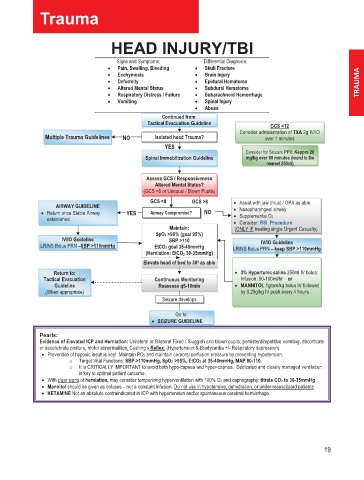
                         HEAD INJURY/TBI

                          Signs and Symptoms:   Differential Diagnosis:
                        •  Pain, Swelling, Bleeding  •  Skull Fracture
                        •  Ecchymosis      •  Brain Injury
                        •  Deformity       •  Epidural Hematoma
                        •  Altered Mental Status  •  Subdural Hematoma
                        •  Respiratory Distress / Failure  •  Subarachnoid Hemorrhage
                        •  Vomiting        •  Spinal Injury
                                           •  Abuse
                                    Continued from:
                                 Tactical Evacuation Guideline   GCS <12
                                                     Consider administration of TXA 2g IV/IO
           Multiple Trauma Guidelines   NO  Isolated head Trauma?   over 1 minutes
                                     YES
                                                       Consider for Seizure PPX: Keppra 20
                                 Spinal Immobilization Guideline   mg/kg over 60 minutes   (round to the  e
                                                                    h
                                                                    t
                                                                 r
                                                                 o

                                                                  d
                                                                (
                                                                   o
                                                                   t

                                                                  n
                                                                 u
                                                             e
                                                           n nearest 250ml)  l )
                                                             s

                                                              t
                                                               5
                                                            a
                                                                m
                                                            r
                                                              2
                                                           e
                                                               0
                                 Assess GCS / Responsiveness
                                   Altered Mental Status?
                                (GCS <8 or Unequal / Blown Pupils)
                                  GCS <8   GCS >8   • Assist with jaw thrust / OPA as able
             AIRWAY GUIDELINE
          • Return once Stable Airway  YES  Airway Compromise?   NO   • Nasopharyngeal airway
           established                              • Supplemental O2
                                                    • Consider: RSI  Procedure
                                      Maintain:     (ONLY IF treating single Urgent Casualty)
                                   Sp pO2 >90% (goal 95%)
              IV/IO Guideline         SBP >110
                                                          IV/IO Guideline
          LR/NS Bolus PRN –SBP >110mmHg   Et tCO2 goal 35-40mmHg   LR/NS Bolus PRN – keep SBP >110mmHg
                                 (Herniation: Et tCO 2  30-35mmHg)
                                Elevate head of bed to 30 0  as able
             Return to:                             • 3% Hypertonic saline 250ml IV bolus:
           Tactical Evacuation     Continuous Monitoring   Infusion: 50-100ml/hr    or
             Guideline              Reassess q5-10min   • MANNITOL 1gram/kg bolus IV followed
           (When appropriate)                        by 0.25g/kg IV push every 4 hours.
                                    Seizure develops
                                       Go to:
                                  • SEIZURE GUIDELINE
          Pearls:
          Evidence of Elevated ICP and Herniation: Unilateral or Bilateral Fixed / Sluggish and blown pupils, persistent/repetitive vomiting, decorticate
          or decerebrate posture, motor abnormalities, Cushing’s Reflex: (Hypertension & Bradycardia +/- Respiratory depression)
          • Prevention of hypoxic insult is key!  Maintain PO2 and maintain cerebral perfusion pressure by preventing hypotension.
                o  Target Vital Functions: SBP >110mmHg, Sp pO2  >95%, EttCO2 at 35-40mmHg, MAP 80-110.
                o  It is CRITICALLY IMPORTANT to avoid both hypo-capnea and hyper-capnea.  Dedicated and closely managed ventilation
                  is key to optimal patient outcome.
          • With clear signs of herniation, may consider temporizing hyperventilation with 100% O2 and capnography: titrate CO2 to 30-35mmHg.
          • Mannitol should be given as boluses – not a constant infusion. Do not use in hypotensive, dehydration, or under-resuscitated patients
          • KETAMINE Not an absolute contraindicated in ICP with hypertension and/or spontaneous cerebral hemorrhage.
                                                                        19

