


Page 24 - 2023 SMOG Digital
P. 24
Trauma


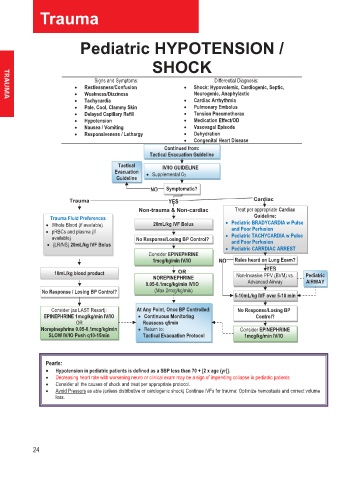
                  Pediatric HYPOTENSION /

                                  SHOCK
                      Signs and Symptoms:       Differential Diagnosis:
                 •  Restlessness/Confusion  •  Shock: Hypovolemic, Cardiogenic, Septic,
                 •  Weakness/Dizziness     Neurogenic, Anaphylactic
                 •  Tachycardia          •  Cardiac Arrhythmia
                 •  Pale, Cool, Clammy Skin  •  Pulmonary Embolus
                 •  Delayed Capillary Refill  •  Tension Pneumothorax
                 •  Hypotension          •  Medication Effect/OD
                 •  Nausea / Vomiting    •  Vasovagal Episode
                 •  Responsiveness / Lethargy  •  Dehydration
                                         •  Congenital Heart Disease

                                     Continued from:
                                  Tactical Evacuation Guideline
                           Tactical   IV/IO GUIDELINE
                          Evacuation
                          Guideline   • Supplemental O2
                                  NO  Symptomatic?
                Trauma                YES               Cardiac
                               Non-trauma & Non-cardiac  Treat per appropriate Cardiac
            Trauma Fluid Preferences                    Guideline:
           • Whole Blood (if available)  20mL/kg IVF Bolus   • Pediatric BRADYCARDIA w Pulse
           • pRBCs and plasma (if                  and Poor Perfusion
            available)         No Response/Losing BP Control?   • Pediatric TACHYCARDIA w Pulse
                                                   and Poor Perfusion
           • (LR/NS) 20mL/kg IVF Bolus            • Pediatric CARRDIAC ARREST

                                 Consider EPINEPHRINE
                                  1mcg/kg/min IV/IO   NO  Rales heard on Lung Exam?
                                                           YES
             10mL/kg blood product      OR
                                  NOREPINEPHRINE    Non-Invasive PPV (BVM) vs.   Pediatric
                                 0.05-0.1mcg/kg/min IV/IO   Advanced Airway    AIRWAY
          No Response / Losing BP Control?   (Max 2mcg/kg/min)
                                                    5-10mL/kg IVF over 5-10 min
            Consider (as LAST Resort):   At Any Point, Once BP Controlled:   No Response/Losing BP
           EPINEPHRINE 1mcg/kg/min IV/IO   • Continuous Monitoring   Control?
                  OR            Reassess q5min
          Norepinephrine 0.05-0.1mcg/kg/min   • Return to:  Consider EPINEPHRINE
            SLOW IV/IO Push q10-15min   Tactical Evacuation Protocol  1mcg/kg/min IV/IO
           Pearls:
           •  Hypotension in pediatric patients is defined as a SBP less than 70 + [2 x age (yr)].
           •  Decreasing heart rate with worsening neuro or clinical exam may be a sign of impending collapse in pediatric patients
           •  Consider all the causes of shock and treat per appropriate protocol.
           •  Avoid Pressors as able (unless distributive or cardiogenic shock) Continue IVFs for trauma: Optimize hemostasis and correct volume
             loss.


        24

