


Page 21 - 2023 SMOG Digital
P. 21
Trauma


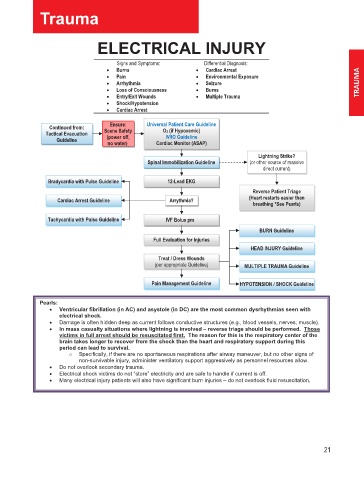
                      ELECTRICAL INJURY

                          Signs and Symptoms:   Differential Diagnosis:
                        •  Burns            •  Cardiac Arrest
                        •  Pain             •  Environmental Exposure
                        •  Arrhythmia       •  Seizure
                        •  Loss of Consciousness  •  Burns
                        •  Entry/Exit Wounds  •  Multiple Trauma
                        •  Shock/Hypotension
                        •  Cardiac Arrest
            Continued from:    Ensure:   Universal Patient Care Guideline
           Tactical Evacuation   Scene Safety   O2 (if Hypoxemic)
             Guideline   (power off,   IV/IO Guideline
                        no water)   Cardiac Monitor (ASAP)
                                                         Lightning Strike?
                                 Spinal Immobilization Guideline   (or other source of massive
                                                          direct current)
           Bradycardia with Pulse Guideline   12-Lead EKG
                                                        Reverse Patient Triage
             Cardiac Arrest Guideline   Arrythmia?     (Heart restarts easier than
                                                        breathing *See Pearls)
           Tachycardia with Pulse Guideline   IVF Bolus pprn  n
                                          r
                                                         BURN Guideline
                                  Full Evaluation for Injuries
                                                        HEAD INJURY Guideline
                                   Treat / Dress Wounds
                                   (per appropriate Guideline)   MULTIPLE TRAUMA Guideline

                                  Pain Management Guideline   HYPOTENSION / SHOCK Guideline

          Pearls:
            •  Ventricular fibrillation (in AC) and asystole (in DC) are the most common dysrhythmias seen with
              electrical shock.
            •  Damage is often hidden deep as current follows conductive structures (e.g., blood vessels, nerves, muscle).
            •  In mass casualty situations where lightning is involved – reverse triage should be performed.  Those
              victims in full arrest should be resuscitated first.  The reason for this is the respiratory center of the
              brain takes longer to recover from the shock than the heart and respiratory support during this
              period can lead to survival.
                o  Specifically, if there are no spontaneous respirations after airway maneuver, but no other signs of
                  non-survivable injury, administer ventilatory support aggressively as personnel resources allow.
            •  Do not overlook secondary trauma.
            •  Electrical shock victims do not “store” electricity and are safe to handle if current is off.
            •  Many electrical injury patients will also have significant burn injuries – do not overlook fluid resuscitation.


                                                                        21

