


Page 18 - 2023 SMOG Digital
P. 18
Trauma


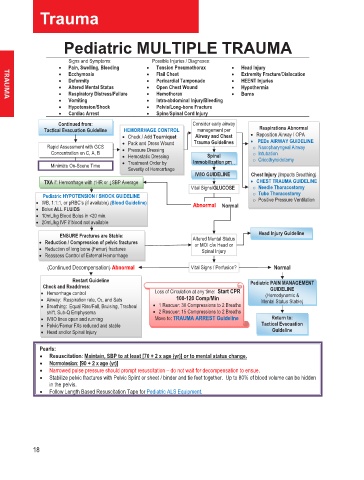
               Pediatric MULTIPLE TRAUMA

                Signs and Symptoms:   Possible Injuries / Diagnoses:
              •  Pain, Swelling, Bleeding  •  Tension Pneumothorax  •  Head Injury
              •  Ecchymosis      •  Flail Chest    •  Extremity Fracture/D Dislocation
              •  Deformity       •  Pericardial Tamponade  •  HEENT Injuries
              •  Altered Mental Status  •  Open Chest Wound  •  Hypothermia
              •  Respiratory Distress/Failure  •  Hemothorax  •  Burns
              •  Vomiting        •  Intra-abdominal Injury/Bleeding
              •  Hypotension/Shock  •  Pelvis/Long-bone Fracture
              •  Cardiac Arrest  •  Spine/ /Spinal Cord Injury
              Continued from:              Consider early airway
           Tactical Evacuation Guideline   HEMORRHAGE CONTROL   management per   Respirations Abnormal
                            • Check / Add Tourniquet  Airway and Chest   • Reposition Airway / OPA
                                                        • PEDs AIRWAY GUIDELINE
           Rapid Assessment with GCS   • Pack and Dress Wound  Trauma Guidelines   o Nasopharyngeal Airway
                            • Pressure Dressing
            Concentration on C, A, B                    o Intubation
                            • Hemostatic Dressing  Spinal   o Cricothyroidotomy
                                                  p
            Minimize On-Scene Time   • Treatment Order by  Immobilization prn r n
                             Severity of Hemorrhage
                                           IV/IO GUIDELINE   Chest Injury (Impacts Breathing)
           TXA if: Hemorrhage with ↑HR or ↓SBP Average   • CHEST TRAUMA GUIDELINE
                                                 C
                                           Vital Signs/GGLUCOSE   o Needle Thoracostomy
                                                L
                                                 U
                                                   S
                                                  O
                                                   E
          Pediatric HYPOTENSION / SHOCK GUIDELINE       o Tube Thoracostomy
         • WB, 1:1:1, or pRBC’s (if available) (Blood Guideline)   Abnormal  Normal  o Positive Pressure Ventilation
         • Bolus ALL FLUIDS
         • 10mL/kg Blood Bolus in <20 min.
         • 20mL/kg IVF if blood not available

              ENSURE Fractures are Stable:               Head Injury Guideline
          • Reduction / Compression of pelvic fractures  Altered Mental Status
                                           or MOI c/w Head or
          • Reduction of long bone (Femur) fractures  Spinal Injury
          • Reassess Control of External Hemorrhage
           (Continued Decompensation) Abnormal   Vital Signs / Perfusion?   Normal
                 Restart Guideline                     Pediatric PAIN MANAGEMENT
          Check and Readdress:                              GUIDELINE
          • Hemorrhage control     Loss of Circulation at any time:  Start CPR   (Hemodynamic &
          • Airway:  Respiration rate, O2, and Sats  100-120 Comp/Min  Mental Status Stable)
          • Breathing:  Equal Rise/Fall, Bruising, Tracheal   • 1 Rescuer: 30 Compressions to 2 Breaths
           shift, Sub-Q Emphysema  • 2 Rescuer: 15 Compressions to 2 Breaths
          • IV/IO lines open and running  Move to: TRAUMA ARREST Guideline  Return to:
          • Pelvic/Femur FXs reduced and stable           Tactical Evacuation
          • Head and/or Spinal Injury                       Guideline
          Pearls:
          •  Resuscitation: Maintain, SBP to at least [70 + 2 x age (yr)] or to mental status change.

                       a

                      x
                       g
                         y
                          r
                         (
                        e

                s
               e
                 o
                i
               t
             r
             o
              o
             m
                 n
                    +

                     2

                   0

                  :
                   9
                  [
          •  N Normotesion: [90 + 2 x age (yr)] ) ]
          •  Narrowed pulse pressure should prompt resuscitation – do not wait for decompensation to ensue.
          •  Stabilize pelvic fractures with Pelvic Splint or sheet / binder and tie feet together.  Up to 80% of blood volume can be hidden
            in the pelvis.
          •  Follow Length Based Resuscitation Tape for Pediatric ALS Equipment.
        18

