


Page 14 - 2023 SMOG Digital
P. 14
Trauma


                       ABDOMINAL INJURY

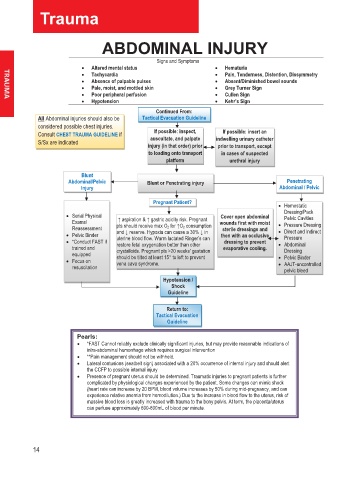
                                   Signs and Symptoms
                   •  Altered mental status     •  Hematuria
                   •  Tachycardia               •  Pain, Tenderness, Distention, Dissymmetry
                   •  Absence of palpable pulses  •  Absent/Diminished bowel sounds
                   •  Pale, moist, and mottled skin  •  Grey Turner Sign
                   •  Poor peripheral perfusion  •  Cullen Sign
                   •  Hypotension               •  Kehr’s Sign

                                   Continued From:
         All Abdominal injuries should also be   Tactical Evacuation Guideline
         considered possible chest injuries.
         Consult CHEST TRAUMA GUIDELINE if   If possible: inspect,   If possible: insert an
         S/Sx are indicated       auscultate, and palpate   indwelling urinary catheter
                                 injury (in that order) prior   prior to transport, except
                                 to loading onto transport   in cases of suspected
                                     platform      urethral injury
                   Blunt
                Abdominal/Pelvic   Blunt or Penetrating injury   Penetrating
                   Injury                                     Abdominal / Pelvic
                                  Pregnant Patient?
                                                              • Hemostatic
               • Serial Physical                 Cover open abdominal   Dressing/Pack
                                                               Pelvic Cavities
                 Exams/    ↑ aspiration & ↑ gastric acidity risk. Pregnant   wounds first with moist
                 Reassessment  pts should receive max O 2  for ↑O 2  consumption   sterile dressings and   • Pressure Dressing
               • Pelvic Binder  and ↓ reserve. Hypoxia can cause a 30% ↓ in   then with an occlusive   • Direct and Indirect
                                                               Pressure
                          uterine blood flow. Warm lactated Ringer’s can
               • *Conduct FAST if  restore fetal oxygenation better than other   dressing to prevent   • Abdominal
                 trained and  crystalloids. Pregnant pts >20 weeks’ gestation   evaporative cooling.   Dressing
                 equipped  should be tilted at least 15° to left to prevent   • Pelvic Binder
               • Focus on  vena cava syndrome.                • AAJT-uncontrolled
                 resuscitation                                 pelvic bleed
                                     Hypotension /
                                      Shock
                                      Guideline
                                     Return to:
                                   Tactical Evacuation
                                     Guideline
                  Pearls:
                  •  *FAST Cannot reliably exclude clinically significant injuries, but may provide reasonable indications of
                    intra-abdominal hemorrhage which requires surgical intervention
                  •  **Pain management should not be withheld.
                  •  Lateral contusions (seatbelt sign) associated with a 20% occurrence of internal injury and should alert
                    the CCFP to possible internal injury
                  •  Presence of pregnant uterus should be determined. Traumatic injuries to pregnant patients is further
                    complicated by physiological changes experienced by the patient. Some changes can mimic shock
                    (heart rate can increase by 20 BPM, blood volume increases by 50% during mid-pregnancy, and can
                    experience relative anemia from hemodilution.) Due to the increase in blood flow to the uterus, risk of
                    massive blood loss is greatly increased with trauma to the bony pelvis. At term, the placenta/uterus
                    can perfuse approximately 600-800mL of blood per minute.
        14

