


Page 11 - 2023 SMOG Digital
P. 11
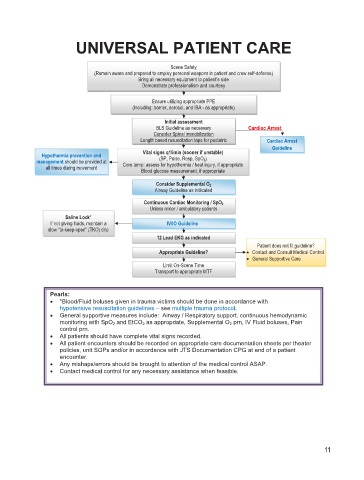
UNIVERSAL PATIENT CARE


                                      Scene Safety
                      (Remain aware and prepared to employ personal weapons in patient and crew self-defense)
                               Bring all necessary equipment to patient’s side
                                Demonstrate professionalism and courtesy
                                  Ensure utilizing appropriate PPE
                              (Including: barrier, aerosol, and IBA - as appropriate)
                                     Initial assessment
                                   BLS Guideline as necessary   Cardiac Arrest
                                  Consider Spinal immobilization
                                Length based resuscitation tape for pediatric   Cardiac Arrest
                                       patients             Guideline
                                Vital signs q15min (sooner if unstable)
          Hypothermia prevention and   (BP, Pulse, Resp, SpO 2 )
         management should be provided at   Core temp: assess for hypothermia / heat injury, if appropriate
           all times during movement
                                Blood glucose measurement, if appropriate
                                   Consider Supplemental O 2   2
                                              O
                                   Airway Guideline as indicated
                                                p
                                Continuous Cardiac Monitoring / SpO 2  2
                                                 O
                                  Unless minor / ambulatory patients
               Saline Lock*
            If not giving fluids, maintain a   IV/IO Guideline
           slow “to-keep-open” (TKO) drip
                                   12 Lead EKG as indicated
                                                         Patient does not fit guideline?
                                    Appropriate Guideline?   • Contact and Consult Medical Control
                                                       • General Supportive Care
                                    Limit On-Scene Time
                                   Transport to appropriate MTF
            Pearls:
            •  *Blood/Fluid boluses given in trauma victims should be done in accordance with
              hypotensive resuscitation guidelines – see multiple trauma protocol.
            •  General supportive measures include:  Airway / Respiratory support, continuous hemodynamic
              monitoring with SpO 2  and EtCO 2  as appropriate, Supplemental O 2  prn, IV Fluid boluses, Pain
              control prn.
            •  All patients should have complete vital signs recorded.
            •  All patient encounters should be recorded on appropriate care documentation sheets per theater
              policies, unit SOPs and/or in accordance with JTS Documentation CPG at end of a patient
              encounter.
            •  Any mishaps/errors should be brought to attention of the medical control ASAP.
            •  Contact medical control for any necessary assistance when feasible.


                                                                        11

