


Page 20 - 2023 SMOG Digital
P. 20
Trauma


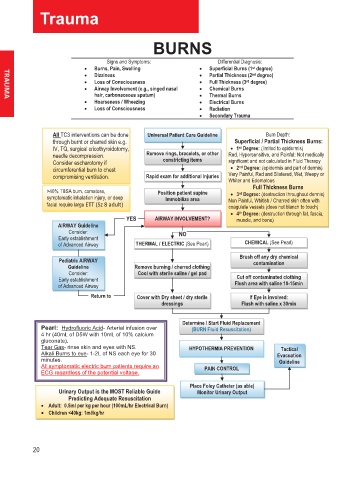
                                  BURNS

                        Signs and Symptoms:     Differential Diagnosis:
                   •  Burns, Pain, Swelling  •  Superficial Burns (1 st  degree)
                   •  Dizziness             •  Partial Thickness (2 nd  degree)
                   •  Loss of Consciousness  •  Full Thickness (3 rd  degree)
                   •  Airway Involvement (e.g., singed nasal  •  Chemical Burns
                      hair, carbonaceous sputum)  •  Thermal Burns
                   •  Hoarseness / Wheezing  •  Electrical Burns
                   •  Loss of Consciousness  •  Radiation
                                            •  Secondary Trauma
             All TC3 interventions can be done   Universal Patient Care Guideline   Burn Depth:
             through burnt or charred skin e.g.      Superficial / Partial Thickness Burns:
             IV, TQ, surgical cricothyroidotomy,   • 1 st  Degree: (limited to epidermis)
             needle decompression.     Remove rings, bracelets, or other   Red, Hypersensitive, and Painful: Not medically
             Consider escharotomy if   constricting items   significant and not calculated in Fluid Therapy
                                                   • 2 nd  Degree: (epidermis and part of dermis)
             circumferential burn to chest         Very Painful, Red and Blistered, Wet, Weepy or
             compromising ventilation.     Rapid exam for additional Injuries   Whiter and Edematous
                                                        Full Thickness Burns
           >40% TBSA burn, comatose,  Position patient supine   • 3 rd  Degree: (destruction throughout dermis)
           symptomatic inhalation injury, or deep  Immobilize area   Non Painful, Whitish / Charred skin often with
           facial require large ETT (Sz 8 adult)   coagulate vessels (does not blanch to touch)
                                                   • 4 th  Degree: (destruction through fat, fascia,
                             YES   AIRWAY INVOLVEMENT?   muscle, and bone)
              AIRWAY Guideline
                Consider:               NO
              Early establishment
              of Advanced Airway   THERMAL / ELECTRIC (See Pearl)   CHEMICAL (See Pearl)
                                                     Brush off any dry chemical
              Pediatric AIRWAY                          contamination
                Guideline     Remove burning / charred clothing
                Consider:      Cool with sterile saline / gel pad
              Early establishment                    Cut off contaminated clothing
              of Advanced Airway                    Flush area with saline 10-15min
                     Return to   Cover with Dry sheet / dry sterile   If Eye is involved:
                                    dressings         Flush with saline x 30min
                                         Determine / Start Fluid Replacement
          Pearl:  Hydrofluoric Acid- Arterial infusion over   (BURN Fluid Resuscitation)
          4 hr (40mL of D5W with 10mL of 10% calcium
          gluconate).
          Tear Gas- rinse skin and eyes with NS.   HYPOTHERMIA PREVENTION   Tactical
          Alkali Burns to eye- 1-2L of NS each eye for 30    Evacuation
          minutes.                                            Guideline
          All symptomatic electric burn patients require an   PAIN CONTROL
          ECG regardless of the potential voltage.

                                          Place Foley Catheter (as able)
              Urinary Output is the MOST Reliable Guide   Monitor Urinary Output
                Predicting Adequate Resuscitation
          • Adult:  0.5ml per kg per hour (100mL/hr Electrical Burn)
          • Children <40kg: 1ml/kg/hr
        20

