


Page 26 - 2023 SMOG Digital
P. 26
Trauma


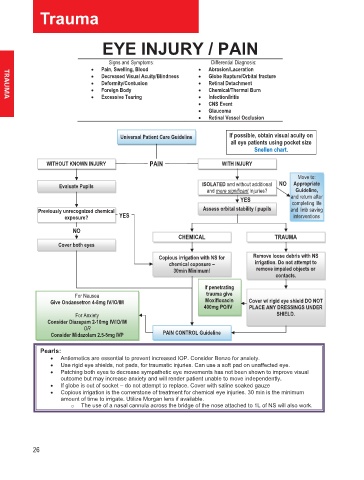
                       EYE INJURY / PAIN

                         Signs and Symptoms:   Differential Diagnosis:
                     •  Pain, Swelling, Blood  •  Abrasion/Laceration
                     •  Decreased Visual Acuity/Blindness  •  Globe Rupture/Orbital fracture
                     •  Deformity/Contusion  •  Retinal Detachment
                     •  Foreign Body        •  Chemical/Thermal Burn
                     •  Excessive Tearing   •  Infection/Iritis
                                            •  CNS Event
                                            •  Glaucoma
                                            •  Retinal Vessel Occlusion
                           Universal Patient Care Guideline   If possible, obtain visual acuity on
                                                   all eye patients using pocket size
                                                        Snellen chart.
           WITHOUT KNOWN INJURY   PAIN           WITH INJURY
                                                                  Move to:
              Evaluate Pupils                ISOLATED and without additional  NO   Appropriate
                                              and more significant Injuries?   Guideline,
                                                     YES        and return after
                                                                 completing life
         Previously unrecognized chemical    Assess orbital stability / pupils   and limb saving
               exposure?   YES                                   interventions

                 NO
                                        CHEMICAL             TRAUMA
              Cover both eyes
                                    Copious irrigation with NS for   Remove loose debris with NS
                                      chemical exposure –    irrigation. Do not attempt to
                                       30min Minimum!    remove impaled objects or
                                                             contacts.
                                              If penetrating
                 For Nausea                   trauma give
            Give Ondansetron 4-8mg IV/IO/IM   Moxifloxacin   Cover w/ rigid eye shield DO NOT
                                             400mg PO/IV   PLACE ANY DRESSINGS UNDER
                 For Anxiety                                 SHIELD.
           Consider Diazepam 2-10mg IV/IO O/IM
                   OR
            Consider Midazolam 2.5-5mg IVP    PAIN CONTROL Guideline
          Pearls:
            •  Antiemetics are essential to prevent increased IOP. Consider Benzo for anxiety.
            •  Use rigid eye shields, not pads, for traumatic injuries. Can use a soft pad on unaffected eye.
            •  Patching both eyes to decrease sympathetic eye movements has not been shown to improve visual
              outcome but may increase anxiety and will render patient unable to move independently.
            •  If globe is out of socket – do not attempt to replace. Cover with saline soaked gauze
            •  Copious irrigation is the cornerstone of treatment for chemical eye injuries. 30 min is the minimum
              amount of time to irrigate. Utilize Morgan lens if available.
                o  The use of a nasal cannula across the bridge of the nose attached to 1L of NS will also work.


        26

