


Page 130 - JSOM Fall 2021
P. 130
Treatment Phases                                   TABLE 2  The LSP Code
                                                                     Lesion/Injury
                                                                     L1. Ventilatory compromise
                                                                     L2. Nonpenetrating trauma
                                                                L
                                                                     L3. Low-risk penetrating trauma
                                                                     L4. High-risk penetrating trauma
                                                                     L5. Neurological compromise
                                                                     Subjective
                                                                S
                                                                     Subjective evaluation by the NCVM system (Table 1)
                                                                     Peligro “danger”
                                                                     P1. No danger
                                                                P
                                                                     P2. Low risk of danger
                                                                     P3. High risk of danger
          Red Zone
          The first objective of the Red Team in the Red Zone is to keep   with heavy armor. The team leader, usually a physician, an
          itself safe from injury and keep the team members in a covered   individual with rescue experience, or a medical specialist, was
          position, able to observe the environment away from direct   equipped with the radio and a flag to identify the team during
          contact. The second objective is to analyze the environment   the demonstration and thus be quickly identified to avoid be-
          to avoid possible danger but be able to identify casualties and   coming an accidental target. Four support members helped
          determine the best route for extraction, treatment, and trans-  with  patient  extraction,  guarding  from  danger,  or assisting
          port. The Red Team maintains constant communication with   with treatment.
          the OC, which uses several ways to obtain information about
          both the movement of possible danger in the scene and the   Red Team equipment included, as basic equipment, hard flak
          location of the other teams, principally by radio or cellphone.  jackets (not always ballistic), helmets (not always ballistic),
                                                             boots, gloves with cut protection, gas masks, a shield (for the
          The third objective of the Red Team is to identify casualties   guard team member), a radio (for the team leader), and a flag
          that require immediate attention. This can be difficult in a sit-  (for the team leader). Special equipment included combat appli-
          uation of social commotion, where many of the participants   cation tourniquets (CATs), needles for chest decompression, alu-
          with non-life-threatening injuries may be reacting in panic.   minum-magnesium hydroxide solution for CS gas (ie, tear gas)
          For this reason, we needed a system to identify the casualties   injuries, bandages, rescue lines for extraction, nasopharyng eal
          requiring immediate extraction and medical attention. Thus,   and oropharyngeal airways, adhesive, and chest seal patches.
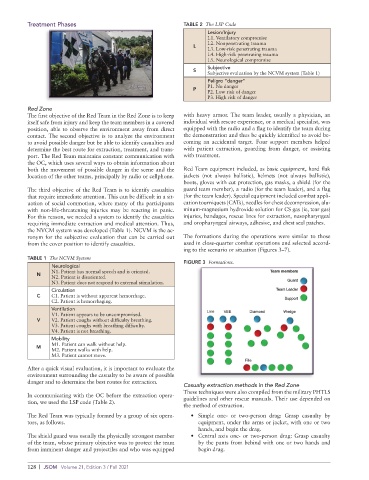
          the NVCM system was developed (Table 1). NCVM is the ac-
          ronym for the subjective evaluation that can be carried out   The formations during the operations were similar to those
          from the cover position to identify casualties.    used in close-quarter combat operations and selected accord-
                                                             ing to the scenario or situation (Figures 3–7).
          TABLE 1  The NCVM System
                                                             FIGURE 3  Formations.
                  Neurological
                  N1. Patient has normal speech and is oriented.
             N
                  N2. Patient is disoriented.
                  N3. Patient does not respond to external stimulation.
                  Circulation
             C    C1. Patient is without apparent hemorrhage.
                  C2. Patient is hemorrhaging.
                  Ventilation
                  V1. Patient appears to be uncompromised.
             V    V2. Patient coughs without difficulty breathing.
                  V3. Patient coughs with breathing difficulty.
                  V4. Patient is not breathing.
                  Mobility
                  M1. Patient can walk without help.
             M
                  M2. Patient walks with help.
                  M3. Patient cannot move.
          After a quick visual evaluation, it is important to evaluate the
          environment surrounding the casualty to be aware of possible
          danger and to determine the best routes for extraction.
                                                             Casualty extraction methods in the Red Zone
                                                             These techniques were also compiled from the military PHTLS
          In communicating with the OC before the extraction opera-
          tion, we used the LSP code (Table 2).              guidelines and other rescue manuals. Their use depended on
                                                             the method of extraction.
          The Red Team was typically formed by a group of six opera-  •  Simple one- or two-person drag: Grasp casualty by
          tors, as follows.                                       equipment, under the arms or jacket, with one or two
                                                                  hands, and begin the drag.
          The shield guard was usually the physically strongest member   •  Central axis one- or two-person drag: Grasp casualty
          of the team, whose primary objective was to protect the team   by the pants from behind with one or two hands and
          from imminent danger and projectiles and who was equipped   begin drag.


          128  |  JSOM   Volume 21, Edition 3 / Fall 2021

