


Page 132 - JSOM Fall 2021
P. 132
nearest the litter. The leader of the litter team positions
                                                                  himself at the handle nearest the casualty’s right shoul-
                                                                  der and directs the other bearers. This position allows
                                                                  the leader to monitor the casualty during the evacua-
                                                                  tion. Upon command of the leader, the four litter bear-
                                                                  ers lift the litter in unison and move the casualty to the
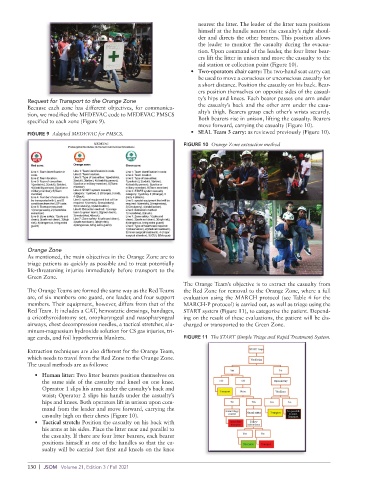
                                                                  aid station or collection point (Figure 10).
                                                               •  Two-operators chair carry: The two-hand seat carry can
                                                                  be used to move a conscious or unconscious casualty for
                                                                  a short distance. Position the casualty on his back. Bear-
                                                                  ers position themselves on opposite sides of the casual-
          Request for Transport to the Orange Zone                ty’s hips and knees. Each bearer passes one arm under
          Because each zone has different objectives, for communica-  the casualty’s back and the other arm under the casu-
          tion, we modified the MEDEVAC code to MEDEVAC PMSCS     alty’s thigh. Bearers grasp each other’s wrists securely.
          specified to each zone (Figure 9).                      Both bearers rise in unison, lifting the casualty. Bearers
                                                                  move forward, carrying the casualty (Figure 10).
          FIGURE 9  Adapted MEDEVAC for PMSCS.                 •  SEAL Team 3 carry: as reviewed previously (Figure 10).
                                                             FIGURE 10  Orange Zone extraction method


          Orange Zone
          As mentioned, the main objectives in the Orange Zone are to
          triage patients as quickly as possible and to treat potentially
          life-threatening injuries immediately before transport to the
          Green Zone.
                                                             The Orange Team’s objective is to extract the casualty from
          The Orange Teams are formed the same way as the Red Teams   the Red Zone for removal to the Orange Zone, where a full
          are, of six members: one guard, one leader, and four support   evaluation using the MARCH protocol (see Table 4 for the
          members. Their equipment, however, differs from that of the   MARCH-P protocol) is carried out, as well as triage using the
          Red Team. It includes a CAT, hemostatic dressings, bandages,   START system (Figure 11), to categorize the patient. Depend-
          a cricothyroidotomy set, oropharyngeal and nasopharyngeal   ing on the result of these evaluations, the patient will be dis-
          airways, chest decompression needles, a tactical stretcher, alu-  charged or transported to the Green Zone.
          minum-magnesium hydroxide solution for CS gas injuries, tri-
          age cards, and foil hypothermia blankets.          FIGURE 11  The START (Simple Triage and Rapid Treatment) System.

          Extraction techniques are also different for the Orange Team,
          which needs to travel from the Red Zone to the Orange Zone.
          The usual methods are as follows:
            •  Human litter: Two litter bearers position themselves on
               the same side of the casualty and kneel on one knee.
               Operator 1 slips his arms under the casualty’s back and
               waist; Operator 2 slips his hands under the casualty’s
               hips and knees. Both operators lift in unison upon com-
               mand from the leader and move forward, carrying the
               casualty high on their chests (Figure 10).
            •  Tactical stretch: Position the casualty on his back with
               his arms at his sides. Place the litter near and parallel to
               the casualty. If there are four litter bearers, each bearer
               positions himself at one of the handles so that the ca-
               sualty will be carried feet first and kneels on the knee


          130  |  JSOM   Volume 21, Edition 3 / Fall 2021

