


Page 129 - JSOM Fall 2021
P. 129
were not allowed to have any force posture during the opera-  FIGURE 2  Operational zones.
              tion, thus making tactical strategies our principal tool.
              Morbidity Statistics
              Between April 2 and July 26, 2017, a total of 60 operations
              were developed; 5,000 casualties were extracted from the Red
              Zones (see below), and of these 5,000, 4 were extracted with-
              out vital signs: 2 with penetrating head injury by firearm pro-
              jectile, and 2 with open chest trauma related to an explosive
              device. Only one member of the team was injured in 2017 by
              penetrating trauma in the lower extremities related to a fire-
              arm projectile.

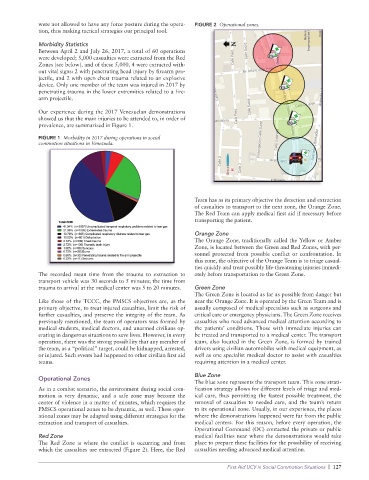
              Our experience during the 2017 Venezuelan demonstrations
              showed us that the main injuries to be attended to, in order of
              prevalence, are summarized in Figure 1.

              FIGURE 1  Morbidity in 2017 during operations in social
              commotion situations in Venezuela.


                                                                 Team has as its primary objective the detection and extraction
                                                                 of casualties to transport to the next zone, the Orange Zone.
                                                                 The Red Team can apply medical first aid if necessary before
                                                                 transporting the patient.

                                                                 Orange Zone
                                                                 The Orange Zone, traditionally called the Yellow or Amber
                                                                 Zone, is located between the Green and Red Zones, with per-
                                                                 sonnel protected from possible conflict or confrontation. In
                                                                 this zone, the objective of the Orange Team is to triage casual-
                                                                 ties quickly and treat possibly life-threatening injuries immedi-
              The recorded mean time from the trauma to extraction to   ately before transportation to the Green Zone.
              transport vehicle was 30 seconds to 5 minutes; the time from
              trauma to arrival at the medical center was 5 to 20 minutes.  Green Zone
                                                                 The Green Zone is located as far as possible from danger but
              Like those of the TCCC, the PMSCS objectives are, as the   near the Orange Zone. It is operated by the Green Team and is
              primary objective, to treat injured casualties, limit the risk of   usually composed of medical specialists such as surgeons and
              further casualties, and preserve the integrity of the team. As   critical care or emergency physicians. The Green Zone receives
              previously mentioned, the team of operators was formed by   casualties who need advanced medical attention according to
              medical students, medical doctors, and unarmed civilians op-  the patients’ conditions. Those with immediate injuries can
              erating in dangerous situations to save lives. However, in every   be treated and transported to a medical center. The transport
              operation, there was the strong possibility that any member of   team, also located in the Green Zone, is formed by trained
              the team, as a “political” target, could be kidnapped, arrested,   drivers using civilian automobiles with medical equipment, as
              or injured. Such events had happened to other civilian first aid   well as one specialist medical doctor to assist with casualties
              teams.                                             requiring attention in a medical center.

                                                                 Blue Zone
              Operational Zones
                                                                 The blue zone represents the transport team. This zone strati-
              As in a combat scenario, the environment during social com-  fication strategy allows for different levels of triage and med-
              motion is very dynamic, and a safe zone may become the   ical care, thus permitting the fastest possible treatment, the
              center of violence in a matter of minutes, which requires the   removal of casualties to needed care, and the team’s return
              PMSCS operational zones to be dynamic, as well. These oper-  to its operational zone. Usually, in our experience, the places
              ational zones may be adapted using different strategies for the   where the demonstrations happened were far from the public
              extraction and transport of casualties.            medical centers. For this reason, before every operation, the
                                                                 Operational Command (OC) contacted the private or public
              Red Zone                                           medical facilities near where the demonstrations would take
              The Red Zone is where the conflict is occurring and from   place to prepare these facilities for the possibility of receiving
              which the casualties are extracted (Figure 2). Here, the Red   casualties needing advanced medical attention.

                                                                           First Aid UCV in Social Commotion Situations  |  127

