


Page 125 - JSOM Fall 2021
P. 125
An Ongoing Series


                                               Lessons Learned From a
                                  Traumatic Brain Injury Mass Casualty Incident


                                Brendan Killian, FP-C, ATP-C, NRP ; Roman Clark, FP-C, ATP-C ;
                                                                 1
                                                                                             2
                                                   Collin Hu, DO, FAAFP *
                                                                         3


              ABSTRACT
              In January 2020, an American base was attacked by the larg-  Background
              est theater ballistic missile strike in history. This case report
              covers the resulting mass casualty (MASCAL) incident. In this   Immediately after the attack, base operations and other com-
              case, we defined this incident as a MASCAL due to a lack of   mand team members were under the assumption that there were
              medical personnel available to properly and timely evaluate   no injuries sustained, as reported by lower leadership. On fur-
              the patients. There was no loss of life during the attack but   ther evaluation of areas of the base involved in the attack, it
              there were > 80 traumatic brain injuries (TBIs). This article fo-  became apparent that several Joint Servicemembers were within
              cuses on lessons learned from diagnosing and treating Soldiers   100 m of various theater ballistic missile impact sites, with pay-
              during a TBI MASCAL event.                         loads of up to 650 kg. Unfortunately, screening for nonphysical
                                                                 injuries was initiated a little > 72 hours after the strike. Two
                                                                 of the injured included an embedded aeromedical physician as-
              Keywords: lessons learned; mass casualty; traumatic brain injury
                                                                 sistant (APA) and a MEDEVAC platoon leader. Both Soldiers
                                                                 were within 50 to 20 m of an impact site. The APA and platoon
                                                                 leader were both diagnosed with a mild to moderate TBI due to
              Introduction                                       symptoms and their Military Acute Concussion Evaluation 2
              In January 2020, an American base was attacked by the largest   (MACE2) score. They were both instructed to initiate bed rest.
              theater ballistic missile strike in history. This case report cov-  The APA provided the aeromedical care of the local aviation
              ers the resulting mass casualty (MASCAL) incident.  MASCAL   assets on base, and though the APA desired and attempted to
              is defined as: “Any number of human casualties produced   treat the Soldiers under his care, his condition did not allow him
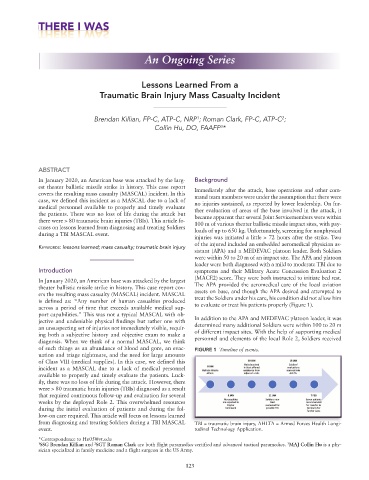
              across a period of time that exceeds available medical sup-  to evaluate or treat his patients properly (Figure 1).
              port capabilities.” This was not a typical MASCAL with ob-
              jective and undeniable physical findings but rather one with   In addition to the APA and MEDEVAC platoon leader, it was
              an unsuspecting set of injuries not immediately visible, requir-  determined many additional Soldiers were within 100 to 20 m
              ing both a subjective history and objective exam to make a   of different impact sites. With the help of supporting medical
              diagnosis. When we think of a normal MASCAL, we think   personnel and elements of the local Role 2, Soldiers received
              of such things as an abundance of blood and gore, an evac-  FIGURE 1  Timeline of events.
              uation and triage nightmare, and the need for large amounts
              of Class VIII (medical supplies). In this case, we defined this
              incident  as a MASCAL  due to a lack  of medical  personnel
              available to properly and timely evaluate the patients. Luck-
              ily, there was no loss of life during the attack. However, there
              were > 80 traumatic brain injuries (TBIs) diagnosed as a result
              that required continuous follow-up and evaluation for several
              weeks by the deployed Role 2. This overwhelmed resources
              during the initial evaluation of patients and during the fol-
              low-on care required. This article will focus on lessons learned
              from diagnosing and treating Soldiers during a TBI MASCAL     TBI = traumatic brain injury, AHLTA = Armed Forces Health Longi-
              event.                                             tudinal Technology Application.
              *Correspondence to Hu05@vt.edu
                                2
              1 SSG Brendan Killian and  SGT Roman Clark are both flight paramedics-certified and advanced tactical paramedics.  MAJ Collin Hu is a phy-
                                                                                               3
              sician specialized in family medicine and a flight surgeon in the US Army.
                                                              123

