


Page 56 - JSOM Spring 2020
P. 56
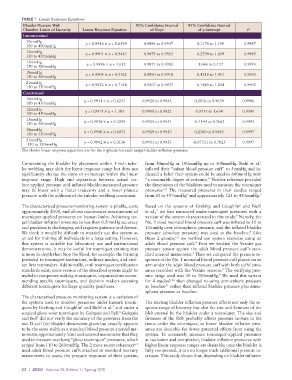
TABLE 1  Linear Response Equations
           Bladder Pressure With                         95% Confidence Interval    95% Confidence Interval
           Chamber Limits of Linearity  Linear Response Equation  of Slope         of y-intercept      r 2
           Unconstrained
            10mmHg                  y = 0.9916 ✕ x + 0.6539  0.9896 to 0.9937     0.1178 to 1.190     0.9987
            100 to 400mmHg
            12mmHg                  y = 0.9901 ✕ x + 0.9413  0.9879 to 0.9923     0.2739 to 1.609     0.9985
            150 to 450mmHg
            15mmHg
            150 to 500mmHg           y = 0.9886 ✕ x + 1.612  0.9871 to 0.9902      1.066 to 2.157     0.9993
            18mmHg
            150 to 500mmHg          y = 0.9904 ✕ x + 0.9162  0.9890 to 0.9918     0.4218 to 1.411     0.9993
            21mmHg
            150 to 550mmHg          y = 0.9922 ✕ x + 0.7144  0.9907 to 0.9937     0.1845 to 1.244     0.9992
           Constrained
            10mmHg                  y = 0.9931 ✕ x + 0.6257  0.9920 to 0.9943    0.2876 to 0.9639    0.9996
            100 to 450mmHg
            12mmHg                  y = 0.9911 ✕ x + 1.305  0.9900 to 0.9922      0.9755 to 1.634    0.9996
            100 to 450mmHg
            15mmHg
            150 to 500mmHg          y = 0.9938 ✕ x + 0.3259  0.9925 to 0.9951    -0.1144 to 0.7663   0.9995
            18mmHg
            150 to 550mmHg          y = 0.9940 ✕ x + 0.6073  0.9929 to 0.9950    0.2300 to 0.9845    0.9997
            21mmHg
             150 to 550mmHg         y = 0.9942 ✕ x + 0.3136  0.9931 to 0.9953    -0.07531 to 0.7025  0.9997
          The shown linear response equations are for the triplicate for each target bladder inflation pressure.

          Constraining the bladder by placement within 1-inch tubu-  from 50mmHg or 100mmHg up to 300mmHg. Biehl et al.
                                                                                                            7
          lar webbing may shift the linear response range but does not   inflated their “infant blood pressure cuff” to 5mmHg and in-
          significantly change the slope or y-intercept within the linear   dicated a belief their system could be used to 600mmHg with
          response  range.  High end  separation  between  actual sur-  “a reasonable degree of certainty.” Neither reference provided
          face-applied pressure and inflated-bladder-measured pressure   the dimensions of the bladders used to measure the tourniquet
          may  be  lower  with  a  flatter  trajectory  and  a  lower  plateau   pressures.  The measured pressures in their studies ranged
                                                                     6,7
          pressure with the addition of the tubular webbing constraint.  from 85 to 497mmHg  and approximately 125 to 450mmHg. 7
                                                                              6
          The characterized pressure-monitoring system is pliable, costs   Based on the systems of Grebing and Coughlin  and Biehl
                                                                                                    6
          approximately $500, and allows noninvasive measurement of   et  al.,   we  first  measured  under-tourniquet  pressures  with  a
                                                                  7
          tourniquet-applied pressures on human limbs. Achieving tar-  variant of the system characterized in this study.  Namely, the
                                                                                                   9
          get bladder inflation pressures to less than 0.5mmHg accuracy   No. 1 sized neonatal blood pressure cuff was inflated to 10 to
          and precision is challenging and requires patience and finesse.   15mmHg over atmospheric pressure, and the inflated bladder
          We think it would be difficult to routinely use this system as   pressure (absolute pressure) was used as the baseline.  Like
                                                                                                        9
          an aid for training all individuals in a large setting. However,   those 2 groups,  we verified our system response using an
                                                                         6,7
          this system is suitable  for laboratory use and instructional   adult  blood pressure  cuff.   First  we verified  the  Vernier  gas
                                                                                  9
          demonstrations. It may be useful for tourniquet training that   pressure sensor against the adult blood pressure cuff’s stan-
          is more in-depth than Stop the Bleed, for example: the training   dard aneroid manometer.  Then we compared the pressure re-
                                                                                 9
          provided to tourniquet instructors, military medics, and civil-  sponses of the No. 1 neonatal blood pressure cuff placed on an
          ian first responders. Additionally, until tourniquet certification   arm under the adult blood pressure cuff with both cuffs’ pres-
          standards exist, some version of the described system might be   sures recorded with the Vernier sensors.  The verifying pres-
                                                                                             9
          useful to companies making tourniquets, organizations recom-  sure range used was 50 to 300mmHg.  We used this variant
                                                                                           9
          mending specific tourniquets, and decision makers assessing   for 4 studies 9-12  then changed to using atmospheric pressure
          different tourniquets for large quantity purchases.  as baseline  rather than inflated bladder pressure plus atmo-
                                                                     13
                                                             spheric pressure as baseline.
          The characterized pressure-monitoring system is a variation of
          the systems used to monitor pressures under Esmark tourni-  The starting bladder inflation pressure affects not only the re-
          quets by Grebing and Coughlin  and Biehl et al.  and under a   sponse range of linearity but also the size and firmness of the
                                   6
                                               7
          surgical glove wrist tourniquet by Guirguis and Bell.  Guirguis   bleb created by the bladder under a tourniquet. The size and
                                                  8
          and Bell  did not verify the accuracy of the pressures from the   firmness of the bleb probably affects pressure isobars in the
                8
          size D cuff (no bladder dimensions given but visually appears   tissue under the tourniquet, so lower bladder inflation pres-
          to be the same width as a standard blood pressure aneroid ma-  sures are desirable for fewer potential effects from using the
          nometer, approximately 5cm) and aneroid manometer that they   system.  To accurately  measure  tourniquet-applied  pressures
          used to measure overlying “glove tourniquet” pressures, which   at occlusion and completion, bladder inflation pressures with
          ranged from 110 to 260mmHg. The 2 more recent references    higher linear response ranges are desirable; once the bladder is
                                                         6,7
          used adult blood pressure cuffs attached to standard mercury   fully compressed, it can no longer track additional pressure in-
          manometers to assess the pressure responses of their systems   creases. This study shows that, depending on bladder inflation
          52  |  JSOM   Volume 20, Edition 1 / Spring 2020

