


Page 60 - JSOM Spring 2020
P. 60
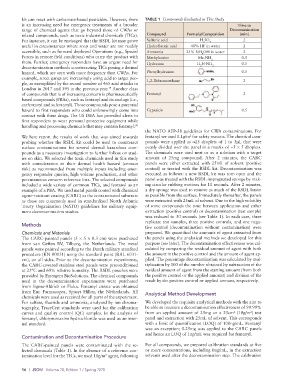
kit can react with carbamate-based pesticides. However, there   TABLE 1  Compounds Evaluated in This Study
          is an increasing need for emergency treatments of a broader                              Time to
          range of chemical agents that go beyond those of CWAs or                              Decontamination
          related compounds, such as toxic industrial chemicals (TICs).   Compound  Formula/Composition  (min)
          For instance, it can be envisaged that the RSDL kit may prove   Sulfuric acid  H SO 4      2
                                                                                     2
          useful in circumstances where soap and water are not readily   Hydrofluoric acid  48% HF in water  2
          accessible, such as forward deployed Operations (e.g., Special   Ammonia  25% NH OH in water  2
                                                                                    4
          Forces in remote field conditions) who carry the product with   Methylamine  Me-NH         0.5
          them. Further, emergency responders have an urgent need for   Hydrazine  H N-NH 2          0.5
          decontamination methods counteracting TICs posing a dermal                2    2
          hazard, which are seen with more frequency than CWAs. For   Phenylhydrazine                0.5
          example, street gangs are increasingly using acid to target peo-
          ple, as exemplified by the record number of 465 acid attacks in   1,2-Dibromoethane        2
          London in 2017 and 395 in the previous year.  Another class
                                              19
          of compounds that is of increasing concern is pharmaceutically   Fentanyl                  2
          based compounds (PBAs), such as fentanyl and its analogs (i.e.,
          carfentanyl and sufentanyl). Those compounds pose a potential
          hazard to first responders who could unknowingly come into   Capsaicin                     0.5
          contact with these drugs. The US DEA has provided alerts to

          first responders to wear personal protective equipment while
          handling and processing chemicals that may contain fentanyl. 20
                                                             the NATO AEP-58 guidelines for CWA contaminations. For
                                                                               2
          We here report the results of work that was aimed towards   fentanyl we used 0.1g/m  for safety reasons. The chemical com-
          probing whether the RSDL kit could be used to counteract   pounds were applied as ≈25 droplets of 1 to 3µL that were
          surface contaminations for several dermal hazardous com-  evenly divided over the panel in a matrix of ~5 ✕ 5 droplets.
          pounds as a necessary investigation to further follow on stud-  The chemicals were used neat or as a solution with a target
          ies on skin. We selected the toxic chemicals used in this study   amount of 25mg compound. After 2 minutes, the CARC
          with consideration to their dermal health hazard (contact   panels were either extracted with 25mL of solvent (positive
          risk) as recommended from multiple inputs including emer-  control) or treated with the RSDL kit. Decontamination was
          gency responder queries, high volume production, and other   executed as follows: a new RSDL kit was torn open and the
          percutaneous concern reference lists. The selected compounds   panel was treated with the RSDL-impregnated sponge by mak-
          included a wide variety of common TICs, and fentanyl as an   ing circular rubbing motions for 10 seconds. After 2 minutes,
          example of a PBA. We used metal panels coated with chemical   a dry sponge was used to remove as much of the RSDL lotion
          agent–resistant coating (CARC) as the contaminated substrate   as possible from the surface. Immediately thereafter, the panels
          as these are commonly used in standardized North Atlantic   were extracted with 25mL of solvent. Due to the high volatility
          Treaty Organization (NATO) guidelines for military equip-  of some compounds the time between application and either
          ment decontamination studies.                      extraction (positive control) or decontamination (test sample)
                                                             was reduced to 30 seconds (see Table 1). In each case, three
                                                             replicate test samples, three positive controls, and one nega-
          Methods
                                                             tive control (decontamination without contamination) were
          Chemicals and Materials                            prepared. We quantified the amounts of agent extracted from
          The CARC-painted panels (5 ✕ 5 ✕ 0.3 cm) were purchased   the panels using the analytical methods we developed for this
          from van Geffen BV, Tilburg, the Netherlands. The metal   purpose (see later). The decontamination effectiveness was cal-
          panels were painted according to the Dutch military standard   culated by comparing the residual amount of agent with both
          procedure (KN 00031) using the standard paint (RAL 6031-  the amount in the positive control and the amount of agent ap-
          zm), on all sides. Prior to the decontamination experiments,   plied. The percentage decontamination was calculated by mul-
          the CARC-covered stainless steel panels were preconditioned   tiplication by 100 of the number obtained by subtraction of the
          at 23°C and 60% relative humidity. The RSDL pouches were   residual amount of agent from the starting amount (from both
          provided by Emergent BioSolutions. The chemical compounds   the positive control or the applied amount) and division of the
          used in the decontamination experiments were purchased   result by the positive control or applied amount, respectively.
          from Sigma-Aldrich or Fluka. Fentanyl citrate was obtained
          from Eur. Farmacopea, Spruyt Hillen, the Netherlands. All   Analytical Method Development
          chemicals were used as received for all parts of the experiment.
          For sulfate, fluoride and ammonia, analyzed by ion chroma-  We developed the requisite analytical methods with the aim to
          tography, TraceCert standards were used for the calibration   be able to measure a decontamination effectiveness of 99.99%
          curves and quality control (QC) samples. In the analysis of   from an applied amount of 25mg on a 25cm  (10g/m ) test
                                                                                                        2
                                                                                                  2
          fentanyl, chlorpromazine hydrochloride was used as an inter-  panel and extraction with 25mL of solvent. This corresponds
          nal standard.                                      with a limit of quantification (LOQ) of 100ng/mL. Fentanyl
                                                             was an exception; 0.25mg was applied to the CARC panels
                                                             and hence an LOQ of 1ng/mL was required for fentanyl.
          Contamination and Decontamination Procedure
          The  CARC-painted  panels were  contaminated  with the  se-  For all compounds, we prepared calibration standards at five
          lected chemicals (Table 1). In the absence of a reference con-  or more concentrations, including 0ng/mL, in the extraction
          tamination level for the TICs, we used 10g/m  agent, following   solvents used after the decontamination step. The calibration
                                             2

          56  |  JSOM   Volume 20, Edition 1 / Spring 2020

