


Page 62 - JSOM Spring 2020
P. 62
with the commercially available AccQTag derivatization kit   TABLE 3  Results of the Decontamination Experiments
          (methylamine and hydrazine). The two acids (H SO  and HF)        Amount                    Net
                                                  4
                                               2
          and ammonia were quantified by using the IC of the respective    Applied  Decontamination Decontamination
          ions (sulfate, fluoride, and ammonium). In the case of more   Compound  (mg)  efficiency (%)*  Efficiency (%) †
          hydrophilic compounds, we found that the use of methanol   Sulfuric acid  25  98.78 ± 0.15  98.81 ± 0.14
          (capsaicin) or methanol–water mixtures (fentanyl) was ade-  Hydrofluoric   25  97.79 ± 0.61  97.38 ± 0.72
          quate, whereas for ethylenedibromide, we used n-hexane with   acid
          subsequent GC-MS analysis.                          Ammonia        25     99.94 ± 0.04  89.17 ± 1.84
                                                              solution
          The RSDL lotion contains MPEG-550. Following one of the   Methylamine  25  99.98 ± 0.00  99.85 ± 0.02
          decontamination experiments, we found that some MPEG-  Hydrazine   26     99.98 ± 0.01  99.95 ± 0.01
          550 remained on the CARC panels and this ended up in the   solution
          extracts. By weighing several (uncontaminated) CARC panels   Phenylhydrazine  26  99.86 ± 0.12  99.84 ± 0.14
          before and after a decontamination procedure (the contam-  Fentanyl  0.25  99.87 ± 0.07  99.86 ± 0.07
          ination step was omitted), we were able to estimate that the   Capsaicin  25  99.70 ± 0.02  99.73 ± 0.02
          concentration of MPEG-550 in the extracts (25mL) was in the   Ethylene
          order of 0.1%. As the presence of MPEG-550 in the extracts   dibromide  25  99.93 ± 0.07  97.87
          may alter the response of the various techniques (matrix ef-  Net decontamination was calculated relative to the measured amount
          fect), we analyzed QC samples containing 0.1% and 0.5%   in the positive controls as well as relative to the amount of substance
          MPEG-550. No interference of MPEG-550 was found at these   applied.
          concentrations. Table 2 provides the specifics of the analytical   *Decontamination: decontamination relative to the amount applied.
                                                             †
                                                              Net decontamination: decontamination relative to untreated.
          methods including the dynamic range, precision, and accuracy
          of the respective compounds in the QC samples. The required
          LOQ of 100ng/mL (1ng/mL for fentanyl), corresponding to   for skin decontamination of chemical warfare agents. The de-
          a measurable 99.99% decontamination, was achieved for all   contamination efficiency ranged from 97.79% (≈0.5mg left
          compounds. The precision and accuracy obtained from the   from 25mg initially applied) to 99.99% (2.5µg left). These
          analysis of independent QC samples at or below the required   results indicate that the RSDL Kit could be an effective decon-
          LOQ (100 and 1ng/mL) were within the limits of 15% for pre-  taminant for similar substrates and hence suggest a possible
          cision and 85% to 115% for accuracy. Thus, we established   broadened applicability of the RSDL Kit as a decontaminant
          validated analytical methods for all compounds.    for material or equipment beyond the classic CWA. In addi-
                                                             tion, the evaluation of the decontamination efficacy of the
          Surface Decontamination Experiments                RSDL kit for CARC-painted panels serves as a first-step qual-
                                                             ification for use of the RSDL kit for decontamination of the
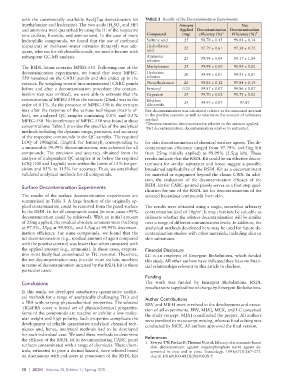
          The results of the surface decontamination experiments are   selected hazardous compounds from skin.
          summarized in Table 3. A large fraction of the originally ap-
          plied contamination could be removed from the panel surface   The results were obtained using a single, somewhat arbitrary
          by the RSDL kit for all compounds tested (in most cases >99%   contamination level of 10g/m . It may therefore be valuable to
                                                                                    2
          decontamination could be achieved). With an initial amount   delineate whether the relative decontamination will be similar
          of 25mg applied, the residual absolute amounts were 0.625mg   over a range of different contamination levels. In addition, the
          at 97.5%, 25µg at 99.90%, and 2.5µg at 99.99% decontam-  analytical methods developed here may be used for future de-
          ination efficiency. For some compounds, we found that the   contamination studies with other materials, including skin or
          net decontamination (e.g., residual amount of agent compared   skin substitutes.
          with the positive control) was lower than when compared with
          the applied amount (e.g., ammonia). In those cases, evapora-  Financial Disclosure
          tion most likely had contributed to TIC removal. Therefore,   LC is an employee of Emergent BioSolutions, which funded
          the net decontamination may provide more realistic numbers   this study. All other authors have indicated they have no finan-
          in terms of decontamination incurred by the RSDL kit in those   cial relationships relevant to this article to disclose.
          particular cases.
                                                             Funding
          Conclusions                                        The work was funded by Emergent BioSolutions. RSDL
                                                             pouches were supplied free of charge by Emergent BioSolutions.
          In this study, we developed satisfactory quantitative analyti-
          cal methods for a range of analytically challenging TICs and   Author Contributions
          a PBA with varying physicochemical properties. The selected   ERV and MB-H were involved in the development and execu-
          TICs/PBA  cover  a broad set  of physicochemical  properties.   tion of all experiments. ERV, MJAJ, MCK, and LC conceived
          Some of the compounds are reactive or exhibit a low molec-  the study concept. MJAJ coordinated the project. All authors
          ular weight and high polarity. Such properties complicate the   were involved in manuscript writing, whereas final editing was
          development of reliable quantitative analytical chemical tech-  conducted by MCK. All authors approved the final version.
          niques and, hence, analytical methods had to be developed
          for each individual case. We used these methods to determine
          the efficacy of the RSDL kit in decontaminating CARC panel   References
          surfaces contaminated with a range of chemicals. These chem-  1.  Sawyer TW, Parker D, Thomas N, et al. Efficacy of an oximate-based
                                                               skin decontaminant against organophosphate nerve agents de-
          icals, estimated to pose a dermal hazard, were selected based   termined in vivo and in vitro.  Toxicology. 1991;67(3):267–277.
          on discussions with end-users in possession of the RSDL Kit   doi:10.1016/0300-483X(91)90028-Y


          58  |  JSOM   Volume 20, Edition 1 / Spring 2020

