


Page 66 - JSOM Spring 2020
P. 66
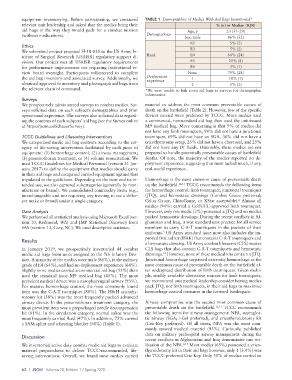
equipment inventorying. Before participating, we contacted   TABLE 1  Demographics of Medics With Aid Bags Inventoried*
          relevant unit leadership and asked that the medics bring their                  % (n) or Median (IQR)
          aid bags in the way they would pack for a combat mission            Age, y           23 (31–29)
          (without medications).                              Demographics   Sex, male         86% (32)
                                                                                E2              5% (2)
          Ethics
          We submitted project proposal H-18-035 to the US Army In-             E3              5% (2)
          stitute of Surgical Research (USAISR) regulatory support di-  Rank    E4             64% (24)
          vision. Our project met all USAISR regulatory requirements            E5             21% (8)
          for performance improvement not requiring institutional re-           E6              3% (1)
          view  board  oversight.  Participants  volunteered  to  complete     None            75% (28)
          the aid bag inventory and associated survey. Additionally, we   Deployment   1       18% (7)
          obtained approval to inventory and photograph aid bags from   experience  2           5% (2)
          the relevant chain of command.                     *We were unable to link seven aid bags to surveys for demographic
                                                             information.
          Surveys
          We prospectively administered surveys to combat medics. Sur-  materiel to address the most common preventable causes of
          veys solicited data on each subject’s demographics and prior   death on the battlefield (Table 2). However, few of the specific
          operational experience. The surveys also solicited data regard-  devices carried were preferred by TCCC. More medics used
          ing the contents of each subjects’ aid bag (see the Survey online   a commercial, nonstandard aid bag than used the unit- issued
          at https://jsom.us/SchauerSurvey).                 M9 medical bag. More concerning is that 9% of medics did
                                                             not have any limb tourniquets, 98% did not have a junctional
          TCCC Guidelines and Lifesaving Interventions       tourniquet, 69% did not have an SGA, 36% did not have a
          We categorized medic aid bag contents according to the cat-  cricothyrotomy setup, 25% did not have a chest seal, and 25%
          egory of life-saving intervention  facilitated by each piece of   did not have any IV fluids. Ostensibly, these medics are not
          equipment: (1) hemorrhage control; (2) airway management;   prepared to handle potentially preventable causes of battlefield
          (3) pneumothorax treatment, or (4) volume resuscitation. We   deaths. Of note, the majority of the medics reported no de-
          used TCCC Guidelines for Medical Personnel (version 31 Jan-  ployment experience, suggesting that most lacked much, if any,
          uary 2017) to define the equipment that medics should carry   real-world experience.
          in their aid bags and compared carried equipment against that
          stipulated in the guidelines. Depending on the item and its in-  Hemorrhage is the most common cause of preventable death
          tended use, we also captured subcategories (generally by man-  on the battlefield. 12,13  TCCC recommends the following items
          ufacturer or brand). We consolidated commodity items (e.g.,   for hemorrhage control: limb tourniquet, junctional tourniquet
          interchangeable and not requiring any training to use a differ-  (JTQ), and hemostatic dressings (Combat Gauze preferred;
          ent make or brand) under a single category.        Celox Gauze, ChitoGauze, or XStat acceptable).  Almost all
                                                                                                   2
                                                             medics (94%) carried a CoTCCC-approved limb tourniquet.
          Data Analysis                                      However, only one medic (2%) possessed a JTQ and no medics
          We performed all statistical analysis using Microsoft Excel (ver-  packed hemostatic dressings. During the recent conflicts in Af-
          sion 10, Redmond, WA) and JMP Statistical Discovery from   ghanistan and Iraq, it was standard unit practice for all service
          SAS (version 13, Cary, NC). We used descriptive statistics.  members to carry C-A-T tourniquets in the pockets of their
                                                             uniforms.  US Army standard issue now also includes the im-
                                                                    5
                                                             proved first aid kit (IFAK) that contains C-A-T tourniquets and
          Results
                                                             a hemostatic dressing. US Army combat lifesavers (CLS) receive
          In January 2019, we prospectively inventoried 44 combat   CLS bags that also contain C-A-T tourniquets and hemostatic
                                                                    14
          medic aid bags from units assigned to the 7th Infantry Divi-  dressings.  However, none of these medical kits contain a JTQ.
          sion. A majority of the medics were male (86%), in the military   Junctional hemorrhage surpassed extremity hemorrhage as the
          grade of E4 (64%), and had no deployment experience (64%).   most common cause of preventable death on the battlefield af-
          Slightly more medics carried a commercial aid bag (55%) than   ter widespread distribution of limb tourniquets. Given multi-
          used the standard issue M9 medical bag (45%). The most   ple, readily available alternative sources for limb tourniquets,
          prevalent medical device was a nasopharyngeal airway (93%).   we recommend unit medical leadership consider having medics
          For massive hemorrhage control, the most commonly found   pack JTQ, not limb tourniquets, in their aid bags to maximize
          item was the C-A-T tourniquet (88%). The H&H cricothy-  hemorrhage control measures in the forward battlespace.
          rotomy kit (38%) was the most frequently packed advanced
          airway device. In the pneumothorax treatment category, the   Airway compromise was the second most common cause of
          most prevalent item was a prepackaged needle decompression   preventable death on the battlefield. 12,13  TCCC recommends
          kit (81%). In the circulation category, normal saline was the   the following items for airway management: NPA, supraglot-
          most frequently carried fluid (47%). In addition, 75% carried   tic airway (SGA; i-Gel preferred), and cricothyroidotomy kit
          a SAM splint and a heating blanket (54%) (Table 1).  (Cric-Key preferred). Of all items, NPA was the most com-
                                                             monly stowed medical materiel (93%). Curiously, published
                                                             data on military prehospital airway management during the
          Discussion
                                                             recent conflicts in Afghanistan and Iraq demonstrate rare uti-
          We inventoried active duty combat medic aid bags to evaluate   lization of the NPA. 6,15  Most medics (65%) possessed a crico-
          materiel preparedness to deliver TCCC-recommended, life-   thyroidotomy kit in their aid bag; however, only 1 (3.4%) was
          saving interventions. Overall, we found most medics carried   the TCCC-preferred Cric-Key. Only 31% of medics carried an


          62  |  JSOM   Volume 20, Edition 1 / Spring 2020

