


Page 61 - JSOM Spring 2020
P. 61
standards were analyzed in duplicate. Linear regression was   Gas Chromatography–Mass Spectrometry (GC-MS)
              applied to obtain the calibration model. For ammonia, a sec-  We analyzed ethylene dibromide on a model 7890 B gas chro-
              ond-order polynomial was applied to obtain a more optimal   matograph and a model 5977A MSD mass spectrometer (Ag-
              fit compared with linear regression. In the case of fentanyl,    ilent). We used a VF-5MS (30m ✕ 250µm × 0.25µm, Agilent)
              we used weighted regression (1/Y ) to improve the fit of the   column with helium at 1mL/min as carrier gas. The injection
                                        2
              model at low concentration (see supplementary data at https://  volume was 1.0µL using a split-less injector at 250°C. The
              jsom.us/deKoningSupp.                              solvent was n-hexane. The temperature program was 40°C for
                                                                 2 minutes followed by an increase of 10°C/min to a final tem-
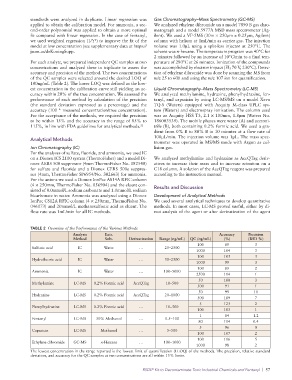
              For each analyte, we prepared independent QC samples at two   perature of 280°C at 26 minutes. Ionization of the compounds
              concentrations and analyzed these in triplicate to assess the   was accomplished by electron impact (EI; 70 V, 230°C). Detec-
              accuracy and precision of the method. The two concentrations   tion of ethylene dibromide was done by scanning the MS from
              of the QC samples were selected around the desired LOQ of   m/z 25 to 600 and using the m/z 107 ion for quantification.
              100ng/mL (Table 2). The lower LOQ was defined as the low-
              est concentration in the calibration curve still yielding an ac-  Liquid Chromatography–Mass Spectrometry (LC-MS)
              curacy within 20% of the true concentration. We assessed the   We analyzed methylamine, hydrazine, phenylhydrazine, fen-
              performance of each method by calculation of the precision   tanyl, and capsaicin by using LC-MS/MS on a model Xevo
              (the standard deviation expressed as a percentage) and the   TQ-S (Waters) equipped with Acquity M-class UPLC sys-
              accuracy (100 * measured concentration/true concentration).   tem (Waters) and electrospray ionization. The column used
              For the acceptance of the methods, we required the precision   was an Acquity HSS T3, 2.1 ✕ 100mm, 1.8µm (Waters No.
              to be within 15% and the accuracy in the range of 85% to   186003539). The mobile phases were water (A) and acetoni-
              115%, in line with FDA guidelines for analytical methods. 21  trile (B), both containing 0.2% formic acid. We used a gra-
                                                                 dient from 0% B to 80% B in 10 minutes at a flow rate of
                                                                 100µL/min. The injection volume was 1µL. The mass spec-
              Analytical Methods
                                                                 trometer was operated in MS/MS mode with Argon as col-
              Ion Chromatography (IC)                            lision gas.
              For the analyses of sulfate, fluoride, and ammonia, we used IC
              on a Dionex ICS 2100 system (ThermoFisher) and a model Di-  We analyzed methylamine and hydrazine as AccQTag deriv-
              onex AERS 500 suppressor (4mm ThermoFisher No. 082540)   atives to increase their mass and to increase retention on a
              for sulfate and fluoride and a Dionex CERS 500e suppres-  C18 column. A solution of the AccQTag reagent was prepared
              sor (4mm, ThermoFisher SP6954/No. 302663) for ammonia.    according to the instruction manual.
              For the anions we used a Dionex IonPac AS14A RFIC column
              (4 ✕ 250mm, ThermoFisher No. 056904) and the eluent con-  Results and Discussion
              sisted of 8.0mmol/L sodium carbonate and 1.0mmol/L sodium
              bicarbonate in water. Ammonia was analyzed using a Dionex   Development of Analytical Methods
              IonPac CS12A RFIC column (4 ✕ 250mm, ThermoFisher No.   We used several analytical techniques to develop quantitative
              046073) and 20mmol/L methanesulfonic acid as eluent. The   methods. In most cases, LC-MS proved useful, either by di-
              flow rate was 1mL/min for all IC methods.          rect analysis of the agent or after derivatization of the agent


              TABLE 2  Overview of the Performance of the Various Methods
                               Analysis     Extr.                                           Accuracy    Precision
                               Method       Solv.     Derivatization  Range (ng/mL)  QC (ng/mL)  (%)    (RSD %)
                                                                                   100        89          3
              Sulfuric acid      IC         Water          …         25–2500
                                                                                  1000       104          3
                                                                                   100       103          3
              Hydrofluoric acid  IC         Water          …         50–2500
                                                                                  1000        99          3
                                                                                   100        89          2
              Ammonia            IC         Water          …         100–5000
                                                                                  2500       114          1
                                                                                   50        100          3
              Methylamine       LC-MS   0.2% Formic acid  AccQTag    10–500
                                                                                   500        91          1
                                                                                   50         99          11
              Hydrazine         LC-MS   0.2% Formic acid  AccQTag    20–1000
                                                                                   500       109          7
                                                                                   5         123          2
              Phenylhydrazine   LC-MS   0.2% Formic acid   …         10–500
                                                                                   100       103          1
                                                                                   1          84          1.2
              Fentanyl          LC-MS    50% Methanol      …         0.5–100
                                                                                   80        114          0.4
                                                                                   5          96          0
              Capsaicin         LC-MS      Methanol        …          5–500
                                                                                   100       107          2
                                                                                   100       116          5
              Ethylene dibromide  GC-MS    n-Hexane        …         100–1000
                                                                                  1000        98          2
              The lowest concentration in the range reported is the lowest limit of quantification (LLOQ) of the methods. The precision, relative standard
              deviation, and accuracy for the QC samples at two concentrations are all within 15% limits.

                                                            RSDL  Kit to Decontaminate Toxic Industrial Chemicals and Fentanyl  |  57
                                                                ®

