


Page 59 - JSOM Spring 2020
P. 59
Decontamination of Toxic Industrial Chemicals and
                                    Fentanyl by Application of the RSDL  Kit
                                                                                    ®


                                                                                         3
                                    E. R. Verheij, PhD ; M. J. A. Joosen, PhD ; L. Cochrane ;
                                                                           2
                                                     4
                                      M. de Bruin-Hoegée, MSc ; M. C. de Koning, PhD   5*
                                                                1


              ABSTRACT
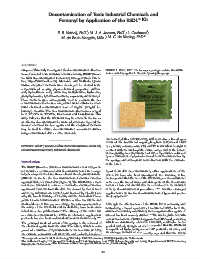
              Purpose: This study investigated the decontamination effective-  FIGURE 1  RSDL Kit . The tear-open package contains the RSDL
                                                                                ®
                                                       ®
              ness of selected toxic industrial chemicals using RSDL  (Reac-  lotion, which is applied to the skin by using the sponge.
              tive Skin Decontamination Lotion Kit; Emergent  BioSolutions
              Inc.; https://www.rsdl.com/). Materials and Methods: Quan-
              titative analytical methods were developed for dermal toxic
              compounds of varying physicochemical properties: sulfuric
              acid, hydrofluoric acid, ammonia, methylamine, hydrazine,
              phenylhydrazine, 1,2-dibromoethane, capsaicin, and fentanyl.
              These methods were subsequently used to evaluate the de-
              contamination effectiveness on painted metal substrates at an
              initial chemical contamination level of 10g/m  (0.1g/m  for
                                                          2
                                                  2
              fentanyl). Results: The decontamination effectiveness ranged
              from 97.79% to 99.99%.  Discussion and Conclusion: This
              study indicates that the RSDL kit may be amenable for use as
              an effective decontaminant for material substrates beyond the
              classical chemical warfare agents and the analytical methods
              may be used for future decontamination assessment studies
              using contaminated skin or other materials.
                                                                 monomethylether (MPEG-550), will neutralize a broad spec-
                                                                 trum of the traditional organophosphate (OP)-based CWA
              Keywords: RSDL ; Reactive Skin Decontamination Lotion Kit;   (i.e., tabun, soman, sarin, VX) and T2 toxin when brought in
                          ®
                                                                                                                2
              decontamination; toxic; industrial chemicals       contact with the nucleophilic oxime compound in the lotion.
                                                                 Consequently, decontamination of OP compounds is achieved
                                                                 by a combination of physical removal from the skin surface by
                                                                 the sponge, and subsequent neutralization with the oximates
              Introduction
                                                                 in the lotion.
                      ®
              The RSDL  (Reactive Skin Decontamination Lotion Kit) prod-
              uct includes a commercial skin decontamination lotion origi-  Apart from skin decontamination, other applications of the
              nally developed at Defence Research and Development Canada   RSDL kit have also been investigated. For instance, it has
              (DRDC)  to use for the decontamination of chemical warfare   been reported that the use of the RSDL kit provides additional
                    1
              agents (CWAs) on intact skin (Figure 1). The RSDL kit is a med-  value over the use of water and detergents in the decontami-
              ical device intended to remove or neutralize chemical warfare   nation of hair and should thus be considered to be included
              agents and T2-toxin from the skin. It is cleared by the US Food   in body decontamination procedures. 13–15  Another envisaged
              and Drug Administration (FDA) and licensed by Health Can-  application is its use for decontamination of (personal protec-
              ada, the Israeli Ministry of Health, and the Australian Thera-  tive) equipment. 8
              peutic Goods Administration. RSDL is a Class IIa CE marked
              medical device in Europe, accordingly. Various aspects, such as   Although the effectiveness of the RSDL kit in removing and
              the safety of the RSDL kit and its shelf-life, have been estab-  neutralizing a broad spectrum of traditional CWAs from the
              lished in earlier publications.  The efficacy of the RSDL kit   skin has been widely established, its use against other agents of
                                    2,3
                                                                                           16
              as a skin decontaminant for CWAs in relation to application   interest has been scarcely studied.  The nucleophilic detoxifi-
              protocols has also been evaluated and reviewed extensively. 4–12    cation mechanism of KBDO suggests that OP-based pesticides,
              The principal mode of action of the sponge is the removal of   which are structurally related to OP-CWA, could also be de-
                                                                                          17
              the chemical agents from the skin. The lotion, which is com-  graded. Indeed, Elsinghorst et al.  reported that the RSDL kit
              posed of a mixture of 2,3- butanedione mono-oxime (DAM),   is capable of hydrolyzing several OP pesticides in vitro, and
              its oximate potassium salt (KBDO), and polyethyleneglycol   in analogy, Fentabil et al.  recently reported that the RSDL
                                                                                     18
              *Correspondence to Dr M.C. de Koning, TNO dep. CBRN Protection, 2288GJ Rijswijk, the Netherlands.
                              2
                                      4
              1 Mrs de Bruin-Hoegée,  Dr Joosen,  Dr Verheij, and  Dr de Koning are from TNO Defense, Security and Safety, Department of CBRN Protection,
                                                 5
              Rijswijk, the Netherlands.  Mrs Cochrane is from Emergent BioSolutions Inc., Gaithersburg, MD.
                                3
                                                              55

