


Page 53 - JSOM Spring 2020
P. 53
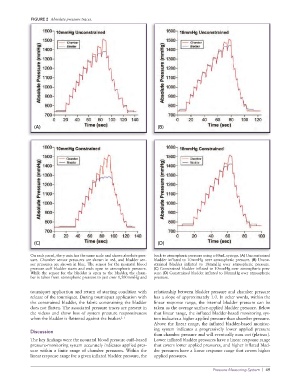
FIGURE 2  Absolute pressure traces.


               (A)                                                (B)


               (C)                                                (D)

              On each panel, the y-axis has the same scale and shows absolute pres-  back to atmospheric pressure using a 60mL syringe. (A) Unconstrained
              sure. Chamber sensor pressures are shown in red, and bladder sen-  bladder inflated to 10mmHg over atmospheric pressure. (B) Uncon-
              sor pressures are shown in blue. The sensor for the neonatal blood   strained bladder inflated to 18mmHg over atmospheric pressure.
              pressure cuff bladder starts and ends open to atmospheric pressure.   (C) Constrained bladder inflated to 10mmHg over atmospheric pres-
              While the sensor for the bladder is open to the bladder, the cham-  sure. (D) Constrained bladder inflated to 18mmHg over atmospheric
              ber is taken from atmospheric pressure to just over 1,500mmHg and   pressure.

              tourniquet application and return of starting condition with   relationship between bladder pressure and chamber pressure
              release of the tourniquet. During tourniquet application with   has a slope of approximately 1.0. In other words, within the
              the constrained bladder, the fabric constraining the bladder   linear response range, the internal bladder pressure can be
              does not flatten. The associated pressure traces are present in   taken as the average surface-applied bladder pressure. Below
              the videos and show loss of system pressure responsiveness   that linear range, the inflated bladder-based monitoring sys-
              when the bladder is flattened against the beaker. 2–5  tem indicates a higher applied pressure than chamber pressure.
                                                                 Above the linear range, the inflated bladder-based monitor-
                                                                 ing system indicates a progressively lower applied pressure
              Discussion
                                                                 than chamber pressure and will eventually max out (plateau).
              The key findings were the neonatal blood pressure cuff–based   Lower inflated bladder pressures have a linear response range
              pressure-monitoring system accurately indicates applied pres-  that covers lower applied pressures, and higher inflated blad-
              sure within a finite range of chamber pressures. Within the   der pressures have a linear response range that covers higher
              linear response range for a given inflated bladder pressure, the   applied pressures.

                                                                                         Pressure Measuring System  |  49

