


Page 48 - JSOM Spring 2020
P. 48
on trauma patients with data ranging from January 2007 to
          August 2017. 15–17  The US Army Institute of Surgical Research
          (USAISR) regulatory office reviewed protocols H-16-005 and
          H-17-020 and determined they were exempt from institutional
          review board oversight. We obtained only deidentified data.

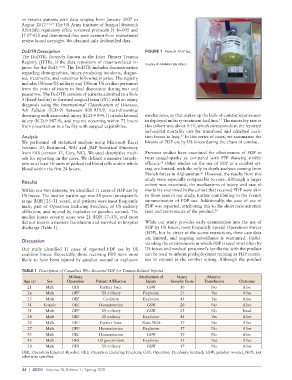
          DoDTR Description                                  FIGURE 1  French FDP kit.
          The DoDTR, formerly known as the Joint Theater Trauma
          Registry (JTTR), is the data repository of trauma-related in-  (Courtesy of USAMMDA Public Affairs.)
          juries for the DoD. 18-22  The DoDTR includes documentation
          regarding demographics, injury-producing incidents, diagno-
          ses, treatments, and outcomes following injuries. The registry
          includes US/non-US military and US/non-US civilian personnel
          from the point of injury to final disposition during war and
          peacetime. The DoDTR consists of patients admitted to a Role
          3 (fixed-facility) or forward surgical team (FST) with an injury
          diagnosis using the  International Classification of Diseases,
          9th Edition (ICD-9) between 800-959.9, near-drowning/
          drowning with associated injury (ICD-9 994.1) or inhalational   mechanisms, as that makes up the bulk of combat injuries seen
                                                                                            17
          injury (ICD-9 987.9), and trauma occurring within 72 hours   in deployed military treatment facilities.  The mortality rate in
          from presentation to a facility with surgical capabilities.  this cohort was about 1:11, which corresponds to the reported
                                                             in-hospital mortality rate for transfused and admitted coali-
                                                                            23
          Analysis                                           tion forces in Iraq.  In this series of cases, we summarize the
          We performed all statistical analysis using Microsoft Excel   history of FDP use by US forces during the chaos of combat.
          (version 10, Redmond, WA) and JMP Statistical Discovery
          from SAS (version 13, Cary, NC). We used descriptive meth-  Previous studies have examined the effectiveness of FDP to
          ods for reporting on the cases. We defined a massive transfu-  treat coagulopathy as compared with FFP showing similar
          sion as at least 10 units of packed red blood cells and/or whole   efficacy.  Other studies on the use of FDP in a combat set-
                                                                   24
          blood within the first 24 hours.                   ting are limited, with the only in depth analyses coming from
                                                             French forces in Afghanistan.  However, the results from this
                                                                                    25
                                                             study were especially comparable to ours. Although a larger
          Results
                                                             cohort was examined, the mechanisms of injury and rate of
          Within our two datasets, we identified 11 cases of FDP use by   mortality examined in the cohort that received FDP were akin
          US forces. The median patient age was 28 years (interquartile   to those seen in our study, further contributing to the French
          range [IQR] 25–31 years), and patients were most frequently   summarization of FDP use. Additionally, the ease of use of
          male, part of Operation Enduring Freedom, of US military   FDP was reported, attributing this to the short reconstitution
          affiliation, and injured by explosive or gunshot wound. The   time and convenience of the product. 26
          median injury severity score was 21 (IQR 17–33), and most
          did not receive a massive transfusion and survived to hospital   While our study provides early examination into the use of
          discharge (Table 1).                               FDP by US forces, most frequently Special Operations Forces
                                                             (SOF), but by virtue of the access restrictions, these case data
                                                             are limited, and ongoing surveillance is warranted. Under-
          Discussion
                                                             standing the environments in which FDP is used most often by
          Our study identified 11 cases of reported FDP use by US   US forces and medical personnel’s familiarity with the product
          coalition forces. Expectedly, those receiving FDP were most   can be used to inform predeployment training as FDP contin-
          likely to have been injured by gunshot wound or explosive   ues to expand in the combat setting. Although the product

          TABLE 1  Description of Casualties Who Received FDP for Trauma-Related Injuries
                             Military                      Mechanism of   Injury       Massive
           Age (y)  Sex      Operation   Patient Affiliation  Injury    Severity Score  Transfusion  Outcome
            21      Male       OIR        Partner force       GSW          10           No           Alive
            26      Male       OEF         US military      Explosive      21           Yes          Alive
            25      Male       OEF          Coalition       Explosive      45           Yes          Alive
            31     Female      OEF        Humanitarian        GSW          20           No           Alive
            31      Male       OEF         US military        GSW          25           No           Dead
            24      Male       OEF         US military      Explosive      45           Yes          Alive
            30      Male       OEF        Partner force     Blunt NOS      17           No           Alive
            27      Male       OEF        Humanitarian      Explosive      17           No           Alive
            45      Male       OEF        Humanitarian        GSW          30           No           Alive
            45      Male       OFS        US government     Explosive      33           Yes          Alive
            28      Male       OFS         US military        GSW          17           No           Alive
          OIR, Operation Inherent Resolve; OEF, Operation Enduring Freedom; OFS, Operation Freedom’s Sentinel; GSW, gunshot wound; NOS, not
          otherwise specified.


          44  |  JSOM   Volume 20, Edition 1 / Spring 2020

