


Page 137 - JSOM Spring 2020
P. 137
about their use of orthotics found that 73% of AT patients re-  body, thus providing localized NO secretions.  NO is a free
                                                                                                     87
              ported total or “great” improvement of symptoms with the or-  radical produced when nitric oxide synthases (NOS) catalyzes
              thotics.  A randomized controlled trial showed a reduction in   the conversion of l-arginine to l-citrulline. NO is toxic at high
                   78
              pain in runners wearing orthotics after 4 weeks compared to   dosages, but at lower dosages it appears to be involved in ten-
              a control group without orthotics.  However, these findings   don healing, in addition to effecting vasodilation, memory, and
                                         79
              may have been due to a placebo effect since both patients and   immune function. In rat models of uninjured Achilles tendons
              researchers knew which group wore orthotics. A more recent   there was little or no NOS activity, but after injury a 5-fold in-
              study  had participants use either a custom foot orthotic or a   crease in the conversion of l-arginine to l-citrulline was found
                  80
              sham orthotic that provided virtually no support. Participants   suggesting increased NOS activity. In injured human tendons,
              in both groups also followed the 12-week Alfredson eccentric   NOS expression was upregulated and isolated human teno-
              exercise protocol. In follow-ups at 1, 3, 6, and 12 months,   cytes exposure to NO increased collagen synthesis. 88
              there were no significant group differences on VISA-A scores
              (pain and function), participant perception of treatment effec-  Table 2 presents a summary of data from studies that have
              tiveness, or level of physical activity between the two groups.   evaluated the effectiveness of glyceryl trinitrate patches for
              Thus, the current data suggest that orthotics are not effective   reducing pain and improving function in patients with AT.
              in reducing pain and improving function in AT. 68  One study  was a long-term follow-up of an earlier study
                                                                         89
                                                                                                               90
                                                                 and is thus included in the row with the earlier study.  Data
                                                                                                           90
              Bracing                                            from most studies 88–90  indicated that when glyceryl trinitrate
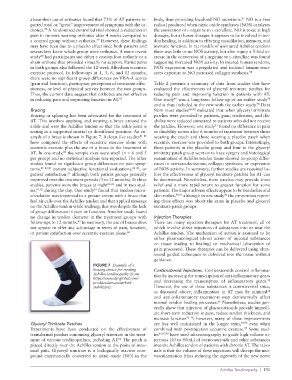
              Bracing or splinting has been advocated for the treatment of   patches were provided to patients, pain, tenderness, and dis-
              AT. This involves applying and wearing a brace around the   ability were reduced compared to patients who did not receive
              ankle and over the Achilles tendon so that the ankle joint is   the patches. However, one study  found no difference in pain
                                                                                          91
              resting in a supported neutral or dorsiflexed position. An ex-  or disability scores after 6 months of treatment between those
              ample of a brace is shown in Figure 7. At least five studies 81–85    wearing the patch and those wearing a placebo patch when
              have compared the effects  of eccentric exercise  alone with   eccentric exercise was provided to both groups. Interestingly,
              eccentric exercise plus the use of a brace in the treatment of   three patients in the placebo group and four in the glyceryl
              AT. In one study,  the sample sizes were small (n = 6 and 5   trinitrate patch group went on to have surgery and histological
                           84
              per group) and no statistical analysis was reported. The other   examination of Achilles tendon tissue showed no group differ-
              studies found no significant group differences on pain symp-  ences in neovascularization, collagen synthesis, or expression
              toms, 81–83,85  patient subjective functional evaluations, 81–83 , or   of NOS activity. In summary, further studies are required be-
              patient satisfaction,  although both patient groups generally   fore the effectiveness of glyceryl trinitrate patches for AT can
                             83
              improved over the treatment periods (3 to 12 months). In three   be determined. Nonetheless, these patches may provide some
              studies, patients wore the braces at night 83–85  and in two stud-  relief and a more rapid return to greater function for some
              ies, 81,82  during the day. One study  found that tendon micro-  patients. The major adverse effects appear to be headaches and
                                        81
              circulation was improved to a greater extent with a brace that   skin rashes, 90,91  although in one study  the proportion report-
                                                                                              90
              had air cells over the Achilles tendon and that applied massage   ing these effects was about the same in placebo and glyceryl
              on the Achilles tendon while walking; this was despite the lack   trinitrate patch groups.
              of group differences in pain or function. Another study found
              no change in tendon diameter in the treatment groups with   Injection Therapies
              follow-ups to 12 months.  In summary, the use of braces does   There  are  many injection  therapies for  AT  treatment,  all of
                                 82
              not appear to offer any advantage in terms of pain, function,   which involve direct injections of substances into or near the
              or patient satisfaction over eccentric exercise alone. 68  Achilles tendon. The mechanism of action is assumed to be
                                                                 either pharmacological (direct action of injected substances
                                                                 on tissue leading to healing) or mechanical (disruption of
                                                                 pain processes). These therapies can be delivered using ultra-
                                                                 sound guided techniques or delivered into the tissue without
                                                                 guidance.
                                        FIGURE 7  Example of a
                                        bracing device for treating   Corticosteroid Injections. Corticosteroids control inflamma-
                                        Achilles tendinopathy (from   tion by increasing the transcription of anti-inflammatory genes
                                        https://www.djoglobal.com/                                             92
                                        products/aircast/airheel-  and decreasing the transcription of inflammatory genes.
                                        stabilizers).            However, the use of these substances is controversial since,
                                                                 as discussed above, inflammation in AT may be minimal
                                                                                                               28
                                                                 and anti-inflammatory treatments may detrimentally affect
                                                                 normal tendon healing processes.  Nonetheless, studies gen-
                                                                                           66
                                                                 erally show that injection of glucocorticoids provide immedi-
                                                                 ate short-term reduction in pain, reduce tendon thickness, and
                                                                 increase function 93–96 ; however, many of these improvements
              Glyceryl Trinitrate Patches                        are less well maintained in the longer term, 93,96  even when
              Experiments  have been  conducted  on the effectiveness  of   combined with postinjection eccentric exercise.  Some stud-
                                                                                                      97
              transdermal patches containing glyceryl trinitrate in the treat-  ies 94,97,98  have used ultrasonography to guide high-volume in-
              ment of various tendinopathies, including AT.  The patch is   jections (50 to 90mL) of corticosteroids and other substances
                                                  86
              placed directly over the Achilles tendon at the point of max-  into the Achilles tendon of patients with chronic AT. The ratio-
              imal  pain.  Glyceryl  trinitrate  is  a  biologically  inactive  com-  nale is that the volume of these injections will disrupt the neo-
              pound enzymatically converted to nitric oxide (NO) in the   vascularization (thus reducing the ingrowth of the new nerve

                                                                                            Achilles Tendinopathy  |  131

