


Page 134 - JSOM Spring 2020
P. 134
use of oral contraceptives and/or hormone replacement ther-  if AT is not present) of each test. In both studies 48,49  ultrasound
          apy.  Oral contraceptives have been shown to decrease the   was used to identify a “true” AT case and the ultrasound crite-
             36
          rate of collagen synthesis, at least partly explaining the latter   ria were identical in both investigations. Note in Table 1 that
          association.  Biomechanically, prospective studies have found   the within-tester reproducibility (intratester kappa coefficient)
                   39
          risk factors include reduced or excessive ankle dorsiflexion   can differ considerably, as indicated by the results of the study
          range of motion, 7,40,41  less displacement of the center of force   conducted by Maffulli et al.,  which included three clinicians.
                                                                                   48
          during running, and a more laterally directed force distribution   This  suggests  that  clinicians  need  to  train  on  these  tests  as
          when the foot is flat during running.  At least two systematic   was done in the study of Hutchison et al.,  where generally
                                      42
                                                                                               49
          reviews have indicated that consumption of antibiotics in the   higher reproducibility was achieved. Table 1 suggests that on
          fluoroquinolone class substantially increases AT risk 43,44  with   the basis of accuracy and reproducibility, the morning stiff-
          one meta-analysis indicating a 4-fold risk increase (odds ratio   ness, self-reported pain, palpation, and tendon thickening tests
          = 3.95, 95% confidence interval (95% CI) = 3.11–5.01). 44  appear to be the most useful, although false positives were
                                                             high on the morning stiffness test, and there was considerable
          The DMED provides data that can be used to examine a lim-  variability between the two studies 48,49  on the sensitivity of the
          ited number of demographic factors that might be associated   palpation test.
          with AT in military personnel. To examine these potential
          risk factors DMED data on the incidence of AT (ICD-9 code   If the clinical evaluation is inconclusive imaging studies can
          726.71) was compiled by sex, age, race, and military service   be useful. Both ultrasound and magnetic resonance imaging
          for the years 2001 to 2015. Incidence was calculated using the   (MRI) have been used in this regard. Ultrasonography is read-
          entire population for each group (e.g., for women [new fe-  ily available and less expensive, but it is operator dependent,
          male cases (n)/female population (n) × 1000]). Figure 5 shows   provides only a two-dimensional image, and transducer han-
          the overall incidence by sex, age, race, and military service.   dling and machine settings can influence the images. MRI pro-
          Incidence was about 10% higher for women than men (Fig-  vides better images because the three-dimensional structure of
          ure 5A). Blacks had an incidence rate about 22% higher than   tendon can be acquired and there is better ability to visualize
          those of whites and others (Figure 5B). Incidence was high   soft tissue. Further, MRI can assist in differentiating between
          among the youngest age group (<20 years old), but lowest in   stages of the AT process and between paratenonitis and ten-
          the 20-24 yr olds and progressively rose in subsequent age   dinosis. 24,45,47  In head-to-head comparisons, MRI has proven
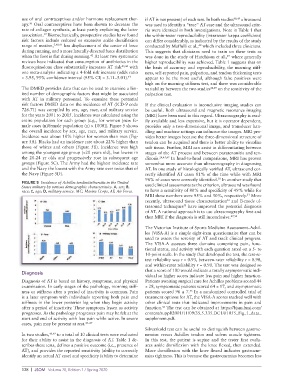
          groups (Figure 5C). The Army had the highest incidence rate   somewhat more accurate than ultrasonography in diagnosing
          and the Navy the lowest with the Army rate over twice that of   AT. In one study of histologically verified AT, ultrasound cor-
          the Navy (Figure 5D).                              rectly identified AT cases 81% of the time while with MRI
                                                             96% of cases were correctly identified.  In another study that
                                                                                           50
          FIGURE 5  Incidence of Achilles tendinitis/bursitis in the United   used clinical assessments as the criterion, ultrasound was found
          States military by various demographic characteristics. A, sex; B,
          race; C, age; D, military service. MC, Marine Corps, AF, Air Force.  to have a sensitivity of 80% and specificity of 49% while for
                                                             MRI these numbers were 95% and 50%, respectively.  More
                                                                                                       51
                                                             recently, ultrasound tissue characterization  and B-mode ul-
                                                                                               52
                                                             trasound techniques  have improved the potential diagnosis
                                                                             53
                                                             of AT. A rational approach is to use ultrasonography first and
                                                             then MRI if the diagnosis is still inconclusive. 47,54
                                                             The Victorian Institute of Sports Medicine Assessment–Achil-
                                                             les (VISA-A) is a simple eight-item questionnaire that can be
                                                             used to assess the severity of AT and track clinical progress.
                                                             The VISA-A assesses three domains comprising pain, func-
                                                             tional status, and activity with each question rated on a 5- to
                                                             10-point scale. In the study that developed the test, the test-re-
                                                             test reliability was r = 0.93, between-rater reliability r = 0.90,
                                                             and within-rater reliability r = 0.90. The test was designed so
                                                             that a score of 100 would indicate a totally asymptomatic indi-
          Diagnosis
                                                             vidual so higher scores indicate less pain and higher function.
          Diagnosis of AT is based on history, symptoms, and physical   Patients awaiting surgical care for Achilles problems scored 44
          examination. In early stages of the pathology, morning stiff-  ± 28, symptomatic patients scored 64 ± 17, and asymptomatic
          ness or stiffness after a period of inactivity is common. Pain   patients scored 96 ± 7.  In a randomized controlled trial of
                                                                               55
          is a later symptom with individuals reporting both pain and   treatment options for AT, the VISA-A scores tracked well with
          stiffness in the lower posterior leg when they begin activity   other clinical tests that indicated improvements in pain and
          after a period of inactivity. These symptoms lessen as activity   function.  The test can be obtained at https://bjsm.bmj.com/
                                                                    56
          progresses. As the pathology progresses pain may be felt at the   content/suppl/2001/11/09/35.5.335.DC1/01055_Fig_1_data_
          start and end of activity with less pain while active. In severe   supplement.pdf.
          cases, pain may be present at rest. 45–47
                                                             Silverskold test can be useful to distinguish between gastroc-
          In two studies, 48,49  to a total of 10 clinical tests were evaluated   nemius versus Achilles tendon and soleus muscle tightness.
          for their ability to assist in the diagnosis of AT. Table 1 de-  In this test, the patient is supine and the tester first evalu-
          scribes these tests, defines a positive outcome (i.e., presence of   ates ankle dorsiflexion with the knee flexed, then extended.
          AT), and provides the reported sensitivity (ability to correctly   More dorsiflexion with the knee flexed indicates gastrocne-
          identify an actual AT case) and specificity (ability to determine   mius tightness. This is because the gastrocnemius becomes less


          128  |  JSOM   Volume 20, Edition 1 / Spring 2020

