


Page 136 - JSOM Spring 2020
P. 136
many types of tendinopathies,  but studies on their pain-re-  average of 166 and 112 repetitions/day, respectively. Both
                                  60
          ducing effectiveness for AT are at best conflicting, 60,62–65  and   groups showed similar improvements on pain and function
          if an analgesic effect is achieved it may allow patients to ig-  scales (VISA-A and 0- to 100-point visual analog scale [VAS])
          nore symptoms and do more damage to the tendon.  Further,   at the end of treatment. This suggests that the as-tolerated
                                                  47
          NSAIDs have been shown to have detrimental effects on the   protocol results in similar improvements when compared to
          normal healing processes associated with AT, specifically by   the Alfredson protocol and thus the former may be preferable
          preventing restoration of extracellular matrix components and   since it is likely to increase patient compliance.
          interfering with cellular control of inflammatory and wound
          healing genes.  Even in cases where paratenonitis appears to   Another study  addressed the question of whether or not ac-
                                                                        56
                     66
          be contributing to AT and could perhaps provide an indication   tive AT patients could continue their normal activity while do-
          for use of NSAIDs, these concerns regarding effects of NSAIDs   ing the eccentric exercise protocol. Patients with ultrasound
          on normal healing processes for any coexisting tendon damage   verified AT were randomized into two groups. Both groups
          should be carefully considered before NSAIDs are prescribed.  performed a progressive Achilles tendon loading and strength-
                                                             ening program for 3 to 6 months that included eccentric and
          Eccentric Exercise Training                        concentric exercise (with increasing load and repetitions) and
          Eccentric exercise training is one of the more effective and   in later phases, plyometric training. However, one continued
          apparently safe treatment options for AT. Systematic reviews   with sport activities (e.g. running, jumping) while the other
          involving various conservative treatments for AT have gener-  group was restricted from these. The group that continued ac-
          ally shown that eccentric muscle training reduces pain and im-  tivity used a pain monitoring criterion such that if pain was
          proves function 67,68  and is superior to concentric exercise for   ≤5 (on a 10-point scale with 10 being the worst pain) they
          pain reduction.  The classic Alfredson eccentric exercise pro-  could continue activity. The investigators found there were
                      68
          tocol  is the one most often cited in the literature. The exercise   no significant differences between groups on pain or symp-
              69
          begins with the patient standing on their forefoot in full plan-  toms (VISA-A test) or clinical evaluations (hop test), and both
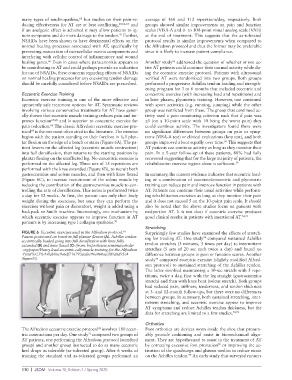
          tar flexion on the edge of a bench or stairs (Figure 6A). The pa-  groups improved about equally over time.  This suggests that
                                                                                              56
          tient lowers on the affected leg (eccentric muscle contraction)   AT patients can continue activity as long as they monitor their
          into full dorsiflexion, then returns to the starting position by   pain. In a 5-year follow-up of these patients, 80% had fully
          plantar flexing on the unaffected leg. No concentric exercise is   recovered suggesting that for the large majority of patients, the
          performed on the affected leg. Three sets of 15 repetitions are   rehabilitation exercise regime alone is sufficient. 59
          performed with the knee extended (Figure 6B), to recruit both
          gastrocnemius and soleus muscles, and then with knee flexed   In summary, the current evidence indicates that eccentric load-
          (Figure 6C), to increase recruitment of the soleus muscle by   ing or a combination of eccentric/concentric and plyometric
          reducing the contribution of the gastrocnemius muscle to con-  training can reduce pain and improve function in patients with
          trolling the rate of dorsiflexion. This series is performed twice   AT. Patients can continue their usual activities while perform-
          a day for 12 weeks. At first, the patient uses only their body   ing rehabilitation exercises as long as they monitor their pain
          weight during the exercises, but once they can perform the   and it does not exceed 5 on the 10-point pain scale. It should
          exercises without pain or discomfort, weight is added using a   also be noted that the above studies focus on patients with
          backpack or Smith machine. Interestingly, one mechanism by   midportion AT. It is not clear if eccentric exercise produces
          which eccentric exercise appears to improve function in AT   good clinical results in patients with insertional AT. 72,73
          patients is by increasing type I collagen synthesis. 70
                                                             Stretching
          FIGURE 6  Eccentric exercises used in the Alfredson protocol.    Surprisingly few studies have examined the effects of stretch-
                                                    69
          Patient positioned on bench in full plantar flexion (A). Achilles tendon   ing for treating AT. One study  compared sustained Achilles
                                                                                     74
          eccentrically loaded going into full dorsiflexion with knee fully   tendon stretches (3 minutes, 3 times per day) to intermittent
          extended (B) and knee flexed (C) (from: https://www.semanticscholar
          .org/paper/Heavy-load-eccentric-calf-muscle-training-for-the-Alfredson   stretches (5 sets of 20 sec each twice a day) and found no
          -Pietil%C3%A4/ab06c9e6df716793acdee96e060ea3f89a8d95c4   difference between groups in pain or function scores. Another
          /figure/0).                                        study  compared eccentric exercise (slightly modified Alfred-
                                                                 75
                                                             son protocol) to sustained stretching of the Achilles tendon.
                                                             The latter involved maintaining a 30-sec stretch with 5 repe-
                                                             titions, twice a day, first with the leg straight (gastrocnemius
                                                             stretch) and then with knee bent (soleus stretch). Both groups
                                                             had reduced pain, stiffness, tenderness, and tendon thickness
                                                             at 3- and 12-month follow-ups, but there were no differences
                                                             between groups. In summary, both sustained stretching, inter-
                                                             mittent stretching, and eccentric exercise appear to improve
                                                             AT symptoms and reduce Achilles tendon thickness, but the
                                                             data for stretching are limited to a few studies. 74,75

                                                             Orthotics
          The Alfredson eccentric exercise protocol  involves 180 eccen-  Foot orthotics are devices worn inside the shoe that presum-
                                          69
          tric contractions per day. One study  compared two groups of   ably provide cushioning and assist in biomechanical align-
                                      71
          AT patients, one performing the Alfredson protocol (standard   ment. They are hypothesized to assist in the treatment of AT
          group) and another group instructed to do as many eccentric   by correcting excessive foot pronation  or improving the ac-
                                                                                           76
          heel drops as tolerable (as-tolerated group). After 6 weeks of   tivation of the quadriceps and gluteus medius to reduce strain
          training the standard and as-tolerated groups performed an   on the Achilles tendon.  An early study that surveyed runners
                                                                               77
          130  |  JSOM   Volume 20, Edition 1 / Spring 2020

