


Page 133 - JSOM Spring 2020
P. 133
simplicity and convenience this continuum can be conceptual-  with increased vascularity may not be painful and tendons
              ized in three main stages as shown in Figure 3. The first stage   without increased vascularity  may be  painful,  but  there is
                                                                                                     32
              is called reactive tendinopathy, which is an adaptive response   generally a higher degree of pain in pathological tendons with
              from an acute overload such as a sudden increase in activity.   increased vascularity. 33
              In this stage, tenocytes proliferate and increase their protein
              production thickening the portion of the tendon under load   Epidemiology
              to better tolerate the stress. A 2- to 3-fold increase in collagen
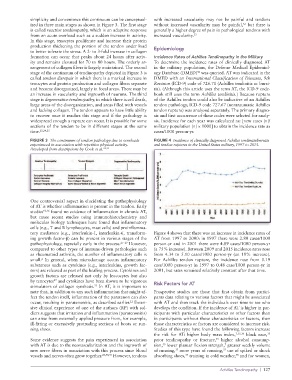
              formation can occur that peaks about 24 hours after activ-  Incidence Rates of Achilles Tendinopathy in the Military
              ity and remains elevated for 70 to 80 hours. The orderly ar-  To  determine  the  incidence  rates  of  clinically  diagnosed  AT
              rangement of collagen fibers is largely maintained. The second   in the military population, the Defense Medical Epidemiol-
              stage of the continuum of tendinopathy depicted in Figure 3 is   ogy Database (DMED)  was queried. AT was indicated in the
                                                                                  34
              called tendon disrepair in which there is a marked increase in   DMED with an International Classification of Diseases, 9th
              tenocytes and protein production and collagen fibers separate   Revision (ICD-9) code of 726.71 (Achilles tendinitis or bursi-
              and become disorganized, largely in focal areas. There may be   tis). (Although this article uses the term AT, the ICD-9 code-
              an increase in vascularity and ingrowth of neurons. The third   book still uses the term Achilles tendinitis.) Because rupture
              stage is degenerative tendinopathy, in which there is cell death,   of the Achilles tendon could also be indicative of an Achilles
              large areas of the disorganization, and areas filled with vessels   tendon pathology, ICD-9 code 727.67 (nontraumatic Achilles
              and lacking collagen. The tendon appears to have little ability   tendon rupture) was analyzed separately. The primary diagno-
              to recover once it reaches this stage and if the pathology is   sis and first occurrence of these codes were selected for analy-
              widespread enough a rupture can occur. It is possible for some   sis. Incidence for each year was calculated as: [new cases (n)/
              sections  of  the  tendon to  be  in different  stages  at  the  same   military population (n) × 1000] to obtain the incidence rate as
              time. 22,24,25                                     cases/1000 person-yr.

              FIGURE 3  The continuum of tendon pathology due to overloads   FIGURE 4  Incidence of clinically diagnosed Achilles tendinitis/bursitis
              experienced in association with repetitive physical activity.   and tendon ruptures in the United States military, 1997 to 2015.
              Developed from descriptions by Cook et al. 24,25


              One controversial aspect in elucidating the pathophysiology
              of AT is whether inflammation is present in the tendon. Early
              studies 10,26  found no evidence of inflammation in chronic AT,
              but more recent studies using immunohistochemistry and
              molecular biology techniques have found that inflammatory
              cells (e.g., T and B lymphocytes, mast cells) and proinflamma-
              tory mediators (e.g., interleukin-1, interleukin-6, transform-  Figure 4 shows that there was an increase in incidence rates of
              ing growth factor-β) can be present in various stages of the   AT from 1997 to 2000: in 1997 there were 2.80 cases/1000
              pathophysiology, especially early in the process. 27–29  However,   person-yr and in 2001 there were 4.89 cases/1000 person-yr
              compared to other types of immune-driven pathologies such   (a 75% increase). Between 2009 and 2015 incidence rates rose
              as rheumatoid arthritis, the number of inflammatory cells is   from 4.34 to 5.10 cases/1000 person-yr (an 18% increase).
              small.  In general, when microdamage occurs inflammatory   For  Achilles  tendon  rupture,  the  incidence  rose  from  0.19
                  2
              substances such as cytokines (e.g., interleukins, growth fac-  case/1000 person-yr in 1997 to 0.48 case/1000 person-yr in
              tors) are released as part of the healing process. Cytokines and   2001, but rates remained relatively constant after that time.
              growth factors are released not only by leucocytes but also
              by tenocytes  and cytokines have been shown to be vigorous   Risk Factors for AT
                       27
              stimulators of collagen synthesis.  In AT, it is important to
                                        22
              note that, in addition to any such inflammation that might af-  Prospective studies are those that first obtain from partici-
              fect the tendon itself, inflammation of the paratenon can also   pants data relating to various factors that might be associated
              occur, resulting in paratenonitis, as described earlier.  Exten-  with AT and then track the individuals over time to see who
                                                       12
              sive clinical experience of one of the authors (RP) with sol-  develops the condition. If the incidence of AT is higher in par-
              diers suggests that irritation and inflammation (paratenonitis)   ticipants with particular characteristics or other factors than
              can arise from externally applied pressure from, for example,   in participants without those characteristics or factors, then
              ill-fitting or excessively protruding sections of boots or run-  those characteristics or factors are considered to increase risk.
              ning shoes.                                        Studies of this type have found the following factors increase
                                                                 the risk for AT: higher body mass index, 7,35,36  black race,
                                                                                                               35
              Some evidence suggests the pain experienced in association   prior tendinopathy or fracture,  higher alcohol consump-
                                                                                          35
              with AT is due to the neovascularization and the ingrowth of   tion,  lower plantar flexion strength,  greater weekly volume
                                                                    35
                                                                                              7
              new nerve fibers in association with this process since blood   of running,  more years of running,  use of spiked or shock
                                                                         37
                                                                                             37
              vessels and nerves often grow together. 28,30,31  However, tendons   absorbing shoes,  training in cold weather,  and for women,
                                                                              37
                                                                                                  38
                                                                                            Achilles Tendinopathy  |  127

