


Page 135 - JSOM Spring 2020
P. 135
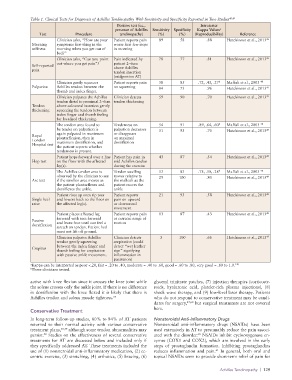
Table 1. Clinical Tests for Diagnosis of Achilles Tendinopathy With Sensitivity and Specificity Reported in Two Studies 48,49
                                                 Positive test (i.e.,               Intratester
                                                presence of Achilles  Sensitivity  Specificity  Kappa Values a
                 Test           Procedure         tendinopathy)   (%)      (%)   (Reproducibility)  Reference
                        Clinician asks, “How are your   Patient reports pain   89  58  .88     Hutchinson et al., 2013 49
              Morning   symptoms first thing in the   worse first few steps
              stiffness  morning when you get out of   in morning
                        bed?”
                        Clinician asks, “Can you point   Pain indicated by   78  77   .81      Hutchinson et al., 2013 49
                        out where you get pain”?  patient 2–6cm
              Self-reported
              pain                              above Achilles
                                                tendon insertion
                                                (midportion AT)
                        Clinician gently squeezes   Patient reports pain   58  85  .72, .43, .27 b  Maffuli et al., 2003  48
              Palpation  Achilles tendon between the   on squeezing  84    73         .96      Hutchinson et al., 2013 49
                        thumb and index finger.
                        Clinician palpates the Achilles   Clinician detects   59  90  .70      Hutchinson et al., 2013 49
                        tendon distal to proximal 2–6cm  tendon thickening
              Tendon    above calcaneal insertion gently
              thickening  squeezing the tendon between
                        index finger and thumb feeling
                        for localized thickening.
                        The tendon area found to   Tenderness on   54      91      .89, .64, .60 b  Maffuli et al., 2003  48
                        be tender on palpation is   palpation decreases   51  93      .70      Hutchinson et al., 2013 49
                        again palpated in maximum   or disappears
              Royal     plantarflexion, then in   on maximal
              London    maximum dorsiflexion, and   dorsiflexion
              Hospital test
                        the patient reports whether
                        tenderness is present.
                        Patient hops forward over a line  Patient has pain in   43  87  .54    Hutchinson et al., 2013 49
              Hop test  on the floor with the affected   mid Achilles tendon
                        leg(s).                 during the exercise
                        The Achilles tendon area is   Tendon swelling   53  83     .75, .50, .28 b  Maffuli et al., 2003  48
                        observed by the clinician to see   moves relative to   25  100  .80    Hutchinson et al., 2013 49
              Arc test  if the swollen area moves as   the malleoli as the
                        the patient plantarflexes and   patient moves the
                        dorsiflexes the ankle.  ankle
                        Patient rises up onto tip toes   Patient reports   21  93     .58      Hutchinson et al., 2013 49
              Single heel   and lowers back to the floor on  pain on upward
              raise     the affected leg(s).    or downward
                                                movement
                        Patient places affected leg   Patient reports pain   13  87   .43      Hutchinson et al., 2013 49
                        forward with toes forward   at extreme range of
              Passive
              dorsiflexion  and leans foot until can feel a   motion
                        stretch on tendon. Patient heel
                        must not lift off ground.
                        Clinician palpates Achilles   Clinician detects   3  100      .66      Hutchinson et al., 2013 49
                        tendon gently squeezing   crepitation (could
                        between the index finger and   detect “wet leather
              Crepitus
                        thumb feeling for crepitation   sign” signifying
                        with passive ankle movement.  inflammation in
                                                paratenon)
              a Kappa can be interpreted as poor <.20, fair = .20 to .40, moderate = .40 to .60, good = .60 to .80, very good = .80 to 1.0. 148
              b Three clinicians tested.

              active with knee flexion since it crosses the knee joint while   glyceryl trinitrate patches, (7) injection therapies (corticoste-
              the soleus crosses only the ankle joint. If there is no difference   roids, hyaluronic acid, platelet-rich plasma injections), (8)
              in dorsiflexion with the knee flexed it is likely that there is   shock wave therapy, and (9) low-level laser therapy. Patients
              Achilles tendon and soleus muscle tightness. 57    who do not respond to conservative treatment may be candi-
                                                                 dates for surgery, 47,60  but surgical treatments are not covered
                                                                 here.
              Conservative Treatment
              In long-term follow-up studies, 80% to 84% of AT patients   Nonsteroidal Anti-Inflammatory Drugs
              returned to their normal activity with various conservative   Nonsteroidal  anti-inflammatory  drugs (NSAIDs)  have  been
              treatment plans, 58,59  although some tendon abnormalities may   used extensively in AT to presumably reduce the pain associ-
                   58
                                                                                   60
              persist.  Studies on the effectiveness of several conservative   ated with the disorder.  NSAIDs inhibit cyclooxygenase en-
              treatments for AT are discussed below and included only if   zymes (COX1 and COX2), which are involved in the early
              they specifically addressed AT. These treatments included the   steps of prostaglandin formation. Inhibiting prostaglandins
                                                                                          61
              use of (1) nonsteroidal anti-inflammatory medication, (2) ec-  reduces  inflammation  and  pain.   In  general,  both  oral  and
              centric exercise, (3) stretching, (4) orthotics, (5) bracing, (6)   topical NSAIDs seem to provide short-term relief of pain for
                                                                                            Achilles Tendinopathy  |  129

