


Page 132 - JSOM Spring 2020
P. 132
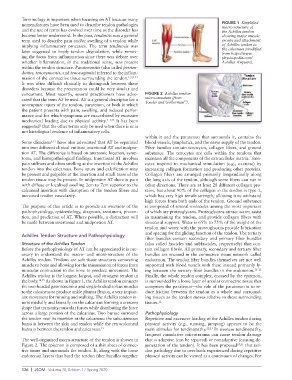
Terminology is important when focusing on AT because many
          nomenclatures have been used to describe tendon pathologies                        FIGURE 1  Simplified
          and the use of terms has evolved over time as the disorder has                     macro-structure of
                                                                                             the Achilles tendon
          become better understood. In the past, tendinitis was a general                    showing major muscle
          term used to describe pain and/or swelling of a tendon while                       groups and attachment
          implying inflammatory processes.  The term  tendinosis  was                        of Achilles tendon to
          later suggested to imply tendon degradation, while remov-                          the calcaneus (modified
                                                                                             from https://www.
          ing the focus from inflammation since there was debate over                        physio-pedia.com/
          whether inflammation, in the traditional sense, was present                        Achilles_Rupture).
          within the tendon structure. Paratenonitis (also called periten-
          dinitis, tenosynovitis, and tenovaginitis) referred to the inflam-
          mation of the connective tissue surrounding the tendon. 1,2,9–11
          It was often difficult clinically to distinguish between these
          disorders because the presentation could be very similar and
          concurrent. Most recently, several practitioners have advo-  FIGURE 2  Achilles tendon
          cated that the term AT be used. AT is a general descriptor for a   micro-structure (from   17
          nonrupture injury of the tendon, paratenon, or both in which   Towler and Gelberman ).
          the patient presents with pain, swelling, and reduced perfor-
          mance and for which symptoms are exacerbated by excessive
          mechanical  loading due  to  physical activity. 1–3,12   It has  been
          suggested  that the other terms only be used when there is or is
                 1
          not histological evidence of inflammatory cells.
                                                             within it and the paratenon that surrounds it, contains the
          Some clinicians 3,13  have also advocated that AT be separated   blood vessels, lymphatics, and the nerve supply of the tendon.
          into two different clinical entities: insertional AT and midpor-  Fiber bundles contain tenocytes, collagen fibers, and ground
          tion AT. The difference is based on anatomic location, symp-  substance. The tenocytes are cells within the tendons that
          toms, and histopathological findings. Insertional AT involves   maintain all the components of the extracellular matrix. Teno-
          pain stiffness and often swelling at the insertion of the Achilles   cytes respond to mechanical stimulation (e.g., exercise) by
          tendon into the calcaneus. Bone spurs and calcification may   increasing collagen formation and producing other proteins.
          be present and palpable at the insertion and small tears of the   Collagen fibers are arranged primarily longitudinally along
          tendon tissue may be present. In midportion AT there is pain   the long axis of the tendon, although some fibers can run in
          with diffuse or localized swelling 2cm to 7cm superior to the   other directions. There are at least 28 different collagen pro-
          calcaneal insertion with disruption of the tendon fibers and   teins, but about 90% of the collagen in the tendon is type 1,
          increased tendon vascularity.                      which has very high tensile strength, allowing it to withstand
                                                             high forces from both ends of the tendon. Ground substance
          The purpose of this article is to provide an overview of the   is composed of several molecules among the most important
          pathophysiology, epidemiology, diagnosis, treatment, preven-  of which are proteoglycans. Proteoglycans attract water, assist
          tion, and prediction of AT. Where possible, a distinction will   in maintaining the tendon, and provide collagen fibers with
          be made between insertional and midportion AT.     structural support. Water is 65% to 75% of the weight of the
                                                             tendon and water with the proteoglycans provide lubrication
          Achilles Tendon Structure and Pathophysiology      and spacing for the gliding function of the tendon. The tertiary
                                                             fiber bundles contain secondary and primary fiber bundles
          Structure of the Achilles Tendon                   (also called fascicles and subfascicles, respectively) that con-
          Before the pathophysiology of AT can be appreciated it is nec-  tain collagen fibrils. All primary, secondary and tertiary fiber
          essary to understand the macro- and micro-structure of the   bundles are encased in the connective tissue network called
          Achilles tendon. Tendons are soft tissue structures connecting   endotenon. The tendon fiber bundles themselves are not well
          muscle to bone and allowing for the transmission of forces from   supported with blood vessels with these instead primarily ly-
          muscular contraction to the bone to produce movement. The   ing between the tertiary fiber bundles in the endotenon. 16–21
          Achilles tendon is the longest, largest, and strongest tendon in   Finally, the whole tendon complex, encased by the epitenon,
          the body. 14,15  As shown in Figure 1, the Achilles tendon connects   is surrounded by a loose layer of areolar connective tissue that
          the two-headed gastrocnemius and single-bodied soleus muscles   comprises the paratenon—the role of the paratenon is to re-
          to the calcaneus to produce ankle plantar flexion, a very import-  duce friction between the tendon as a whole and surround-
          ant movement for running and walking. The Achilles tendon in-  ing tissues as the tendon moves relative to these surrounding
          serts medially and laterally on the calcaneus forming a crescent   tissues. 12
          shape that transmits muscular forces while distributing the force
          across a large portion of the calcaneus. Two bursae surround   Pathophysiology
          the tendon near its insertion at the calcaneus: the subcutaneous   Repetitive and excessive loading of the Achilles tendon during
          bursa is between the skin and tendon while the retrocalcaneal   physical activity (e.g., running, jumping) appears to be the
          bursa is between the tendon and calcaneus. 15      main stimulus for tendinopathy. 22,23  In overuse tendinopathy,
                                                             frequent cumulative microtrauma can cause tendon damage
          The well-organized micro-structure of the tendon is shown in   that is adaptive (can be repaired) or nonadaptive (causing de-
          Figure 2. The epitenon is composed of a thin sheet of connec-  generation of the tendon). It has been proposed 24,25  that ten-
          tive tissue and surrounds the tendon. It, along with the loose   don pathology due to overloads experienced during repetitive
          endotenon layers that bind the tendon fiber bundles together   physical activity can be viewed as a continuum of changes. For


          126  |  JSOM   Volume 20, Edition 1 / Spring 2020

