


Page 127 - JSOM Spring 2020
P. 127
typhus may also occur with a nonspecific febrile presentation,
              mild systemic symptoms and without an obvious primary le-
              sion. Other infections which may cause similar symptoms in-
              cluding a black crusted lesion, such as rickettsial spotted fevers
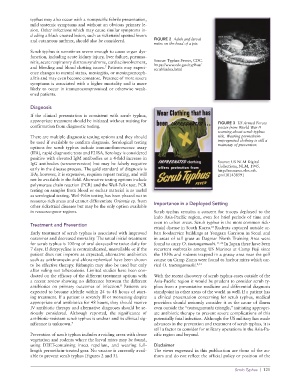
              and cutaneous anthrax, should also be considered.  FIGURE 2  Adult and larval
                                                                 mites on the head of a pin.
              Scrub typhus is sometimes severe enough to cause organ dys-
              function, including acute kidney injury, liver failure, pneumo-
              nitis, acute respiratory distress syndrome, cardiac involvement,   Source: Typhus Fevers, CDC.
              and bleeding and blood clotting issues.  Patients may experi-  https://www.cdc.gov/typhus/
                                            7
                                                                 scrub/index.html
              ence changes to mental status, meningitis, or meningoenceph-
              alitis and may even become comatose. Presence of more severe
              symptoms is associated with a higher mortality and is more
              likely  to occur  in immunocompromised or  otherwise  weak-
              ened patients.

              Diagnosis
              If the clinical presentation is consistent with scrub typhus,
              appropriate treatment should be initiated without waiting for
              confirmation from diagnostic testing.                                        FIGURE 3  US Armed Forces
                                                                                           poster from World War II
                                                                                           warning about scrub typhus
              There are multiple diagnostic testing options and they should                risk. Wearing permethrin-
              be used if available to confirm diagnosis. Serological testing               impregnated clothing is still a
              options for scrub typhus include immunofluorescence assay                    mainstay of prevention.
              (IFA), rapid diagnostic tests and ELISA. Serology is considered
              positive with elevated IgM antibodies or a 4-fold increase in
              IgG antibodies (seroconversion) but may be falsely negative                  Source: US NLM Digital
              early in the disease process. The gold standard of diagnosis is              Collections, NLM, 1945.
                                                                                           http://resource.nlm.nih.
              IFA; however, it is expensive, requires repeat testing, and will             gov/101438591
              not be available in the field. Alternative testing options include
              polymerase chain reaction (PCR) and the Weil-Felix test. PCR
              testing on samples from blood or eschar material is as useful
              as serological testing. Weil-Felix testing has been phased out in
              resource-rich areas and cannot differentiate Orientia sp. from
              other rickettsial diseases but may be the only option available   Importance in a Deployed Setting
              in resource-poor regions.                          Scrub typhus remains a concern for troops deployed to the
                                                                 Indo Asia-Pacific region, even for brief periods of time and
              Treatment and Prevention                           even to urban areas. Scrub typhus is the most common rick-
                                                                                        10
                                                                 ettsial disease in South Korea. Rodents captured outside ur-
              Early treatment of scrub typhus is associated with improved   ban foodservice buildings at Yongsan Garrison in Seoul and
              outcomes and decreased mortality. The usual initial treatment   in areas of tall grass at Dagmar North Training Area were
              for scrub typhus is 100mg of oral doxycycline twice daily for   found to carry O. tsutsugamushi.  11,12  In Japan there have been
              7 days. If doxycycline is contraindicated, unavailable or if the   recurrent outbreaks among US Marines at Camp Fuji since
              patient does not improve as expected, alternative antibiotics   the 1930s and rodents trapped in a grassy area near the golf
              such as azithromycin and chloramphenicol have been shown   course on Camp Zama were found to harbor mites which car-
              to be effective therapy. Rifampin may also be used but only   ried O. tsutsugamushi. 9,13
              after ruling out tuberculosis. Limited studies have been con-
              ducted on the efficacy of the different treatment options with   With the recent discovery of scrub typhus cases outside of the
              a recent review showing no difference between the different   Asia-Pacific region it would be prudent to consider scrub ty-
              antibiotics on primary outcomes of infection.  Patients are   phus from a preventative medicine and differential diagnosis
                                                   8
              expected to become afebrile within 24 to 48 hours of start-  standpoint in other areas of the world as well. If a patient has
              ing treatment. If a patient is severely ill or worsening despite   a clinical presentation concerning for scrub typhus, medical
              appropriate oral antibiotics for 48 hours, they should receive   providers should seriously consider it as the cause of illness
              IV antibiotic therapy and alternative diagnoses should be se-  even outside the “tsutsugamushi triangle,” initiating appropri-
              riously considered. Although reported, the significance of   ate antibiotic therapy to prevent severe complications of this
              antibiotic-resistant scrub typhus is unclear and its clinical sig-  potentially fatal infection. Although the US military has made
              nificance is unknown. 9                            advances in the prevention and treatment of scrub typhus, it is
                                                                 still a factor to consider for military operations in the Asia-Pa-
              Prevention of scrub typhus includes avoiding areas with dense   cific region and beyond.
              vegetation and rodents where the larval mites may be found,
              using DEET-containing insect repellant, and wearing full-  Disclaimer
              length permethrin-treated gear. No vaccine is currently avail-  The views expressed in this publication are those of the au-
              able to prevent scrub typhus (Figures 2 and 3).    thors and do not reflect the official policy or position of the

                                                                                                  Scrub Typhus  |  121

