


Page 126 - JSOM Spring 2020
P. 126
An Ongoing Series


                                                   Scrub Typhus


                                    Elena M. Crecelius, MD *; Mark W. Burnett, MD 2
                                                           1


          ABSTRACT
          Scrub typhus, also known as tsutsugamushi disease, is caused   due to the availability of effective antibiotic treatment. Even
                                                                                                       3,4
          by Orientia sp. and approximately 1 million new cases are re-  in more recent times, outbreaks have occurred in US military
                                                                                                5
          ported annually. This article discusses the importance of scrub   personnel serving in the Asia-Pacific region.  Scrub typhus is
          typhus and its clinical presentation, diagnosis, treatment, and   considered among the top 20 infectious diseases of signifi-
          prevention.                                        cance to the US military. 6
          Keywords: tsutsugamushi disease; scrub typhus; Orientia sp.;   Clinical Presentation
          illness, febrile
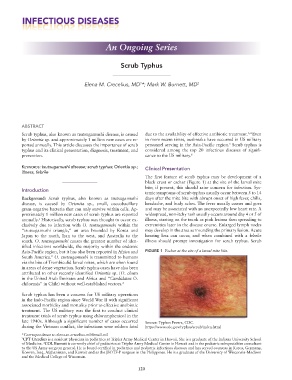
                                                             The first feature of scrub typhus may be development of a
                                                             black crust or eschar (Figure 1) at the site of the larval mite
                                                             bite; if present, this should raise concern for infection. Sys-
          Introduction
                                                             temic symptoms of scrub typhus usually occur between 5 to 14
          Background:  Scrub typhus, also known as tsutsugamushi   days after the mite bite with abrupt onset of high fever, chills,
          disease, is caused by  Orientia sp., small, coccobacillary   headache, and body aches. The fever usually comes and goes
          gram-negative bacteria that can only survive within cells. Ap-  and may be associated with an unexpectedly low heart rate. A
          proximately 1 million new cases of scrub typhus are reported   widespread, non-itchy rash usually occurs around day 4 or 5 of
          annually.  Historically, scrub typhus was thought to occur ex-  illness, starting on the trunk as pink lesions then spreading to
                 1
          clusively due to infection with O. tsutsugamushi within the   extremities later in the disease course. Enlarged lymph nodes
          “tsutsugamushi triangle,” an area bounded by Korea and   may develop in the area surrounding the primary lesion. Acute
            Japan to the north, Iran to the west, and Australia to the   hearing loss can occur, and when combined with a febrile
          south. O. tsutsugamushi causes the greatest number of iden-  illness should prompt investigation for scrub typhus. Scrub
          tified infections worldwide, the majority within the endemic
          Asia- Pacific region, but it has also been reported in Africa and   FIGURE 1  Eschar at the site of a larval mite bite.
          South America.  O. tsutsugamushi is transmitted to humans
                      2
          via the bite of Trombiculid larval mites, which are often found
          in areas of dense vegetation. Scrub typhus cases have also been
          attributed to other recently identified Orientia sp. (O. chuto
          in the United Arab Emirates and Africa and “Candidatus O.
          chiloensis” in Chile) without well-established vectors. 2

          Scrub typhus has been a concern for US military operations
          in the Indo-Pacific region since World War II with significant
          associated morbidity and mortality prior to effective antibiotic
          treatment. The US military was the first to conduct clinical
          treatment trials of scrub typhus using chloramphenicol in the
          late 1940s. Although a significant number of cases occurred   Source: Typhus Fevers, CDC.
          during the Vietnam conflict, the infections were seldom fatal   https://www.cdc.gov/typhus/scrub/index.html

          *Correspondence to elena.m.crecelius.mil@mail.mil
          1 CPT Crecelius is a resident physician in pediatrics at Tripler Army Medical Center in Hawaii. She is a graduate of the Indiana University School
                   2
          of Medicine.  COL Burnett is currently chief of pediatrics at Tripler Army Medical Center in Hawaii and is the pediatric subspecialties consultant
          to the US Army surgeon general. He is board certified in pediatrics and pediatric infectious diseases and has served overseas in Korea, Germany,
          Kosovo, Iraq, Afghanistan, and Kuwait and as the JSOTF-P surgeon in the Philippines. He is a graduate of the University of Wisconsin-Madison
          and the Medical College of Wisconsin.
                                                          120

