


Page 123 - JSOM Spring 2020
P. 123
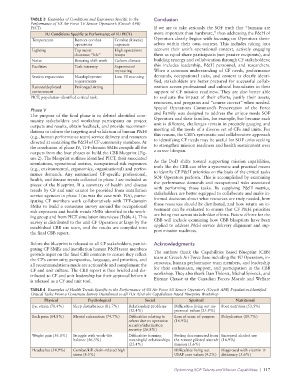
TABLE 3  Examples of Conditions and Exposures Specific to the   Conclusion
              Performance of US Air Force 1U Sensor Operator’s (Creech AFB)
              PICTs                                              If we are to take seriously the SOF truth that “humans are
                    1U Conditions Specific to Performance of 1U PICTs  more important than hardware,” then addressing the P&H of
              Temperature       Remote combat   Combat (kinetic)   Operators clearly begins with focusing on Operators them-
                                operations      exposure         selves within their own context. This includes taking into
              Lighting          Top secret      High operations   account their unit’s operational context, actively engaging
                                clearance “life”  tempo          them as equal-share participants (not passive recipients), and
              Noise             Rotating shift work  Culture climate  building synergy and collaboration through CF stakeholders;
              Facilities        Task intensity  Supervision/     this includes leadership, P&H personnel, and researchers.
                                                mentoring        When a common understanding of CF needs, performance
              Station ergonomics  Nondeployment   Low 1U manning   demands, occupational risks,  and context is  clearly identi-
                                requirements                     fied, stakeholders are better prepared for successful collab-
              Remote/deployed   Prolonged sitting                oration across professional and cultural boundaries in their
              environment                                        support of CF mission readiness. They are also better able
              PICT, population-identified critical task.         to evaluate the impact of their efforts, justify their assets,
                                                                 resources, and programs and “course correct” when needed.
                                                                 Special Operations Command’s Preservation of the Force
              Phase V
              The purpose of the final phase is to debrief identified com-  and Family was designed to address the unique needs SOF
              munity stakeholders and workshop participants on project   Operators and their families, for example, but because each
              outputs and results, obtain feedback, and provide recommen-  unit is different, challenges remain in precisely gauging and
              dations to inform the targeting and validation of human P&H   meeting all the needs of a diverse set of CFs and units. For
              (e.g., human performance team) service delivery and resources   this reason, the CBB’s systematic and collaborative approach
              directed at sustaining the P&H of CF community members. At   to identifying CF needs may be useful for SOF units seeking
              the conclusion of phase IV, TFF-domain SMEs compile all the   to strengthen mission readiness and health sustainment over
              outputs from the four phases to build the CBB blueprint (Fig-  a career lifespan.
              ure 2). The blueprint outlines identified PICT, their associated
              simulations, operational metrics, occupational risk exposures   As the DoD shifts toward supporting mission capabilities,
              (e.g., environmental, ergonomics, organizational) and perfor-  tools like the CBB can offer a systematic and practical means
              mance  demands. Any summarized  CF-specific  professional,   to identify CF P&H priorities on the basis of the critical tasks
              health, and disease trends collected in phase I are included as   SOF Operators perform. This is accomplished by examining
              pieces  of  the  blueprint.  If  a  summary  of  health  and  disease   the performance demands and occupational risks associated
              trends by CF and unit cannot be provided from installation   with performing those tasks. By supplying P&H metrics,
              service agencies in phase I (as was the case with 1Us), partic-  stakeholders are better equipped to collaborate and make in-
              ipating CF members work collaboratively with TFF-domain   formed decisions about what resources are truly needed, how
              SMEs to build a consensus survey around the occupational   those resources should be distributed, and how return on in-
              risk exposures and health trends SMEs identified in the work-  vestment can be evaluated to ensure that CF P&H priorities
              ing group and from PICT simulation interviews (Table 4). This   are being met across stakeholder efforts. Future efforts for the
              survey is distributed to the unit CF Operators at large by the   CBB will include examining how CBB blueprints have been
              established CBB site team, and the results are compiled into   applied to address P&H service delivery alignment and sup-
              the final CBB report.                              port mission readiness.

              Before the blueprint is released to all CF stakeholders, partici-  Acknowledgments
              pating CF SMEs and installation human P&H team members
              provide input on the final CBB contents to ensure they reflect   The  authors thank  the  Capabilities  Based Blueprint  (CBB)
              the CF’s community perspective, language, and priorities, and   team at Creech Air Force Base including the 1U Operators, in-
              all recommendations made are actionable and complement the   structors, human performance team members, and leadership
              CF and unit culture. The CBB report is then briefed and dis-  for their enthusiasm, support, and participation in the CBB
              tributed to CF and unit leadership for their approval before it   workshop. They also thank Dan Théoret, Michal Spivock, and
              is released as a CF and unit tool.                 Etienne Chassé at the Canadian Forces Morale and Welfare
              TABLE 4  Examples of Health Trends Specific to the Performance of US Air Force 1U Sensor Operator’s (Creech AFB) Population-Identified
              Critical Tasks From a Consensus Survey Distributed to all 1Us After the Capabilities-Based Blueprint Workshop
                   Physical          Psychological           Social            Spiritual          Nutritional
              Eye strain (70.4%)  Sleep disturbances (81.7%)  Relationship problems   Difficulties living out my   Poor nutrition (53.5%)
                                                      (32.4%)            personal values (23.9%)
              Back pain (64.8%)  Mental exhaustion (74.7%)  Difficulties relating to   Loss of sense of purpose   Dehydration (19.7%)
                                                      others due to operation   (16.9%)
                                                      security/information
                                                      security (26.8%)
              Weight gain (56.3%)  Struggle with work–life   Difficulties forming   Feeling disconnected from  Increased alcohol use
                               balance (56.3%)        meaningful relationships  the remote piloted aircraft  (16.9%)
                                                      (25.4%)            mission (5.6%)
              Headaches (54.9%)  Combat/kill chain–related high          Difficulties living out   Diagnosed with vitamin D
                               stress (8.5%)                             USAF core values (4.2%)  deficiency (5.6%)

                                                                         Optimizing SOF Talents and Mission Capabilities  |  117

