


Page 121 - JSOM Spring 2020
P. 121
collection that focuses on insider knowledge as well as trian-  Phase I (Preparatory)
              gulation from multiple data sources. These other data sources   The CBB process for SOF would begin with a request from the
              can include, but are not limited to, experienced SOF Oper-  SOF CF Operator and unit community. Before the workshop
              ators, cadre and training managers, unit productivity and   would take place, a CBB site team would be formed consist-
              business reports, CF-specific health and disease trends, P&H   ing of Operator CF SMEs, CF leadership, and members from
              assets,  and  TFF  domain  subject  matter  experts  (SMEs).  In-  the embedded P&H team. This CBB project team then works
              stead of aiming to illuminate “universal truths,” RQI (as it is   collaboratively with external TFF domain SMEs to prepare
              applied here) is used to find population specific truths and un-  for the on-site workshop. The value of RQI is significantly im-
              derstanding that can inform local decision makers who have   proved with intensive preparation before the workshop itself
              to make high-stakes decisions and often do not have the lux-  to ensure TFF domain SMEs can ask informed questions on-
              ury of waiting for the results from lengthy research endeavors   site and collaborating and participating CF and unit members
              to make those decisions. 15                        are prepared for the workshop process. Preparation includes
                                                                 establishing relationships with members of the unit-based CBB
              It is important to note that the CBB is designed to highlight   project team, examining the CF occupation, culture, and unit
              overarching human P&H priorities by CF, on the basis of CTs   mission requirements, building a CF task list that is represen-
              performed within their unit and the occupational risks they   tative of all the tasks CF Operators are required to perform
              may experience as a result of performing those CTs. These   within their unit, and summarizing CF health and disease
              priorities can provide stakeholders with agreed-upon targets   trends related to the performance of these tasks.
              and benchmarks for P&H service delivery. The CBB is not
              designed to be a comprehensive exploration of every perfor-  Phase II (Conducted On-Site)
              mance demand or occupational risk associated with CF tasks   According to HPO tenets 1 and 3, critical tasks become the
              or an exhaustive examination of the various dimensions of   focal point for establishing SOF Operator CFs and service-de-
              performance  needs  (e.g., how  much  strength, endurance,  or   livery targets across the spectrum of human P&H. Therefore,
              attention a task might require). Because SOF unit mission sets,   the CBB blueprint has CF critical tasks as its foundation. Al-
              operational environments, and contexts vary even among the   though CFs may have common training doctrine across mul-
              same CF at different units, priorities highlighted in each CBB   tiple sites, it is essential to begin the mapping process with a
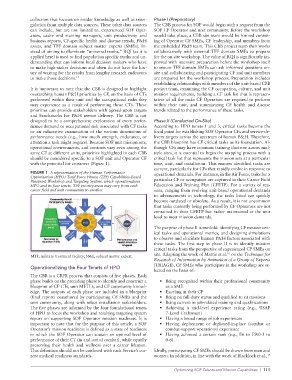
              should be considered specific to a SOF unit and Operator CF   critical task list that represents the mission sets at a particular
              with the potential for crossover (Figure 1).       time, unit, and installation. This ensures identified tasks are
                                                                 current, particularly for CFs that rapidly evolve in response to
              FIGURE 1  A representation of the Human Performance   operational demands. For instance, in the Air Force, tasks for a
              Optimization (HPO) Total Force Fitness (TFF) Capabilities-Based   particular CF or occupation are captured in their Career Field
              Blueprint Workshop and Targeting System, which operationalizes
              HPO and its four tenets. TFF priority areas may vary from each   Education and Training Plan (CFETP). For a variety of rea-
              career field and unit community to another.        sons, ranging from evolving unit-based operational demands
                                                                 to advancements in technology, the tasks listed can quickly
                                                                 become outdated or obsolete. As a result, it is not uncommon
                                                                 that tasks currently being performed by CF Operators are not
                                                                 contained in their CFETP but rather maintained at the unit
                                                                 level to meet mission demands.

                                                                 The purpose of phase II is twofold: identifying CF mission crit-
                                                                 ical tasks and operational metrics, and designing simulations
                                                                 to observe and elucidate human P&H factors associated with
                                                                 these tasks. The first step in phase II is to identify mission
                                                                 critical tasks from the perspective of experienced CF SMEs on
                                                                                               16
              MTF, military treatment facility; SME, subject matter expert.  site. Adapting the work of Mattie et al.  on the Technique for
                                                                 Research of Information by Animation of a Group of Experts
                                                                 (TRIAGE), CF SMEs who participate in the workshop are se-
              Operationalizing the Four Tenets of HPO
                                                                 lected on the basis of:
              The CBB is a CBPR process that consists of five phases. Each
              phase builds on the preceding phase to identify and construct a   •  Being recognized within their professional community
              blueprint of CF CTs, unit METLs, and CF community knowl-  as a SME
              edge. The outputs of each phase are included in a blueprint   •  Exceling in their CF
              (final report) coauthored by participating CF SMEs and the   •  Being on full-duty status and qualified to sit missions
              unit community, along with select installation stakeholders.   •  Being current in job-related training and qualifications
              The five phases are informed by the four foundational tenets   •  Achieving a mid-level experience rating (e.g., USAF
              of HPO to focus the workshop and resulting targeting system   7-Level Craftsman)
              report on supporting SOF Operator mission readiness. It is   •  Having a broad range of job experiences
              important to note that for the purpose of this article, a SOF   •  Having deployment or deployed-in-place (combat or
              Operator’s mission readiness is defined as a state of readiness   combat-support operations) experience
              in which the SOF Operator can sustain an optimal level of   •  Having achieved a certain rank (e.g., E6 to E9/0-3 to
              performance of their CT (in and out of combat), while equally   0-6).
              preserving their health and wellness over a career lifespan.
              This definition should not be confused with each Service’s cur-  Ideally, participating CF SMEs should be drawn from men and
              rent medical readiness standards.                  women. In addition, in line with the work of Blacklock et al.,
                                                                                                               17
                                                                         Optimizing SOF Talents and Mission Capabilities  |  115

