


Page 122 - JSOM Spring 2020
P. 122
SMEs should meet all the following inclusion criteria for CF is designed to identify performance factors from the CF per-
tasks: spective, including performance demands and resources for
PICT. During this phase, CF SME workshop participants in-
• Can participate for the full length of the site visit dividually free list all factors in a specific TFF domain they
• Experience performing the tasks during military exer- view as affecting performance of the identified PICT from the
cise or training perspective of the CF community (Table 2). Free-listed factors
• Experience performing the tasks during military de- are then rank ordered by CF SME participants. This list of
ployment (in-place and traditional) and temporary duty factors provides the foundation for a focused group discussion
assignment between TFF domain SMEs and CF participants as to which
• Experience performing the tasks in a variety of settings factors CF members see as affecting performance of PICTs in
and roles each respective TFF domain. This process includes a discus-
• Experience in a position of leadership where they have sion of how these factors affect performance, and which ones
directed subordinates to perform the tasks and have ob- should be considered priorities for P&H services to address.
served the tasks being performed
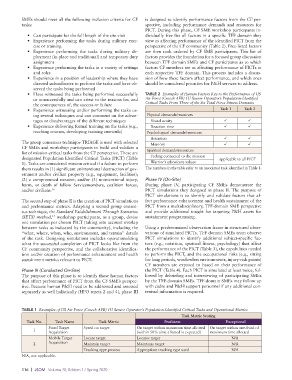
• Have witnessed the tasks being performed successfully TABLE 2 Examples of Human Factors Key to the Performance of US
or unsuccessfully and can attest to the reasons for, and Air Force (Creech AFB) 1U Sensor Operator’s Population-Identified
the consequences of, the success or failure Critical Tasks From Three of the Six Total Force Fitness Domains
• Experience witnessing and/or performing the tasks us- Task 1 Task 2
ing several techniques and can comment on the advan- Physical demands/resources
tages or disadvantages of the different techniques Visual acuity
• Experience delivering formal training on the tasks (e.g., Reaction time
teaching courses, developing training curricula) Psychological demands/resources
Attention
The group consensus technique TRIAGE is used with selected Memory
CF SMEs and workshop participants to build and validate a
list of mission-critical tasks from the CF perspective. These are Spiritual demands/resources
designated Population Identified Critical Tasks (PICT) (Table Feeling connected to the mission applicable to all PICT
1). Tasks are considered mission critical if a failure to perform Warrior’s ethos/core values
them results in (1) significant unintentional destruction of gov- The numbers in the table refer to an associated task identified in Table 1.
ernment and/or civilian property (e.g., equipment, facilities);
(2) a compromised mission; and/or (3) unintentional injury, Phase IV (On-Site)
harm, or death of fellow Servicemembers, coalition forces, During phase IV, participating CF SMEs demonstrate the
and/or civilians. 16 PICT simulations they designed in phase II. The purpose of
PICT simulations is to identify and validate factors that af-
The second step of phase II is the creation of PICT simulations fect performance enhancement and health sustainment of the
and performance metrics. Adapting a second group consen- PICT from a multidisciplinary, TFF-domain SME perspective
sus technique, the Standard Establishment Through Scenarios and provide additional insight for targeting P&H assets for
(SETS) method, workshop participants, as a group, devise sustainment programming.
17
one simulation per chosen PICT (taking into account overlap
between tasks as indicated by the community), including the Using a predetermined observation frame in structured obser-
“what, where, when, who, environment, and terrain” details vations of simulated PICTs, TFF domain SMEs team observe
of the task. Designing simulations includes operationalizing PICT simulations to identify additional subject-specific fac-
what the successful completion of PICT looks like from the tors (e.g., nutrition, spiritual fitness, psychology) that affect
CF community perspective, and the collaborative identifica- the performance of the PICT (Table 3), the capabilities needed
tion and/or creation of performance enhancement and health to perform the PICT, and the occupational risks (e.g., sitting
sustainment metrics relevant to PICT. for long periods, windowless environments, injury-risk points)
CF members are exposed to based on their performance of
Phase III (Conducted On-Site) the PICT (Table 4). Each PICT is simulated at least twice, fol-
The purpose of this phase is to identify those human factors lowed by debriefing and interviewing of participating SMEs
that affect performance of PICT from the CF SME’s perspec- by the TFF-domain SMEs. TFF-domain SMEs may follow up
tive. Because human P&H need to be addressed and assessed with cadre and P&H support personnel if any additional con-
separately as well holistically (HPO tenets 2 and 4), phase III textual information is required.
TABLE 1 Examples of US Air Force (Creech AFB) 1U Sensor Operator’s Population-Identified Critical Tasks and Operational Metrics
Task Metric Scoring
Task No. Task Name Task Metric Proficient Exceptional
Fixed Target Speed on target On target within maximum time allotted On target within one-third of
1
Acquisition (within 50% time allotted is expected) maximum time allotted
Mobile Target Locate target Locates target N/A
2 Acquisition Maintain target Maintains target N/A
Tracking type process Appropriate tracking type used N/A
N/A, not applicable.
116 | JSOM Volume 20, Edition 1 / Spring 2020

