


Page 127 - JSOM Fall 2018
P. 127
An Ongoing Series
Draw-over Anesthesia
Bringing the “Dark Art” Back Into the Light
1
Martin Graves, BSc MBBS, FANZCA *; Smiley Billings, BHlth Sci (Para) 2
ABSTRACT
Drawover anesthesia, once commonly used by military anes What Is Draw-over Anesthesia?
thetists, has become less familiar in highincome countries
(HICs). With favorable properties of robustness, portability, Drawover anesthesia is a simplified method of delivering an
and the ability of the user to service the vaporizer along with anesthetic vapor to a patient, the vapor being the gaseous
being unaffected by unreliable electricity supplies, these ma phase of anesthetic agent that sits above the liquid. Draw
chines are still commonly used in lowmiddle income countries over vaporizers were one of the earliest methods of delivering
(LMICs) throughout the world. They are used to deliver a va a volatile to a patient and have been used by many military
2
riety of anesthetic agents from ether and halothane to the more anesthetists during the past 150 years. On 16 October 1846,
familiar isoflurane and sevoflurane. As Special Operations when William Morton first demonstrated ether anesthesia
medical personnel operate within these remote locations, they at Massachusetts General Hospital, he used a glass bulbous
will come across such equipment. This article aims to refresh structure with two openings that he named the Morton Ether
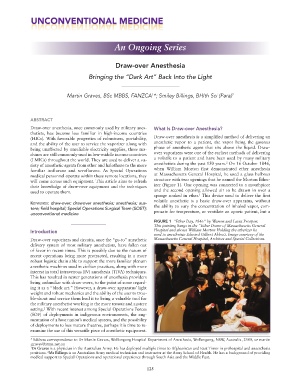
their knowledge of drawover equipment and the techniques izer (Figure 1). One opening was connected to a mouthpiece
used to operate them. and the second opening allowed air to be drawn in over a
sponge soaked in ether. This device used to deliver the first
3
volatile anesthetic is a basic drawover apparatus, without
Keywords: draw-over; drawover anesthesia; anesthesia; aus-
tere; field hospital; Special Operations Surgical Team (SOST); the ability to vary the concentration of inhaled vapor, com
unconventional medicine pensate for temperature, or ventilate an apneic patient, but a
FIGURE 1 “Ether Day, 1846” by Warren and Lucia Prosperi.
This painting hangs in the “Ether Dome of Massachusetts General
Introduction Hospital and shows William Morton Holding the etherizer he
used to anesthetize Edward Gilbert Abbott. Image courtesy of the
Drawover vaporizers and circuits, once the “goto” anesthetic Massachusetts General Hospital, Archives and Special Collections.
delivery system of most military anesthetists, have fallen out
of favor in recent times. This is possibly due to the nature of
recent operations being more protracted, resulting in a more
robust logistic chain able to support the more familiar plenum
anesthetic machines used in civilian practices, along with more
interest in total intravenous (IV) anesthesia (TIVA) techniques.
This has resulted in newer generations of anesthesia providers
being unfamiliar with drawovers, to the point of some regard
ing it as a “black art.” However, a drawover apparatus’ light
weight and robust mechanics and the ability of the user to trou
bleshoot and service them lend it to being a valuable tool for
the military anesthetist working in the more remote and austere
setting. With recent interest among Special Operations Forces
1
(SOF) of deployments in indigenous environments, the aug
mentation of a host nation’s medical system, and the possibility
of deployments to less mature theatres, perhaps it is time to re
examine the use of this versatile piece of anesthetic equipment.
*Address correspondence to Dr Martin Graves, Wollongong Hospital Department of Anesthesia, Wollongong, NSW, Australia, 2500, or martin
.graves@atma.net.au
1 Dr Graves is a physician in the Australian Army. He has deployed multiple times to Afghanistan and East Timor in prehospital and anaesthesia
positions. Mr Billings is an Australian Army medical technician and instructor at the Army School of Health. He has a background of providing
2
medical support to Special Operations and operational experience through South Asia and the Middle East.
125

