


Page 122 - JSOM Fall 2018
P. 122
Prolonged Field Care in
Support of Operation Inherent Resolve, 2016
1
2
Chris Blaine, 18D ; Matthew Abbott, APA-C ; Eric Jacobson, MD *
3
ABSTRACT
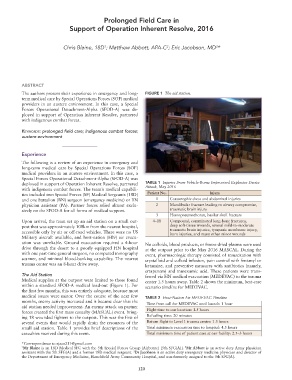
The authors present their experience in emergency and long FIGURE 1 The aid station.
term medical care by Special Operations Forces (SOF) medical
providers in an austere environment. In this case, a Special
Forces Operational DetachmentAlpha (SFODA) was de
ployed in support of Operation Inherent Resolve, partnered
with indigenous combat forces.
Keywords: prolonged field care; indigenous combat forces;
austere environment
Experience
The following is a review of an experience in emergency and
longterm medical care by Special Operations Forces (SOF)
medical providers in an austere environment. In this case, a
Special Forces Operational DetachmentAlpha (SFODA) was
deployed in support of Operation Inherent Resolve, partnered TABLE 1 Injuries From Vehicle-Borne Improvised Explosive Device
with indigenous combat forces. The team’s medical capabili Attack, May 2016
ties included two Special Forces (SF) Medical Sergeants (18D) Patient No. Injury
and one battalion (BN) surgeon (emergency medicine) or BN 1 Catastrophic chest and abdominal injuries
physician assistant (PA). Partner forces relied almost exclu 2 Mandibular fracture leading to airway compromise,
sively on the SFODA for all forms of medical support. traumatic brain injury
3 Hemopneumothorax, basilar skull fracture
Upon arrival, the team set up an aid station on a small out 4–18 Compound, comminuted longbone fractures,
post that was approximately 100km from the nearest hospital, deep softtissue wounds, several mildtomoderate
accessible only by air or offroad vehicles. There were no US traumatic brain injuries, tympanic membrane injury,
burn injuries, and many other minor wounds
Military aircraft available, and hostnation (HN) air evacu
ation was unreliable. Ground evacuation required a 4hour No colloids, blood products, or freezedried plasma were used
drive through the desert to a poorly equipped HN hospital at the outpost prior to the May 2016 MASCAL. During the
with one parttime general surgeon, no computed tomography event, pharmacologic therapy consisted of resuscitation with
scanner, and minimal bloodbanking capability. The nearest crystalloid and colloid infusion, pain control with fentanyl or
trauma center was an 8hour drive away. ketamine, and preventive measures with antibiotics (namely,
ertapenem) and tranexamic acid. These patients were trans
The Aid Station ferred via HN medical evacuation (MEDEVAC) to the trauma
Medical supplies at the outpost were limited to those found center 1.5 hours away. Table 2 shows the minimum, bestcase
within a standard SFODA medical loadout (Figure 1). For scenario timeline for MEDEVAC.
the first few months, this was entirely adequate, because most
medical issues were minor. Over the course of the next few TABLE 2 Host-Nation Air MEDEVAC Timeline
months, enemy activity increased and it became clear that the
aid station needed improvement. An enemy attack on partner Time from call for MEDEVAC until launch: 1 hour
forces created the first mass casualty (MASCAL) event. bring Flight time to our location: 1.5 hours
ing 18 wounded fighters to the outpost. This was the first of Refueling time: 20 minutes
several events that would rapidly drain the resources of the Return flight to Level 1 trauma center: 1.5 hours
small aid station. Table 1 provides brief descriptions of the Total minimum evacuation time to hospital: 4.5 hours
casualties received during this event. Total minimum time of patient care at our facility: 2.5–3 hours
*Correspondence to ejaco211@gmail.com
2
1 Mr Blaine is an 18D Medical SFC with the 5th Special Forces Group (Airborne) [5th SFG(A)]. Mr Abbott is an active duty Army physician
assistant with the 5th SFG(A) and a former 18D medical sergeant. Dr Jacobson is an active duty emergency medicine physician and director of
3
the Department of Emergency Medicine, Blanchfield Army Community Hospital, and was formerly assigned to the 5th SFG(A).
120

