


Page 123 - JSOM Fall 2018
P. 123
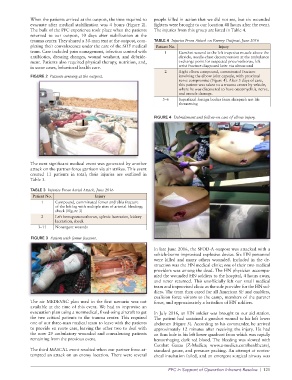
When the patients arrived at the outpost, the time required to people killed in action that we did not see, but six wounded
evacuate after medical stabilization was 4 hours (Figure 2). fighters were brought to our location 48 hours after the event.
The bulk of the PFC experience took place when the patients The injuries from this group are listed in Table 4.
returned to our outpost, 10 days after stabilization at the
trauma center. They shared a 30man tent at the outpost, com TABLE 4 Injuries From Attack on Enemy Outpost, June 2016
pleting their convalescence under the care of the SOF medical Patient No. Injury
team. Care included pain management, infection control with 1 Gunshot wound to the left trapezius muscle above the
antibiotics, dressing changes, wound washout, and debride clavicle, needlechest decompression at the ambulance
ment. Patients also required physical therapy, nutrition, and, exchange point for suspected pneumothorax, left
in some cases, behavioral health care. wrist fracture diagnosed later via ultrasound
2 Right elbow compound, comminuted fracture
FIGURE 2 Patients arriving at the outpost. involving the elbow joint capsule, with proximal
nerve compromise (Figure 4). After 5 days of care,
this patient was taken to a trauma center by vehicle,
where he was discovered to have osteomyelitis, nerve,
and muscle damage.
3–6 Superficial foreign bodies from shrapnel: not life
threatening
FIGURE 4 Debridement and follow-on care of elbow injury.
The next significant medical event was generated by another
attack on the partnerforce garrison via air strikes. This event
created 11 patients in total; their injuries are outlined in
Table 3.
TABLE 3 Injuries From Aerial Attack, June 2016
Patient No. Injury
1 Compound, comminuted femur and tibia fracture
of the left leg with multiple sites of arterial bleeding;
shock (Figure 3)
2 Left hemopneumothorax, splenic laceration, kidney
laceration, shock
3–11 Nonurgent wounds
FIGURE 3 Patient with femur fracture.
In late June 2016, the SFODA outpost was attacked with a
vehicleborne improvised explosive device. Six HN personnel
were killed and many others wounded. Included in the de
struction was the HN medical clinic; one of their two medical
providers was among the dead. The HN physician accompa
nied the wounded HN soldiers to the hospital, 4 hours away,
and never returned. This unofficially left our small medical
team and improvised clinic as the sole provider for the HN sol
diers. The team then cared for all American SF and enablers,
coalition force visitors to the camp, members of the partner
The air MEDEVAC plan used in the first scenario was not force, and approximately a battalion of HN soldiers.
available at the time of this event. We had to improvise an
evacuation plan using a nonmedical, fixedwing aircraft to get In July 2016, an HN soldier was brought to our aid station.
the two critical patients to the trauma center. This required The patient had sustained a gunshot wound to his left lower
one of our threeman medical team to leave with the patients abdomen (Figure 5). According to his commander, he arrived
to provide en route care, leaving the other two to deal with approximately 12 minutes after receiving the injury. He had
the now 29 ambulatory wounded and convalescing patients an 8cm hole in his left lower quadrant from which was rapidly
remaining from the previous event. hemorrhaging dark red blood. The bleeding was slowed with
Combat Gauze (ZMedica; www.zmedica.com/healthcare),
The third MASCAL event resulted when our partner force at standard gauze, and pressure packing. An attempt at orotra
tempted an attack on an enemy location. There were several cheal intubation failed, and an emergent surgical airway was
PFC in Support of Operation Inherent Resolve | 121

