


Page 128 - JSOM Fall 2018
P. 128
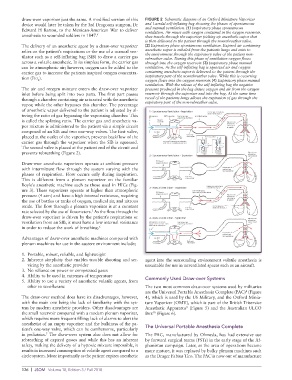
drawover vaporizer just the same. A modified version of this FIGURE 2 Schematic diagram of an Oxford Miniature Vaporizer
device would later be taken by the 3rd Dragoons surgeon, Dr and Laerdal self-inflating bag showing the phases of spontaneous
Edward H Barton, to the MexicanAmerican War to deliver and manual ventilation. (1) Inspiratory phase spontaneous
anesthesia to wounded soldiers in 1847. 4 ventilation. Air mixes with oxygen contained in the oxygen reservoir,
then travels through the vaporizer picking up anesthetic vapor that
is then delivered to the patient through the nonrebreather valve.
The delivery of an anesthetic agent by a drawover vaporizer (2) Expiratory phase spontaneous ventilation. Expired air containing
relies on the patient’s respirations or the use of a manual ven anesthetic vapor is exhaled from the patients lungs and exits to
tilator such as a selfinflating bag (SIB) to draw a carrier gas the environment through the expiratory valve of the patient non-
rebreather valve. During this phase of ventilation oxygen flows
across a volatile anesthetic. In its simplest form, the carrier gas through into the oxygen reservoir. (3) Inspiratory phase manual
can be atmospheric air; however, oxygen can be added to the ventilation. As the self-inflating bag is squeezed air and oxygen
carrier gas to increase the patients inspired oxygen concentra containing anesthetic vapor is delivered to the patient through the
tion (Fio ). inspiratory part of the nonrebreather valve. While this is occurring
2 oxygen flows into the oxygen reservoir. (4) Expiratory phase manual
ventilation. With the release of the self-inflating bag the negative
The air and oxygen mixture enters the drawover vaporizer pressure produced in the bag draws oxygen and air from the oxygen
inlet before being split into two parts. The first part passes reservoir through the vaporizer and into the bag. At the same time
through a chamber containing air saturated with the anesthetic recoil of the patients lungs allows the expiration of gas through the
vapor, while the other bypasses this chamber. The percentage expiratory part of the non-rebreather valve.
of anesthetic vapor delivered to the patient is adjusted by al 1 - Spontaneous Ventilation - Inspiration Carrier gas containing
tering the ratio of gas bypassing the vaporizing chamber. This Atmospheric OMV vaporiser Gas bypassing Self-inating bag anaesthetic vapour
is called the splitting ratio. The carrier gas and anesthetic va air Oxygen vaporising chambers Patient non-
reservoir
por mixture is administered to the patient via a simple circuit rebreather
valve open
to patient
composed of an SIB and two oneway valves. The first valve, O 2 inlet
placed at the outlet of the vaporizer, prevents backflow of the One-way One-way valve
valve open
carrier gas through the vaporizer when the SIB is squeezed. Gas enters vapourizing chamber
and picks up volatile anaesthetic
The second valve is placed at the patient end of the circuit and Patient
prevents rebreathing (Figure 2). Open Closed Patient non-
2 - Spontaneous Ventilation - Expiration rebreather
valve closed
Drawover anesthetic vaporizers operate at ambient pressure O2 ows to
oxygen reservoir
with intermittent flow through the system varying with the Expiration of
expired gas
phases of respiration. Flow occurs only during inspiration. to atmosphere
This is different from a plenum vaporizer on the familiar One-way
valve closed
Boyle’s anesthetic machine such as those used in HICs (Fig Carrier gas containing
ure 3). These vaporizers operate at higher than atmospheric 3 - Manual Ventilation - Inspiration Self-inating bag anaesthetic vapour
oxygen reservoir
pressure (4 atm) and have a high internal resistance, requiring O2 ows to squeezed by anaesthetist Patient non-
rebreather
the use of bottles or tanks of oxygen, medical air, and nitrous valve open
to patient
oxide. The flow through a plenum vaporizer is at a constant One-way Carrier gas plus
anaesthetic vapour
rate selected by the use of flowmeters. As the flow through the valve closed
5
drawover vaporizer is driven by the patient’s respirations or 4 - Manual Ventilation - Expiration Patient non-
ventilation from an SIB, it must have a low internal resistance Atmospheric air enters Gas bypassing rebreather
valve closed
oxygen reservoir and mixes
vaporising chambers
in order to reduce the work of breathing. 6 with contained oxygen
Expiration of
expired gas
Advantages of drawover anesthetic machines compared with O 2 inlet to atmosphere
plenum machines for use in the austere environment include; One-way
valve open
1. Portable, robust, reliable, and lightweight
2. Inherent simplicity that enables trouble shooting and ser agent into the surrounding environment volatile anesthesia is
vicing by the anesthetic provider unsuitable for use in unventilated spaces such as an aircraft.
3. No reliance on power or compressed gases
4. Ability to be used in extremes of temperature
5. Ability to use a variety of anesthetic volatile agents, from Commonly Used Draw-over Systems
ether to sevoflurane The two most common drawover systems used by militaries
8
are the Universal Portable Anesthesia Complete (PAC) (Figure
The drawover method does have its disadvantages, however, 4), which is used by the US Military, and the Oxford Minia
with the main one being the lack of familiarity with the sys ture Vaporizer (OMV), which is part of the British Triservice
tem by modern anesthetic providers. Other disadvantages are Anesthetic Apparatus (Figure 5) and the Australian ULCO
9
the small reservoir compared with a modern plenum vaporizer, Box (Figure 6).
10
which requires more frequent filling; lack of alarms to alert the
anesthetist of an empty vaporizer and the bulkiness of the pa
tient’s oneway valve, which can be cumbersome, particularly The Universal Portable Anesthesia Complete
in pediatrics. The drawover system also does not allow for The PAC, manufactured by Ohmeda, has had extensive use
7
rebreathing of expired gasses and while this has an inherent by forward surgical teams (FSTs) in the early stage of the Af
safety, making the delivery of a hypoxic mixture impossible, it ghanistan campaign. Later, as the area of operations became
results in increased consumption of volatile agent compared to a more mature, it was replaced by bulky plenum machines such
circle system. More importantly as the patient expires anesthetic as the Drager Fabius Tiro. The PAC is now out of manufacture
126 | JSOM Volume 18, Edition 3 / Fall 2018

