


Page 129 - JSOM Fall 2018
P. 129
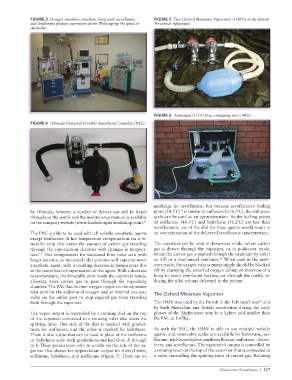
FIGURE 3 Draeger anesthetic machine fitted with sevoflurane FIGURE 5 Two Oxford Miniature Vaporizers (OMVs) in the British
and desflurane plenum vaporizers at the Wollongong Hospital in Tri-service Apparatus.
Australia.
FIGURE 6 Australian ULCO Box containing two OMVs.
FIGURE 4 Ohmeda Universal Portable Anesthesia Complete (PAC).
markings for sevoflurane, but because sevoflurane’s boiling
13
°
°
by Ohmeda, however a number of devices can still be found point (58.5 C) is similar to enflurane’s (56.5 C), the enflurane
throughout the world and the maintenance manual is available scale can be used as an approximation. As the boiling points
°
°
on the company website (www.frankshospitalworkshop.com). 11 of isoflurane (48.5 C) and halothane (50.2 C) are less than
sevoflurane’s, use of the dial for these agents would result in
The PAC is able to be used with all volatile anesthetic agents an overestimation of the delivered sevoflurane concentration.
except desflurane. It has temperature compensation via a bi
metallic strip that varies the amount of carrier gas traveling The vaporizer can be used in drawover mode, where carrier
through the vaporization chamber with changes in tempera gas is drawn through the vaporizer, or in pushover mode,
ture. This compensates for increased flow rates seen with where the carrier gas is pushed through the vaporizer by either
12
14
larger patients, as increased tidal volumes will vaporize more an SIB or a mechanical ventilator. When used in the push
anesthetic agent, with a resulting decrease in temperature due over mode, the oxygen enhancement nipple should be blocked
to the latent heat of vaporization of the agent. With a decrease off by clamping the attached oxygen tubing or insertion of a
in temperature, the bimetallic strip inside the vaporizer bends, bung to avoid ventilation leaking out through the outlet, re
allowing more carrier gas to pass through the vaporizing ducing the tidal volume delivered to the patient.
chamber. The PAC has its own oxygen nipple on the vaporizer
inlet port for the addition of oxygen and an internal oneway The Oxford Miniature Vaporizer
valve on the outlet port to stop expired gas from traveling
15
back through the vaporizer. The OMV was used by the British in the Falkland’s war and
by both Australian and British anesthetists during the early
The vapor output is controlled by a rotating dial on the top phases of the Afghanistan war. It is lighter and smaller than
of the vaporizer connected to a rotating valve that alters the the PAC at 1.65kg.
splitting ratio. One side of the dial is marked with gradua
tions for isoflurane, and the other is marked for halothane. As with the PAC, the OMV is able to use multiple volatile
There is also a disc that can be used in place of the isoflurane agents, and removable scales are available for halothane, iso
or halothane scale with graduations marked from A through flurane, trichloroethylene, methoxyflurane, enflurane, chloro
to F. These graduations refer to a table on the side of the va form, and sevoflurane. The vaporizer’s output is controlled by
porizer that shows the approximate output for diethyl ether, a rotating lever on the top of the vaporizer that is connected to
enflurane, halothane, and isoflurane (Figure 7). There are no a valve controlling the splitting ratio of carrier gas. Rotating
Draw-over Anesthesia | 127

