


Page 121 - JSOM Fall 2018
P. 121
APPENDIX D Cont.
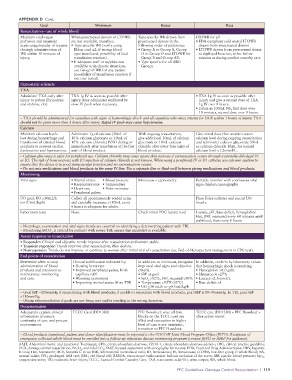
Goal Minimum Better Best
Resuscitation—use of whole blood
Maintain vitalorgan When prescreened donors or LTOWB Typespecific WB drawn from LTOWB for all
perfusion and minimize are not available, transfuse: prescreened donors in the • FDAcompliant coldstored LTOWB
acute coagulopathy of trauma • Typespecific WB (verify using following order of preference: drawn from prescreened donors
through administration of Eldon card x2; if wrong blood • Group A to Group A, Group • LTOWB drawn from prescreened donor
WB within 30 minutes of type transfused, possibility of fatal O to Group O and LTOWB for at deployed location, either before
injury. transfusion reaction). Group B and Group AB. mission or during combat casualty care
• If adequate staff or supplies not • Type specific for all ABO
available or in chaotic situations, Groups.
use Group O WB for any patient
(possibility of transfusion reaction if
not titer tested).
Hemostatic adjuncts
TXA
Administer TXA early after TXA 1g IV as soon as possible after • TXA 1g IV as soon as possible after
injury to reduce fibrinolysis injury. May administer undiluted by injury and give a second dose of TXA
and stabilize clot. slow IV push when necessary. 1g IV over 8 hours.
• Dilute in 100mL NS, first dose over
10 minutes, second dose over 8 hours.
– TXA should be administered for casualties with signs of hemorrhagic shock and all casualties who meet criteria for DCR within 3 hours of injury. TXA
should not be given more than 3 hours after injury. Rapid IV push may cause hypotension.
Calcium
Maintain calcium levels Administer 1g of calcium (30mL of With ongoing resuscitation, Give initial dose then monitor serum
lost during hemorrhage and 10% calcium gluconate or 10mL of give additional 30mL of calcium calcium level during ongoing resuscitation
transfusion of citrated blood 10% calcium chloride) IV/IO during or gluconate or 10mL calcium and administer calcium gluconate 30mL
products to prevent cardiac immediately after transfusion of the first chloride after every four units of or calcium chloride 10mL for ionized
dysfunction and hypotension. unit of blood product. blood product. calcium level <1.2mmol/L.
– Calcium gluconate is safer for peripheral use. Calcium chloride may cause severe skin necrosis if extravasation occurs through a partially dislodged IV
or IO. The risk of bone necrosis with IO injection of calcium chloride is not known. When using a peripheral IV or IO catheter, use extreme caution to
ensure that the device is in good intravascular position and no extravasation occurs.
– Do not mix medications and blood products in the same IV line. Use a separate line or flush well between giving medications and blood products.
Monitoring
Vital signs • Mental status • Blood pressure Minimum + capnometry Portable monitor with continuous vital
• Respiratory rate • Temperature signs display; capnography
• Heart rate • Pulse oximetry
• Peripheral pulses
UO goal: UO >30mL/h Collect all spontaneously voided urine Place Foley catheter and record UO
(or 0.5mL/kg/h) and carefully measure; >180mL every hourly.
6 hours is adequate for adults.
Laboratory tests None Check initial POC lactate level Lactate, pH, base deficit, hemoglobin/
Hct, INR measured every 60 minutes until
stabilized, then every 6 hours
– Neurologic examination and vital signs trends are essential to identifying a deteriorating patient with TBI.
– Monitoring EtCO is critical for patients with severe TBI; ensure this capability is available.
2
Assess response to resuscitation
• Responder: Clinical and objective trends improve after resuscitation and remain stable.
• Transient responder: Trends improve after resuscitation, then decline.
• Nonresponder: Trends do not improve or continue to worsen after initial trial of resuscitation (see Endoflife/expectant management in CPG text).
End points of resuscitation
Determine when to stop Clinical stabilization indicated by: In addition to minimum, recognize In addition, confirm by laboratory values
administration of blood • Slowing heart rate improved vital signs and objective that hemorrhagic shock is resolving.
products and transition to • Improved peripheral pulses, brisk criteria. • Hemoglobin >8.0 g/dL
maintenance monitoring capillary refill • SBP at goal • Hematocrit >27%
and care. • Warming extremities • SpO >92%, FiO required <50% • Lactate <2.5mmol/L
2
2
• Improving mental status (if no TBI) • Temperature >95ºF (35ºC) • Base deficit <4
• UO >30 mL/h or >0.5mL/kg/h
– Goal SBP ~100mmHg if resuscitating with blood products; if unable to resuscitate with blood products, goal SBP is 80–90mmHg. In TBI, goal SBP
>110mmHg.
– Obtain teleconsultation if goals are not being met and/or trending in the wrong direction.
Documentation
Adequately capture clinical TCCC Card (DD1380) PFC flowsheet: once all time TCCC care (DD1380) + PFC flowsheet +
information to ensure blocks on the TCCC card are afteraction report
continuity of care and process filled and evacuation to higher
improvement. level of care is not imminent,
transition to PFC flowsheet.
– Blood products transfused, patient and donor identification must be reported to the COCOM Joint Blood Program Office (JBPO). Recipients of
emergency collected whole blood must be enrolled into a follow-up infectious disease monitoring program (contact JBPO or ASBP for guidance).
AAJT, Abdominal Aortic and Junctional Tourniquet; CPD, citratephosphatedextrose; CPDA1, citratephosphatedextroseadenine; CPG, clinical practice guideline;
DCR, damage control resuscitation; EtCO , endtidal CO ; FAST, focused assessment with sonography for trauma; FDA, Food and Drug Administration; HBV, hepatitis
2
2
B virus; Hct, hematocrit; HCV, hepatitis C virus; INR, international normalized ratio; IO, intraosseous; IV, intravenous; LTOWB, lowtiter group O whole blood; NS,
normal saline; PFC, prolonged field care; RBC, red blood cell; REBOA, resuscitative endovascular balloon occlusion of the aorta; SBP, systolic blood pressure; Spo ,
2
oxygen saturation; TBI, traumatic brain injury; TCCC, Tactical Combat Casualty Care; TXA, tranexamic acid; UO, urine output; WB, whole blood.
PFC Guidelines: Damage Control Resuscitation | 119

