


Page 50 - Journal of Special Operations Medicine - Fall 2017
P. 50
initiation of damage control resuscitation by experienced pro-    neurological function. The team was involved in the care of
          viders during MEDEVAC.                             several patients needing wound and burn care, superficial and
                                                             complex  laceration  repair,  and  traumatic  brain  injury  (TBI)
          Expeditionary, Fixed-Facility Operations           evaluation. Many of these Soldiers were treated and returned
          This mission was an enduring mission throughout the deploy-  to duty, alleviating the need for evacuation.
          ment, providing a fixed facility at a hub of operations. The
          GHOST-T maintained a presence at this location throughout   Large, Temporary Forward Operating Base
          the deployment. The team’s structure was an Alaskan Tent   This mission was undertaken in support of large-scale combat
          (Alaska Structures; https://alaskastructures.com/) and had two   missions lasting several days with a larger number of personnel
          surgical beds and two resuscitation beds (Figure 2). The SOF   at risk. The GHOST-T and MEDEVAC would move forward
          element would conduct partnered train, advise, and assist mis-  to establish a temporary 1-hour evacuation ring and surgical
          sions from this location and project forward by ground (ve-  capability. Most often, facilities of opportunity on a prior U.S./
          hicle) or air (rotary wing). With a large presence, the base had   NATO base that had been turned over to Afghan forces were
          power, giving the GHOST-T the ability to run a blood refriger-  used and served as a staging base for the operation. This for-
          ator and plasma freezer. The addition of a plasma thawer and   ward location provided medical/surgical care, forward arming
          Belmont infusion system (Belmont Instrument Corp.;  http://  and refueling (FARP), and co-located MEDEVAC assets to en-
          www.belmontinstrument.com/) allowed for resuscitation with   sure care for any potentially wounded Soldier within 1 hour.
          warm  blood  products.  Resupply  was  coordinated  for  blood   Coordination with security elements, Afghan forces for use of
          and medical supplies and usually received within 1 to 2 days   their base, and MEDEVAC assets was critical during planning
          of request. Communications were over cellular phone, secure   and execution. Secure communication was necessary for pa-
          phone, official and secure e-mail, and satellite radio. The SOF   tient movement and evacuation, and resupply.
          operations cell, along with their medical planners, would co-
          ordinate with the team leader when missions were scheduled   The  logistics  for  the  scope  and  magnitude  of  the  operation
          and all medical assets (i.e., SOF, MEDEVAC, and GHOST-T)   were sizeable and numerous assets were collocated on the tem-
          were synchronized.                                 porary FOB. Missions longer than 72 hours required use of
                                                             formal blood refrigerator and plasma freezer. Styrofoam tem-
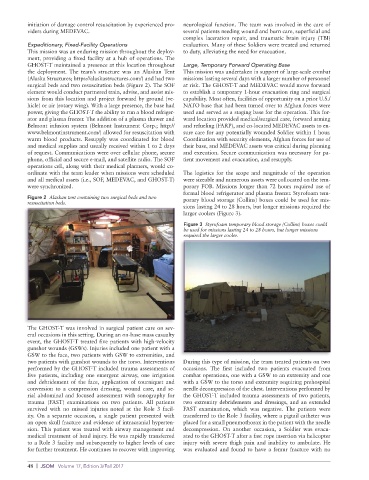
          Figure 2  Alaskan tent containing two surgical beds and two   porary blood storage (Collins) boxes could be used for mis-
          resuscitation beds.
                                                             sions lasting 24 to 28 hours, but longer missions required the
                                                             larger coolers (Figure 3).
                                                             Figure 3  Styrofoam temporary blood storage (Collins) boxes could
                                                             be used for missions lasting 24 to 28 hours, but longer missions
                                                             required the larger cooler.


          The GHOST-T was involved in surgical patient care on sev-
          eral occasions in this setting. During an on-base mass casualty
          event, the GHOST-T treated five patients with high-velocity
          gunshot wounds (GSWs). Injuries included one patient with a
          GSW to the face, two patients with GSW to extremities, and
          two patients with gunshot wounds to the torso. Interventions   During this type of mission, the team treated patients on two
          performed by the GHOST-T included trauma assessments of   occasions. The first included two patients evacuated from
          five patients, including one emergent airway, one irrigation   combat operations, one with a GSW to an extremity and one
          and debridement of the face, application of tourniquet and   with a GSW to the torso and extremity requiring prehospital
          conversion to a compression dressing, wound care, and se-  needle decompression of the chest. Interventions performed by
          rial abdominal and focused assessment with sonography for   the GHOST-T included trauma assessments of two patients,
          trauma (FAST) examinations on two patients. All patients   two extremity debridements and dressings, and an extended
          survived  with  no  missed  injuries  noted  at  the  Role  3  facil-  FAST examination, which was negative. The patients were
          ity. On a separate occasion, a single patient presented with   transferred to the Role 3 facility, where a pigtail catheter was
          an open skull fracture and evidence of intracranial hyperten-  placed for a small pneumothorax in the patient with the needle
          sion. This patient was treated with airway management and   decompression. On another occasion, a Soldier was evacu-
          medical treatment of head injury. He was rapidly transferred   ated to the GHOST-T after a fast rope insertion via helicopter
          to a Role 3 facility and subsequently to higher levels of care   injury with severe  thigh pain and inability  to ambulate. He
          for further treatment. He continues to recover with improving   was evaluated and found to have a femur fracture with no

          48  |  JSOM   Volume 17, Edition 3/Fall 2017

