


Page 51 - Journal of Special Operations Medicine - Fall 2017
P. 51
neurovascular  compromise.  He was splinted,  administered   device.  These  patients were  evaluated,  their wounds  were
              pain medication, and immediately transferred to the Role 3   treated, and they returned to duty without evacuation; light
              facility, where he underwent external fixation.    duty was prescribed for the two patients with minor TBI until
                                                                 they were improved. The seventh patient had severe, bilateral,
              Austere Combat/Train, Advise, Assist Operations    lower-extremity injuries after detonation of an explosive de-
              Certain SOF missions were executed well outside of an ex-  vice. He underwent a left-groin exploration with conversion
              isting MEDEVAC ring and were not conducive environments   to laparotomy for left iliac vessel proximal control with subse-
              for prestaged Role 2, FARP, and MEDEVAC assets. To en-  quent ligation of the left common femoral artery and femoral
              sure compliance with the golden-hour policy, only the Role   vein; he had complete amputations of the both legs. He re-
              2 element was established close to planned operations. Ca-  ceived 10 units of PRBCs and 8 units of FFP. He was evacuated
              sualty movement was by ground to the GHOST-T. Security   to a Role 3 facility within 1 hour of injury, where he under-
              and communications were planned for and co-located with   went shunting of femoral vessels and subsequent repair. The
              the GHOST-T. These missions were short. The GHOST-T   eighth patient had a through-and-through GSW to the lower
              only expected resupply if it provided care for a patient and   leg, with no neurovascular compromise. His leg wounds were
              a prepacked resupply package was staged on the MEDEVAC   irrigated and debrided, and he was monitored for signs of
              helicopter. Blood-product management was planned for based   compartment syndrome. He was also evacuated to an Afghan
              on mission duration and Collins boxes or refrigerator/freezers   hospital with no evidence of compartment syndrome.
              were used.
                                                                 Discussion
              The GHOST-T deployed twice in this configuration. On the
              first mission, the team was set up with resuscitation outside   Maintaining  a golden-hour  surgical  capability  for  U.S.  SOF
              and an operating room inside a tent (Base-X; HDT Global;   during Operation Freedom’s Sentinel required adaptation in
              http://www.hdtglobal.com/). Security and communications   FST configuration, personnel, equipment, and use. FSTs have,
              were provided by a small infantry element. No patients were   since the beginning of the GWOT, been used in a nondoctrinal
              treated  during  these  austere  missions.  Additional  consider-  role. Split operations have become common, and outcomes are
              ations for this mission were night-vision devices to facilitate   comparable between FSTs that are split and those that remain
              movement of assets and surgical capability and a linguist to   at full strength, including the management of mass casualty
              assist with communications with co-located Afghan forces.  incidents.  Thorough knowledge of the battlespace allows the
                                                                        7,8
                                                                 surgeon to decide if a patient is stable enough to be trans-
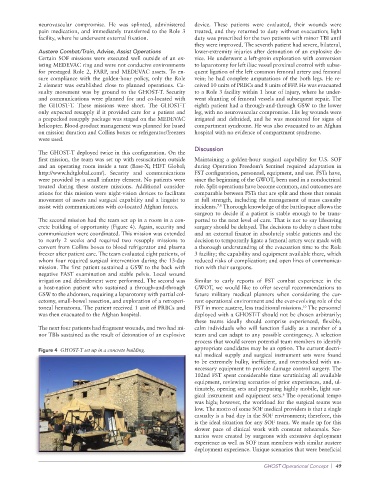
              The second mission had the team set up in a room in a con-  ported to the next level of care. That is not to say lifesaving
              crete building of opportunity (Figure 4). Again, security and   surgery should be delayed. The decisions to delay a chest tube
              communication were coordinated. This mission was extended   and an external fixator in absolutely stable patients and the
              to  nearly  2 weeks  and  required  two  resupply  missions to   decision to temporarily ligate a femoral artery were made with
              convert from Collins boxes to blood refrigerator and plasma   a thorough understanding of the evacuation time to the Role
              freezer after patient care. The team evaluated eight patients, of   3 facility; the capability and equipment available there, which
              whom four required surgical intervention during the 13-day   reduced risks of complication; and open lines of communica-
              mission. The first patient sustained a GSW to the back with   tion with their surgeons.
              negative FAST examination and stable pelvis. Local wound
              irrigation and debridement were performed. The second was   Similar to early reports of FST combat experience  in the
              a host-nation patient who sustained a through-and-through   GWOT, we would like to offer several recommendations to
              GSW to the abdomen, requiring a laparotomy with partial col-  future military medical planners when considering the cur-
              ectomy, small-bowel resection, and exploration of a retroperi-  rent operational environment and the ever-evolving role of the
              toneal hematoma. The patient received 1 unit of PRBCs and   FST in more austere, less traditional missions.  The personnel
                                                                                                    10
              was then evacuated to the Afghan hospital.         deployed with a GHOST-T should not be chosen arbitrarily;
                                                                 these teams ideally should comprise experienced, flexible,
              The next four patients had fragment wounds, and two had mi-  calm individuals who will function fluidly as a member of a
              nor TBIs sustained as the result of detonation of an  explosive   team and can adapt to any possible contingency. A selection
                                                                 process that would screen potential team members to identify
              Figure 4  GHOST-T set up in a concrete building.   appropriate candidates may be an option. The current doctri-
                                                                 nal medical supply and surgical instrument sets were found
                                                                 to be extremely bulky, inefficient, and overstocked with un-
                                                                 necessary equipment to provide damage control surgery. The
                                                                 102nd FST spent considerable time scrutinizing all available
                                                                 equipment, reviewing scenarios of prior experiences, and, ul-
                                                                 timately, opening sets and preparing highly mobile, light sur-
                                                                 gical instrument and equipment sets.  The operational tempo
                                                                                             6
                                                                 was high; however, the workload for the surgical teams was
                                                                 low. The motto of some SOF medical providers is that a single
                                                                 casualty is a bad day in the SOF environment; therefore, this
                                                                 is the ideal situation for any SOF team. We made up for this
                                                                 slower pace of clinical work with constant rehearsals. Sce-
                                                                 narios were created by surgeons with extensive deployment
                                                                 experience as well as SOF team members with similar austere
                                                                 deployment experience. Unique scenarios that were beneficial

                                                                                       GHOST Operational Concept  |  49

