


Page 55 - Journal of Special Operations Medicine - Fall 2017
P. 55
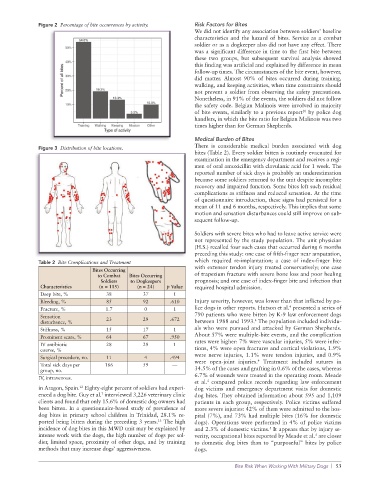
Figure 2  Percentage of bite occurrences by activity.  Risk Factors for Bites
                                                                 We did not identify any association between soldiers’ baseline
                                                                 characteristics and the hazard of bites. Service as a combat
                                                                 soldier or as a dogkeeper also did not have any effect. There
                                                                 was a significant difference in time to the first bite between
                                                                 these two groups, but subsequent survival analysis showed
                                                                 this finding was artificial and explained by difference in mean
                                                                 follow-up times. The circumstances of the bite event, however,
                                                                 did matter. Almost 90% of bites occurred during training,
                                                                 walking, and keeping activities, when time constraints should
                                                                 not prevent a soldier from observing the safety precautions.
                                                                 Nonetheless, in 91% of the events, the soldiers did not follow
                                                                 the safety code. Belgian Malinois were involved in majority
                                                                 of bite events, similarly to a previous report  by police dog
                                                                                                    10
                                                                 handlers, in which the bite ratio for Belgian Malinois was two
                                                                 times higher than for German Shepherds.

                                                                 Medical Burden of Bites
                                                                 There is considerable medical burden associated with dog
              Figure 3  Distribution of bite locations.
                                                                 bites (Table 2). Every soldier bitten is routinely evacuated for
                                                                 examination in the emergency department and receives a regi-
                                                                 men of oral amoxicillin with clavulanic acid for 1 week. The
                                                                 reported number of sick days is probably an underestimation
                                                                 because some soldiers returned to the unit despite incomplete
                                                                 recovery and impaired function. Some bites left such residual
                                                                 complications as stiffness and reduced sensation. At the time
                                                                 of questionnaire introduction, these signs had persisted for a
                                                                 mean of 11 and 6 months, respectively. This implies that some
                                                                 motion and sensation disturbances could still improve on sub-
                                                                 sequent follow-up.

                                                                 Soldiers with severe bites who had to leave active service were
                                                                 not represented by the study population. The unit physician
                                                                 (H.S.) recalled four such cases that occurred during 6 months
                                                                 preceding this study: one case of fifth-finger near amputation,
              Table 2  Bite Complications and Treatment          which required re-implantation; a case of index-finger bite
                               Bites Occurring                   with extensor tendon injury treated conservatively; one case
                                 to Combat   Bites Occurring     of trapezium fracture with severe bone loss and poor healing
                                  Soldiers    to Dogkeepers      prognosis; and one case of index-finger bite and infection that
              Characteristics    (n = 115)    (n = 24)  p Value  required hospital admission.
              Deep bite, %          38          37        1
              Bleeding, %           85          92       .610    Injury severity, however, was lower than that inflicted by po-
                                                                                                4
              Fracture, %           1.7         0         1      lice dogs in other reports. Hutson et al.  presented a series of
              Sensation                                          790 patients who were bitten by K-9 law enforcement dogs
                                                                                    4
              disturbance, %        23          29       .672    between 1988 and 1993.  The population included individu-
              Stiffness, %          15          17        1      als who were pursued and attacked by German Shepherds.
              Prominent scars, %    64          67       .950    About 57% were multiple-bite events, and the complication
                                                                 rates were higher: 7% were vascular injuries, 5% were infec-
              IV antibiotic         28          29        1
              course, %                                          tions, 4% were open fractures and cortical violations, 1.9%
              Surgical procedure, no.  11       4        .494    were nerve injuries, 1.1% were tendon injuries, and 0.9%
                                                                 were open-joint injuries.  Treatment included sutures in
                                                                                     4
              Total sick days per   166         59       —
              group, no.                                         34.5% of the cases and grafting in 0.6% of the cases, whereas
              IV, intravenous.                                   6.7% of wounds were treated in the operating room. Meade
                                                                 et al.  compared police records regarding law enforcement
                                                                     5
              in  Aragon, Spain.  Eighty-eight percent of soldiers had experi-  dog victims and emergency department visits for domestic
                           12
              enced a dog bite. Guy et al.  interviewed 3,226  veterinary clinic   dog bites. They obtained information about 595 and 1,109
                                  7
              clients and found that only 15.6% of domestic dog owners had   patients in each group, respectively. Police victims suffered
              been  bitten.  In  a  questionnaire-based  study  of  prevalence  of   more severe injuries: 42% of them were admitted to the hos-
              dog bites in primary school children in Trinidad, 28.1% re-  pital (7%), and 73% had multiple bites (16% for domestic
              ported being bitten during the preceding 3 years.  The high   dogs). Operations were performed in 4% of police victims
                                                     13
              incidence of dog bites in this MWD unit may be explained by   and 2.3% of domestic victims.  It appears that by injury se-
                                                                                         5
              intense work with the dogs, the high number of dogs per sol-  verity, occupational bites reported by Meade et al.  are closer
                                                                                                        5
              dier, limited space, proximity of other dogs, and by training   to domestic dog bites than to “purposeful” bites by police
              methods that may increase dogs’ aggressiveness.    dogs.
                                                                              Bite Risk When Working With Military Dogs  |  53

