


Page 54 - Journal of Special Operations Medicine - Fall 2017
P. 54
precautions were observed, and the type of activity during   Table 1  Study Subjects’ Baseline Characteristics
          which the bite occurred. Medical bite-specific information in-       Combat Soldiers   Dogkeepers
          cluded bite severity (superficial versus deep), serious bleeding,   Characteristics  (n = 64)  (n = 14)  p Value
          fracture, need for intravenous (IV) antibiotic course, necessity   Mean age, years  20.72  19.75  .002 a
          of a surgical procedure (from approximation sutures to nerve   Female subjects, %  10.4  57  .000 a
          repair), and such complications as loss of sensation (in the   Smokers, %  18%       29      .351
          area proximal to bite), stiffness (in the joint proximal to bite),   Mean height, cm  176  170  .032 a
          and prominent scarring. In addition, participants were asked
          to designate each bite location on a human body diagram.  Mean weight, kg  73        67      .092
                                                              Mean time working                           a
                                                              with dogs, months    17.3       11.5     .023
          Statistical analysis was performed using R 3.3.0 open-source
          software. Baseline characteristics and bite-specific risk factors   Mean time to the    6.7   3.9  .027 a
                                                              first bite, months
          of combat soldiers and dogkeepers were compared using the χ
                                                         2
          test for categorical variables and Welch t test for continuous   Mean number of    1.89  1.85  .945
                                                              bites per person
          variables. Significance level was set at p < .05. The informa-  Persons having no
          tion about time working with dogs and timing of each bite was   bites, %  10.94     28.57    .085
          transcribed in a counting process format for survival analysis.   a Statistically significant at α of 0.05.
          Subjects with missing data on any of the variables were ex-
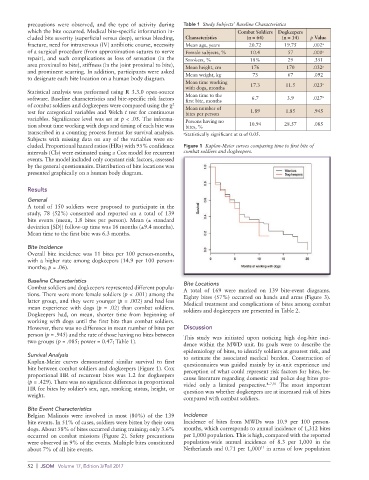
          cluded. Proportional hazard ratios (HRs) with 95% confidence   Figure 1  Kaplan-Meier curves comparing time to first bite of
          intervals (CIs) were estimated using a Cox model for recurrent   combat soldiers and dogkeepers.
          events. The model included only constant risk factors, assessed
          by the general questionnaire. Distribution of bite locations was
          presented graphically on a human body diagram.


          Results
          General
          A total of 150  soldiers were proposed  to participate  in the
          study, 78 (52%) consented and reported on a total of 139
          bite events (mean, 1.8 bites per person). Mean (± standard
          deviation [SD]) follow-up time was 16 months (±9.4 months).
          Mean time to the first bite was 6.3 months.

          Bite Incidence
          Overall bite incidence was 11 bites per 100 person-months,
          with a higher rate among dogkeepers (14.9 per 100 person-
          months; p = .06).

          Baseline Characteristics                           Bite Locations
          Combat soldiers and dogkeepers represented different popula-  A total of 169 were marked on 139 bite-event diagrams.
          tions. There were more female soldiers (p < .001) among the   Eighty bites (57%) occurred on hands and arms (Figure 3).
          latter group, and they were younger (p = .002) and had less   Medical treatment and complications of bites among combat
          mean experience with dogs (p = .02) than combat soldiers.   soldiers and dogkeepers are presented in Table 2.
          Dogkeepers had, on mean, shorter time from beginning of
          working with dogs until the first bite than combat soldiers.
          However, there was no difference in mean number of bites per   Discussion
          person (p = .945) and the rate of those having no bites between   This study was initiated upon noticing high dog-bite inci-
          two groups (p = .085; power = 0.47; Table 1).
                                                             dence within the MWD unit. Its goals were to describe the
                                                               epidemiology of bites, to identify soldiers at greatest risk, and
          Survival Analysis                                  to estimate the associated medical burden. Construction of
          Kaplan-Meier curves demonstrated similar survival to first   questionnaires was guided mainly by in-unit experience and
          bite between combat soldiers and dogkeepers (Figure 1). Cox   perception of what could represent risk factors for bites, be-
          proportional HR of recurrent bites was 1.2 for dogkeepers     cause literature regarding domestic and police dog bites pro-
          (p = .429). There was no significant difference in proportional   vided only a limited perspective. 4–7,10  The most important
          HR for bites by soldier’s sex, age, smoking status, height, or   question was whether dogkeepers are at increased risk of bites
          weight.
                                                             compared with combat soldiers.
          Bite Event Characteristics
          Belgian Malinois were involved in most (80%) of the 139   Incidence
          bite events. In 51% of cases, soldiers were bitten by their own   Incidence of bites from MWDs was 10.9 per 100 person-
          dogs. About 58% of bites occurred during training; only 3.6%   months, which corresponds to annual incidence of 1,312 bites
          occurred on combat missions (Figure 2). Safety precautions   per 1,000 population. This is high, compared with the reported
          were observed in 9% of the events. Multiple bites constituted   population-wide annual incidence of 8.3 per 1,000 in the
                                                                                      11
          about 7% of all bite events.                         Netherlands and 0.71 per 1,000  in areas of low  population
          52  |  JSOM   Volume 17, Edition 3/Fall 2017

