


Page 49 - Journal of Special Operations Medicine - Fall 2017
P. 49
if needed. The GHOST-T surgical sets were modified by the   the team’s roll-up bags, hard cases, personal gear, generator,
              102nd FST surgeons from traditional FST sets to be lighter   and blood products.
              and more mobile (D. Hale et al., personal communication). 6
                                                                 All resupply was handled through the supported unit’s sup-
                                                                 ply chain. During a mission, communication with higher al-
              Makeup and Resuscitation/Surgical Platform
                                                                 lowed the team to resupply after surgical intervention or
              The Army’s traditional 20-person FST was the pool from   expenditure of class VIII supplies. Supplies would arrive with
              which the GHOST-T was formed. The traditional FST has   the supported unit’s sustainment and the surgical team would
              been used as two split teams during the Global War on Ter-  typically receive supplies between 24 and 48 hours after the
              rorism (GWOT) to cover more geography with similar results   request, depending on urgency. Food and water (class I), as
              compared with a full 20-person team.  By doctrine, an FST is   well as fuel (class III) was provided by the requesting element.
                                           7,8
              composed of 20 personnel—10 officers and 10 enlisted—who   All the equipment the surgical team used on the austere mis-
              work and train together to provide Role 2 surgical care. The   sions was easily powered by the standard Army 5K genera-
              team has four surgeons (three general and one orthopedic),   tor. For fixed-facility operations, the base power was used to
              two certified registered nurse anesthetists (CRNAs), three sur-  supply the team’s tent of equipment. In both instances, exten-
              gical technicians, three medics, three licensed practical nurses,   sion cords, attention to detail, and stewardship of the outlets
              and 3 registered nurses (an emergency room, an intensive care,   without wiring multiple devices together (“daisy chaining”)
              and an operating room nurse), a detachment sergeant, and a   allowed the team to function with no power issues.
              medical service corps field medical assistant. The FST has per-
              sonnel who are not organic to the unit who are tasked via a   Experience During Deployment
              professional filler system (PROFIS) and typically include five
              of the 10 officers. The PROFIS personnel usually comprise   Missions
              three surgeons, one nurse anesthetist, and one registered nurse.  The 102nd FST developed and rehearsed mission-ready, de-
                                                                 ployable packages for a broad spectrum of operations and
              The two configurations used by the 102nd FST were a light   mission requirements. Before deploying to Afghanistan, the
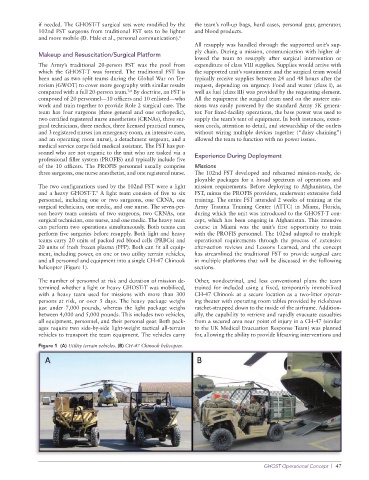
              and a heavy GHOST-T.  A light team consists of five to six   FST, minus the PROFIS providers, underwent extensive field
                                9
              personnel, including one or two surgeons, one CRNA, one   training. The entire FST attended 2 weeks of training at the
              surgical technician, one medic, and one nurse. The seven-per-  Army  Trauma  Training  Center  (ATTC)  in  Miami, Florida,
              son heavy team consists of two surgeons, two CRNAs, one   during which the unit was introduced to the GHOST-T con-
              surgical technician, one nurse, and one medic. The heavy team   cept, which has been ongoing in Afghanistan. This intensive
              can perform two operations simultaneously. Both teams can   course in Miami was the unit’s first opportunity to train
              perform five surgeries before resupply. Both light and heavy   with the PROFIS personnel. The 102nd adapted to multiple
              teams carry 20 units of packed red blood cells (PRBCs) and   operational requirements through the process of extensive
              20 units of fresh frozen plasma (FFP). Both can fit all equip-  after-action reviews and Lessons Learned, and the concept
              ment, including power, on one or two utility terrain vehicles,   has streamlined the traditional FST to provide surgical care
              and all personnel and equipment into a single CH-47 Chinook   in multiple platforms that will be discussed in the following
              helicopter (Figure 1).                             sections.
              The number of personnel at risk and duration of mission de-  Other, nondoctrinal, and less conventional plans the team
              termined whether a light or heavy GHOST-T was mobilized,   trained for included using a fixed, temporarily immobilized
              with a heavy team used for missions with more than 300   CH-47 Chinook at a secure location as a two-litter operat-
              persons at risk, or over 3 days. The heavy package weighs   ing theater with operating room tables provided by rickshaws
              just under 7,000 pounds, whereas the light package weighs   ratchet-strapped down to the inside of the airframe. Addition-
              between 4,000 and 5,000 pounds. This includes two vehicles,   ally, the capability to retrieve and rapidly evacuate casualties
              all equipment, personnel, and their personal gear. Both pack-  from a secured area near point of injury in a CH-47 (similar
              ages require two side-by-side light-weight tactical all-terrain   to the UK Medical Evacuation Response Team) was planned
              vehicles to transport the team equipment. The vehicles carry   for, allowing the ability to provide lifesaving interventions and
              Figure 1  (A) Utility terrain vehicles. (B) CH-47 Chinook helicopter.


                                                                                       GHOST Operational Concept  |  47

