


Page 46 - Journal of Special Operations Medicine - Fall 2017
P. 46
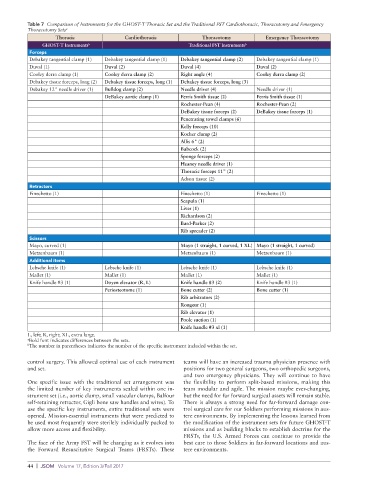
Table 7  Comparison of Instruments for the GHOST-T Thoracic Set and the Traditional FST Cardiothoracic, Thoracotomy and Emergency
          Thoracotomy Sets a
                   Thoracic               Cardiothoracic           Thoracotomy          Emergency Thoracotomy
               GHOST-T Instruments b                           Traditional FST Instruments b
           Forceps
           Debakey tangential clamp (1)  Debakey tangential clamp (1)  Debakey tangential clamp (2)  Debakey tangential clamp (1)
           Duval (1)               Duval (2)                Duval (4)                Duval (2)
           Cooley derra clamp (1)  Cooley derra clamp (2)   Right angle (4)          Cooley derra clamp (2)
           Debakey tissue forceps, long (2)  Debakey tissue forceps, long (1)  Debakey tissue forceps, long (3)
           Debakey 12" needle driver (1)  Bulldog clamp (2)   Needle driver (4)      Needle driver (1)
                                   DeBakey aortic clamp (1)  Ferris Smith tissue (2)  Ferris Smith tissue (1)
                                                            Rochester-Pean (4)       Rochester-Pean (2)
                                                            DeBakey tissue forceps (2)  DeBakey tissue forceps (1)
                                                            Penetrating towel clamps (6)
                                                            Kelly forceps (10)
                                                            Kocher clamp (2)
                                                            Allis 6" (2)
                                                            Babcock (2)
                                                            Sponge forceps (2)
                                                            Heaney needle driver (1)
                                                            Thoracic forceps 11” (2)
                                                            Adson tissue (2)
           Retractors
           Finechetto (1)                                   Finechetto (1)           Finechetto (1)
                                                            Scapula (1)
                                                            Liver (1)
                                                            Richardson (2)
                                                            Bard-Parker (2)
                                                            Rib spreader (2)
           Scissors
           Mayo, curved (1)                                 Mayo (1 straight, 1 curved, 1 XL) Mayo (1 straight, 1 curved)
           Metzenbaum (1)                                   Metzenbaum (1)           Metzenbaum (1)
           Additional items
           Lebsche knife (1)       Lebsche knife (1)        Lebsche knife (1)        Lebsche knife (1)
           Mallet (1)              Mallet (1)               Mallet (1)               Mallet (1)
           Knife handle #3 (1)     Doyen elevator (R, L)    Knife handle #3 (2)      Knife handle #3 (1)
                                   Periosteotome (1)        Bone cutter (2)          Bone cutter (1)
                                                            Rib arbitrators (2)
                                                            Rongeur (1)
                                                            Rib elevator (1)
                                                            Poole suction (1)
                                                            Knife handle #3 xl (1)
          L, left; R, right; XL, extra large.
          a Bold font indicates differences between the sets.
          b The number in parentheses indicates the number of the specific instrument included within the set.

          control surgery. This allowed optimal use of each instrument   teams will have an increased trauma physician presence with
          and set.                                           positions for two general surgeons, two orthopedic surgeons,
                                                             and two emergency physicians. They will continue to have
          One specific  issue with the traditional set arrangement  was   the flexibility to perform split-based missions, making this
          the limited number of key instruments sealed within one in-  team modular and agile. The mission maybe ever-changing,
          strument set (i.e., aortic clamp, small vascular clamps, Balfour   but the need for far forward surgical assets will remain stable.
          self-retaining retractor, Gigli bone saw handles and wires). To   There is always a strong need for far-forward damage con-
          use the specific key instruments, entire traditional sets were   trol surgical care for our Soldiers performing missions in aus-
          opened. Mission-essential instruments that were predicted to   tere environments. By implementing the lessons learned from
          be used most frequently were sterilely individually packed to   the modification of the instrument sets for future GHOST-T
          allow more access and flexibility.                 missions and as building blocks to establish doctrine for the
                                                             FRSTs, the U.S. Armed Forces can continue to provide the
          The face of the Army FST will be changing as it evolves into   best care to those Soldiers in far-forward locations and aus-
          the Forward Resuscitative Surgical Teams (FRSTs). These   tere environments.

          44  |  JSOM   Volume 17, Edition 3/Fall 2017

