


Page 47 - Journal of Special Operations Medicine - Fall 2017
P. 47
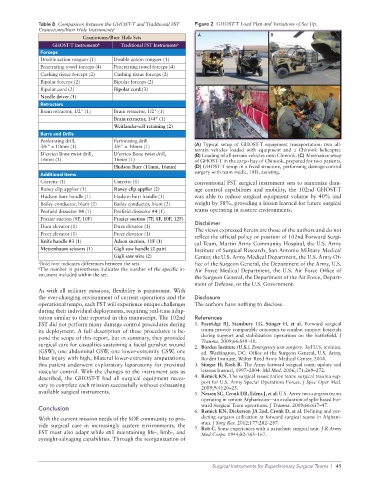
Table 8  Comparison Between the GHOST-T and Traditional FST   Figure 2  GHOST-T Load Plan and Variations of Set Up.
              Craniotomy/Burr Hole Instruments a
                            Craniotomy/Burr Hole Sets
                  GHOST-T Instruments b  Traditional FST Instruments b
              Forceps
              Double action ronguer (1)  Double action ronguer (1)
              Penetrating towel forceps (4)  Penetrating towel forceps (4)
              Cushing tissue forceps (2)  Cushing tissue forceps (2)
              Bipolar forceps (2)     Bipolar forceps (2)
              Bipolar cord (2)        Bipolar cord (3)
              Needle driver (1)
              Retractors
              Brain retractor, 1/2" (1)  Brain retractor, 1/2" (1)
                                      Brain retractor, 1/4" (1)
                                      Weitlander-self retaining (2)
              Burrs and Drills
              Perforating drill,      Perforating drill
              3/6" × 10mm (1)         3/6" × 10mm (1)            (A)  Typical  setup  of  GHOST-T  equipment  transportation:  two  all-
                                                                 terrain vehicles loaded with equipment and a Chinook helicopter.
              D’errico Bone twist drill,    D’errico Bone twist drill,    (B) Loading of all-terrain vehicles onto Chinook. (C) Alternative setup
              16mm (1)                16mm (1)                   of GHOST-T in the cargo bay of Chinook, prepared for two patients.
                                      Hudson Burr (11mm, 16mm)   (D) GHOST-T setup in a fixed structure, performing damage control
                                                                 surgery with team medic, 18D, assisting.
              Additional items
              Currette (1)            Currette (1)               conventional FST surgical instrument sets to maximize dam-
              Raney clip applier (1)  Raney clip applier (2)     age control capabilities and mobility, the 102nd GHOST-T
              Hudson burr handle (1)  Hudson burr handle (1)     was able to reduce surgical equipment volume by 40% and
              Bailey conductor, blunt (2)  Bailey conductor, blunt (2)  weight by 58%, providing a lesson learned for future surgical
              Penfield dissector #4 (1)  Penfield dissector #4 (1)  teams operating in austere environments.
              Frazier suction (8F, 10F)  Frazier suction (7F, 8F, 10F, 12F)
              Dura elevator (1)       Dura elevator (1)          Disclaimer
                                                                 The views expressed herein are those of the authors and do not
              Freer elevator (1)      Freer elevator (1)         reflect the official policy or position of 102nd Forward Surgi-
              Knife handle #3 (1)     Adson suction, 11F (1)     cal Team, Martin Army Community Hospital, the U.S. Army
              Metzenbaum scissors (1)  Gigli saw handle (2 pair)  Institute of Surgical Research, San Antonio Military Medical
                                      Gigli saw wire (2)         Center, the U.S. Army Medical Department, the U.S. Army Of-
              a Bold font indicates differences between the sets.  fice of the Surgeon General, the Department of the Army, U.S.
              b The number in parentheses indicates the number of the specific in-  Air Force Medical Department, the U.S. Air Force Office of
              strument included within the set.                  the Surgeon General, the Department of the Air Force, Depart-
                                                                 ment of Defense, or the U.S. Government.
              As with all military missions, flexibility is paramount. With
              the ever-changing environment of current operations and the   Disclosure
              operational tempo, each FST will experience unique challenges   The authors have nothing to disclose.
              during their individual deployments, requiring real-time adap-
              tation similar to that reported in this manuscript. The 102nd   References
              FST did not perform many damage control procedures during   1.  Eastridge  BJ,  Stansbury  LG,  Stinger  H,  et  al.  Forward  surgical
              its deployment. A full description of these procedures is be-  teams provide comparable outcomes to combat support hospitals
              yond the scope of this report, but in summary, they provided   during support and stabilization operations on the battlefield.  J
                                                                   Trauma. 2009;66:S48–50.
              surgical care for casualties sustaining a facial gunshot wound   2.  Borden Institute (U.S.). Emergency war surgery. 3rd U.S. revision.
              (GSW), one abdominal GSW, one lower-extremity GSW, one   ed. Washington, DC: Office of the Surgeon General, U.S. Army,
              blast injury with high, bilateral lower-extremity amputations;   Borden Institute, Walter Reed Army Medical Center; 2004.
              this patient underwent exploratory laparotomy for proximal   3.  Stinger H, Rush R. The Army forward surgical team: update and
              vascular control. With the changes to the instrument sets as   lessons learned, 1997–2004. Mil Med. 2006;171:269–272.
              described, the GHOST-T had all surgical equipment neces-  4.  Remick KN. The surgical resuscitation team: surgical trauma sup-
              sary to complete each mission successfully without exhausting   port for U.S. Army Special Operations Forces. J Spec Oper Med.
                                                                   2009;9(4):20–25.
              available surgical instruments.                    5.  Nessen SC, Cronk DR, Edens J, et al. U.S. Army two-surgeon teams
                                                                   operating in remote Afghanistan—an evaluation of split-based For-
              Conclusion                                           ward Surgical Team operations. J Trauma. 2009;66:S37–47.
                                                                 6.  Remick KN, Dickerson JA 2nd, Cronk D, et al. Defining and pre-
              With the current mission needs of the SOF community to pro-  dicting surgeon utilization at forward surgical teams in Afghani-
              vide surgical care in increasingly austere environments, the   stan. J Surg Res. 2012;177:282–287.
              FST must also adapt while still maintaining life-, limb-, and   7.  Rob C. Some experiences with a parachute surgical unit. J R Army
                                                                   Med Corps. 1944;82:165–167.
              eyesight-salvaging capabilities. Through the reorganization of


                                                                      Surgical Instruments for Expeditionary Surgical Teams  |  45

