


Page 43 - Journal of Special Operations Medicine - Fall 2017
P. 43
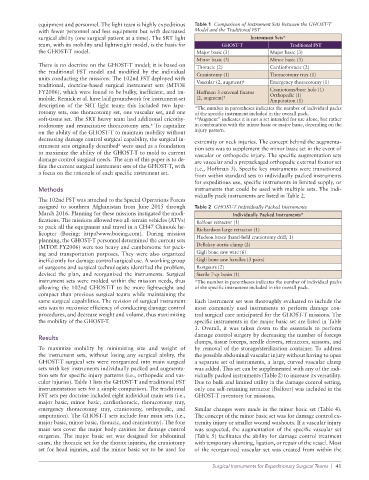
equipment and personnel. The light team is highly expeditious   Table 1  Comparison of Instrument Sets Between the GHOST-T
              with fewer personnel and less equipment but with decreased   Model and the Traditional FST
              surgical ability (one surgical patient at a time). The SRT light     Instrument Sets*
              team, with its mobility and lightweight model, is the basis for   GHOST-T         Traditional FST
              the GHOST-T model.                                 Major basic (3)         Major basic (3)
                                                                 Minor basic (3)         Minor basic (3)
              There is no doctrine on the GHOST-T model; it is based-on   Thoracic (2)   Cardiothoracic (2)
              the traditional FST model and modified by the individual
              units conducting the missions. The 102nd FST deployed with   Craniotomy (1)  Thoracotomy tray (1)
              traditional, doctrine-based surgical instrument sets (MTOE   Vascular (2, augment) †  Emergency thoracotomy (1)
              FY2006), which were found to be bulky, inefficient, and im-  Hoffman 3 external fixator    Craniotomy/burr hole (1)
              mobile. Remick et al. have laid groundwork for instrument-set   (2, augment) †  Orthopedic (1)
                                                                                         Amputation (1)
              description of the SRT light team; this included two lapa-  *The number in parentheses indicates the number of individual packs
              rotomy sets, one thoracotomy set, one vascular set, and one   of the specific instrument included in the overall pack.
              soft-tissue set. The SRT heavy team had additional cricothy-  † “Augment” indicates it is not a set intended for use alone, but rather
              roidotomy and resuscitative thoracotomy sets.  To capitalize   in combination with the minor basic or major basic, depending on the
                                                  6
              on the ability of the GHOST-T to maintain mobility without   injury pattern.
              decreasing damage control surgical capability, the surgical in-  extremity or neck injuries. The concept behind the augmenta-
              strument sets originally described  were used as a foundation   tion sets was to supplement the minor basic set in the event of
                                        6
              to maximize the ability of the GHOST-T to mold to current   vascular or orthopedic injury. The specific augmentation sets
              damage control surgical needs. The aim of this paper is to de-  are vascular and a prepackaged orthopedic external fixator set
              fine the current surgical instrument sets of the GHOST-T, with   (i.e., Hoffman 3). Specific key instruments were transitioned
              a focus on the rationale of each specific instrument set.  from within standard sets to individually packed instruments
                                                                 for expeditious use, specific instruments in limited supply, or
              Methods                                            instruments that could be used with multiple sets. The indi-
                                                                 vidually pack instruments are listed in Table 2.
              The 102nd FST was attached to the Special Operations Forces
              assigned to southern Afghanistan from June 2015 through   Table 2  GHOST-T Individually Packed Instruments
              March 2016. Planning for these missions instigated the modi-   Individually Packed Instruments*
              fications. The missions allowed two all-terrain vehicles (ATVs)   Balfour retractor (1)
              to pack all the equipment and travel in a CH47 Chinook he-
              licopter (Boeing;  http://www.boeing.com). During mission   Richardson large retractor (1)
              planning, the GHOST-T personnel determined the current sets   Hudson brace (hand-held craniotomy drill; 1)
              (MTOE FY2006) were too heavy and cumbersome for pack-  DeBakey aortic clamp (2)
              ing  and transportation  purposes.  They  were  also organized   Gigli bone saw wire (6)
              inefficiently for damage control surgical use. A working group   Gigli bone saw handles (3 pairs)
              of surgeons and surgical technologists identified the problem,   Rongeurs (2)
              devised the plan, and reorganized the instruments. Surgical   Sterile 7-qt basin (1)
              instrument sets were molded within the mission needs, thus   *The number in parentheses indicates the number of individual packs
              allowing the 102nd GHOST-T to be more lightweight and   of the specific instrument included in the overall pack.
              compact than previous surgical teams while maintaining the
              same surgical capabilities. The revision of surgical instrument   Each instrument set was thoroughly evaluated to include the
              sets was to maximize efficiency of conducting damage control   most commonly used instruments to perform damage con-
              procedures, and decrease weight and volume, thus maximizing   trol surgical care anticipated for the GHOST-T missions. The
              the mobility of the GHOST-T.                       specific instruments in the major basic set are listed in Table
                                                                 3. Overall, it was taken down to the essentials to perform
              Results                                            damage control surgery by decreasing the number of forceps
                                                                 clamps, tissue forceps, needle drivers, retractors, scissors, and
              To maximize mobility by minimizing size and weight of   by removal of the storage/sterilization container. To address
              the  instrument  sets,  without  losing  any  surgical  ability,  the   the possible abdominal vascular injury without having to open
                GHOST-T surgical sets were reorganized into main surgical   a separate set of instruments, a large, curved vascular clamp
              sets with key instruments individually packed and augmenta-  was added. This set can be supplemented with any of the indi-
              tion sets for specific injury patterns (i.e., orthopedic and vas-  vidually packed instruments (Table 2) to increase its versatility.
              cular injuries). Table 1 lists the GHOST-T and traditional FST   Due to bulk and limited utility in the damage control setting,
              instrumentation sets for a simple comparison. The traditional   only one self-retaining retractor (Balfour) was included in the
              FST sets per doctrine included eight individual main sets (i.e.,   GHOST-T inventory for missions.
              major basic, minor basic, cardiothoracic, thoracotomy tray,
              emergency  thoracotomy  tray,  craniotomy,  orthopedic,  and   Similar changes were made in the minor basic set (Table 4).
              amputation). The GHOST-T sets include four main sets (i.e.,   The concept of the minor basic set was for damage control ex-
              major basic, minor basic, thoracic, and craniotomy). The four   tremity injury or smaller wound washouts. If a vascular injury
              main sets cover the major body cavities for damage control   was suspected, the augmentation of the specific vascular set
              surgeries. The major basic set was designed for abdominal   (Table 5) facilitates the ability for damage control treatment
              cases, the thoracic set for the thorax injuries, the craniotomy   with temporary shunting, ligation, or repair of the vessel. Most
              set for head injuries, and the minor basic set to be used for   of the reorganized vascular set was created from within the

                                                                      Surgical Instruments for Expeditionary Surgical Teams  |  41

