


Page 45 - Journal of Special Operations Medicine - Fall 2017
P. 45
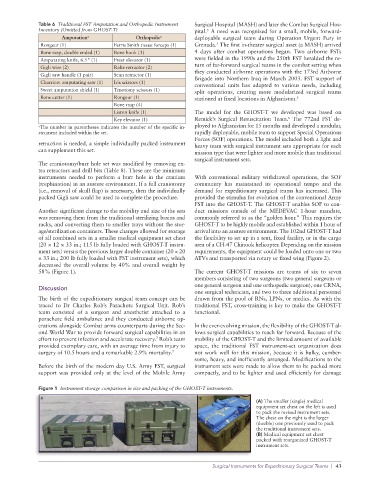
Table 6  Traditional FST Amputation and Orthopedic Instrument   Surgical Hospital (MASH) and later the Combat Surgical Hos-
              Inventory (Omitted from GHOST-T)                   pital.  A need was recognized for a small, mobile, forward-
                                                                     3
                     Amputation a            Orthopedic a        deployable surgical team during Operation Urgent Fury in
                                                                        3
              Rongeur (1)             Ferris Smith tissue forceps (1)  Grenada.  The first in-theater surgical asset (a MASH) arrived
              Bone rasp, double ended (1)  Bone hook (1)         4 days after combat operations began. Two airborne FSTs
              Amputating knife, 6.5" (1)  Freer elevator (1)     were fielded in the 1990s and the 250th FST heralded the re-
              Gigli wire (2)          Rake retractor (2)         turn of far-forward surgical teams in the combat setting when
                                                                 they conducted airborne operations with the 173rd Airborne
              Gigli saw handle (1 pair)  Senn retractor (1)      Brigade into Northern Iraq in March 2003. FST support of
              Charriere amputating saw (1)  Iris scissors (1)    conventional units has adapted to various needs, including
              Sweet amputation shield (1)  Tenotomy scissors (1)  split operations, creating more modularized surgical teams
              Bone cutter (1)         Rongeur (1)                stationed at fixed locations in Afghanistan. 5
                                      Bone rasp (4)
                                      Liston knife (1)           The model for the GHOST-T we developed was based on
                                                                                               6
                                      Key elevator (1)           Remick’s Surgical Resuscitation Team.  The 772nd FST de-
              a The number in parentheses indicates the number of the specific in-  ployed to Afghanistan for 15 months and developed a modular,
              strument included within the set.                  rapidly deployable, mobile team to support Special Operations
                                                                 Forces (SOF) operations. The model included both a light and
              retraction is needed, a simple individually packed instrument   heavy team with surgical instrument sets appropriate for each
              can supplement this set.                           mission type that were lighter and more mobile than traditional
                                                                 surgical instrument sets.
              The craniotomy/burr hole set was modified by removing ex-
              tra retractors and drill bits (Table 8). These are the minimum
              instruments needed to perform a burr hole in the cranium   With conventional military withdrawal operations, the SOF
              (trephination) in an austere environment. If a full craniotomy   community has  maintained its operational  tempo and the
              (i.e., removal of skull flap) is necessary, then the individually   demand for expeditionary surgical teams has increased. This
              packed Gigli saw could be used to complete the procedure.  provided the stimulus for evolution of the conventional Army
                                                                 FST into the GHOST-T. The GHOST-T enables SOF to con-
              Another significant change to the mobility and size of the sets   duct missions outside of the MEDEVAC 1-hour mandate,
              was removing them from the traditional sterilizing basins and   commonly referred to as the “golden hour.” This requires the
              racks, and converting them to smaller trays without the stor-  GHOST-T to be highly mobile and established within 1 hour of
              age/sterilization containers. These changes allowed for storage   arrival into an austere environment. The 102nd GHOST-T had
              of all combined sets in a smaller medical equipment set chest   the flexibility to set up in a tent, fixed facility, or in the cargo
              (20 × 12 × 33 in.; 115 lb fully loaded with GHOST-T instru-  area of a CH-47 Chinook helicopter. Depending on the mission
              ment sets) versus the previous larger double container (20 × 20   requirements, the equipment could be loaded onto one or two
              × 33 in.; 200 lb fully loaded with FST instrument sets), which   ATVs and transported via rotary or fixed wing (Figure 2).
              decreased the overall volume by 40% and overall weight by
              58% (Figure 1).                                    The current GHOST-T missions are teams of six to seven
                                                                 members consisting of two surgeons (two  general surgeons or
                                                                 one general surgeon and one orthopedic surgeon), one CRNA,
              Discussion
                                                                 one surgical technician, and two to three additional personnel
              The birth of the expeditionary surgical team concept can be   drawn from the pool of RNs, LPNs, or medics. As with the
              traced to Dr Charles Rob’s Parachute Surgical Unit. Rob’s   traditional FST, cross-training is key to make the GHOST-T
              team consisted of a surgeon and anesthetist attached to a   functional.
              parachute field ambulance and they conducted airborne op-
              erations alongside Combat arms counterparts during the Sec-  In the ever-evolving mission, the flexibility of the  GHOST-T al-
              ond World War to provide forward surgical capabilities in an   lows surgical capabilities to reach far forward. Because of the
              effort to prevent infection and accelerate recovery.  Rob’s team   mobility of the GHOST-T and the limited amount of available
                                                    7
              provided exemplary care, with an average time from injury to   space, the traditional FST instrument-set organization does
              surgery of 10.5 hours and a remarkable 2.9% mortality. 7  not work well for this mission, because it is bulky, cumber-
                                                                 some, heavy, and inefficiently arranged. Modifications to the
              Before the birth of the modern day U.S. Army FST, surgical   instrument sets were made to allow them to be packed more
              support was provided only at the level of the Mobile Army   compactly, and to be lighter and used efficiently for  damage

              Figure 1  Instrument storage comparison in size and packing of the GHOST-T instruments.

                                                                                     (A) The smaller (single) medical
                                                                                     equipment set chest on the left is used
                                                                                     to pack the revised instrument sets.
                                                                                     The chest on the right is the larger
                                                                                     (double) one previously used to pack
                                                                                     the traditional instrument sets.
                                                                                     (B) Medical equipment set chest
                                                                                     packed with reorganized GHOST-T
                                                                                     instrument sets.


                                                                      Surgical Instruments for Expeditionary Surgical Teams  |  43

