


Page 58 - JSOM Winter 2025
P. 58
Infective Endocarditis

                               Severe Complication from a Common Procedure


                                                       1
                                                                                      2
                               Garrett A. Maurice, FP-C ; Christopher S. Freeman, FP-C ;
                                     Adam M. Spanier, MD ; Joseph W. Jude, MD *
                                                          3
                                                                                 4


          ABSTRACT
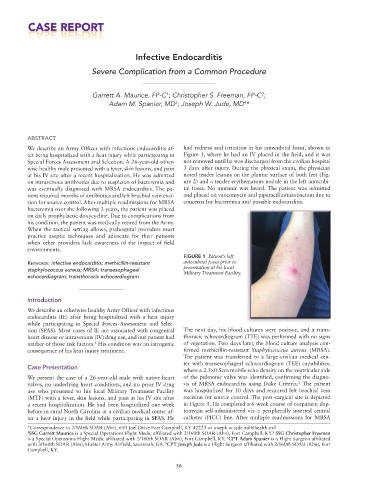
          We describe an Army Officer with infectious endocarditis af-  had redness and irritation in his antecubital fossa, shown in
          ter being hospitalized with a heat injury while participating in   Figure 1, where he had an IV placed in the field, and it was
          Special Forces Assessment and Selection. A 26-year-old other-  not removed until he was discharged from the civilian hospital
          wise healthy male presented with a fever, skin lesions, and pain   3 days after injury. During the physical exam, the physician
          at his IV site after a recent hospitalization. He was admitted   noted tender lesions on the plantar surface of both feet (Fig-
          on intravenous antibiotics due to suspicion of bacteremia and   ure 2) and a tender erythematous nodule in the left antecubi-
          was eventually diagnosed with MRSA endocarditis. The pa-  tal fossa. No murmur was heard. The patient was admitted
          tient required months of antibiotics and left brachial vein exci-  and placed on vancomycin and piperacillin/tazobactam due to
          sion for source control. After multiple readmissions for MRSA   concerns for bacteremia and possible endocarditis.
          bacteremia over the following 2 years, the patient was placed
          on daily prophylactic doxycycline. Due to complications from
          his condition, the patient was medically retired from the Army.
          When the tactical setting allows, prehospital providers must
          practice aseptic techniques and advocate for their patients
          when other providers lack awareness of the impact of field
          environments.
                                                             FIGURE 1  Patient’s left
          Keywords: infective endocarditis; methicillin-resistant   antecubital fossa prior to
          staphylococcus aureus; MRSA; transesophageal       presentation at his local
                                                             Military Treatment Facility.
          echocardiogram; transthoracic echocardiogram


          Introduction
          We describe an otherwise healthy Army Officer with infectious
          endocarditis (IE) after being hospitalized with a heat injury
          while participating  in  Special Forces  Assessment  and  Selec-
          tion (SFAS). Most cases of IE are associated with congenital   The next day, his blood cultures were positive, and a trans-
          heart disease or intravenous (IV) drug use, and our patient had   thoracic echocardiogram (TTE) was performed with no signs
          neither of those risk factors.  His condition was an iatrogenic   of vegetation. Two days later, the blood culture analysis con-
                                1
          consequence of his heat injury treatment.          firmed  methicillin-resistant  Staphylococcus  aureus  (MRSA).
                                                             The patient was transferred to a large civilian medical cen-
                                                             ter with transesophageal echocardiogram (TEE) capabilities,
          Case Presentation
                                                             where a 2.5×0.5cm mobile echo density on the ventricular side
          We present the case of a 26-year-old male with native heart   of the pulmonic valve was identified, confirming the diagno-
          valves, no underlying heart conditions, and no prior IV drug   sis of MRSA endocarditis using Duke Criteria.  The patient
                                                                                                   2
          use who presented to his local Military  Treatment Facility   was hospitalized for 10 days and required left brachial vein
          (MTF) with a fever, skin lesions, and pain at his IV site after   excision for source control. The post-surgical site is depicted
          a recent hospitalization. He had been hospitalized one week   in Figure 3. He completed a 6-week course of outpatient dap-
          before in rural North Carolina at a civilian medical center af-  tomycin self-administered via a peripherally inserted central
          ter a heat injury in the field while participating in SFAS. He   catheter (PICC) line. After multiple readmissions for MRSA

          *Correspondence to 2/160th SOAR (Abn), 650 Joel Drive Fort Campbell, KY 42223 or joseph.w.jude.mil@health.mil
          1 SSG Garrett Maurice is a Special Operations Flight Medic affiliated with 2/160th SOAR (Abn), Fort Campbell, KY.  SSG Christopher Freeman
                                                                                          2
                                                                           3
          is a Special Operations Flight Medic affiliated with 2/160th SOAR (Abn), Fort Campbell, KY.  CPT Adam Spanier is a Flight Surgeon affiliated
          with 3/160th SOAR (Abn), Hunter Army Airfield, Savannah, GA.  CPT Joseph Jude is a Flight Surgeon affiliated with 2/160th SOAR (Abn), Fort
                                                       4
          Campbell, KY.
                                                           56

