


Page 62 - JSOM Winter 2025
P. 62
changes from tourniquet release in under 3 hours have been   prior to evacuation. No longer prevented by rapid evacuation
          studied and considered to be safe in healthy patients, with the   times, medically unnecessary tourniquets would carry the risk
          caveat that buffering capacity would be reduced in a hypovo-  of  avoidable  tourniquet-related  morbidity.  This  could  turn
                           7
          lemic trauma patient.  From 2015–2020, 11 casualties who   minor injuries into ones that cost limbs and lives. Doctrinal
          sustained combat-related extremity injury in Mali were treated   change through emphasis on tourniquet reassessment is re-
          with tourniquets. Each tourniquet was left in place for over   quired to reduce the harms of ineffective and medically unnec-
          3  hours,  leading  to  complications  including  rhabdomyoly-  essary tourniquets while maintaining the lifesaving benefits of
                                                       8
          sis (11/11 patients), and compartment syndrome (10/11).  A   rapid tourniquet application.
          study of tourniquet use in Ukraine from 2014–2022 reviewed
          2,496 patients and found that 92 limbs were amputated when   Doctrinal Deficiencies in Tourniquet Management
          tourniquet application times ranged from 210–380 minutes.
          Seventy-eight amputations were attributed to extensive tissue   Tourniquet application is an All Service Member (ASM) skill
          necrosis distal to tourniquets in place for more than 6 hours. 9  used to address massive hemorrhage during the care under fire
                                                             (CUF) and TFC phases of TCCC. However, once placed, the
                                                             ASM TCCC only teaches tourniquet reassessment to evaluate
          Battlefield Conditions in Ukraine
                                                             their efficacy through lack of distal bleeding or pulse, but not
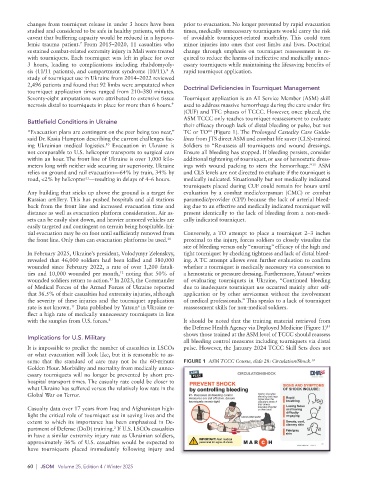
          “Evacuation plans are contingent on the peer being too near,”   TC or TO  (Figure 1). The Prolonged Casualty Care Guide-
                                                                     14
          said Dr. Kasia Hampton describing the current challenges fac-  lines from JTS direct ASM and combat life saver (CLS)-trained
                                    10
          ing Ukrainian medical logistics.  Evacuation in Ukraine is   Soldiers to “Re-assess all tourniquets and wound dressings.
          not comparable to U.S. helicopter transports to surgical care   Ensure all bleeding has stopped. If bleeding persists, consider
          within an hour. The front line of Ukraine is over 1,000 kilo-  additional tightening of tourniquet, or use of hemostatic dress-
          meters long with neither side securing air superiority. Ukraine   ings with wound packing to stem the hemorrhage.”  ASM
                                                                                                       15
          relies on ground and rail evacuation—64% by train, 34% by   and CLS levels are not directed to evaluate if the tourniquet is
          road, <2% by helicopter —resulting in delays of 4–6 hours.  medically indicated. Situationally but not medically indicated
                             11
                                                             tourniquets placed during CUF could remain for hours until
          Any building that sticks up above the ground is a target for   evaluation by a combat medic/corpsman (CMC) or combat
          Russian artillery. This has pushed hospitals and aid stations   paramedic/provider (CPP) because the lack of arterial bleed-
          back from the front line and increased evacuation time and   ing due to an effective and medically indicated tourniquet will
          distance as well as evacuation platform consideration. Air as-  present identically to the lack of bleeding from a non-medi-
          sets can be easily shot down, and heavier armored vehicles are   cally indicated tourniquet.
          easily targeted and contingent on terrain being hospitable. Ini-
          tial evacuation may be on foot until sufficiently removed from   Conversely, a TO attempt  to place  a  tourniquet  2–3  inches
          the front line. Only then can evacuation platforms be used. 10  proximal to the injury, forces soldiers to closely visualize the
                                                             site of bleeding versus only “ensuring” efficacy of the high and
          In February 2025, Ukraine’s president, Volodymyr Zelenskyy,   tight tourniquet by checking tightness and lack of distal bleed-
          revealed that 46,000 soldiers had been killed and 380,000   ing. A TC attempt allows even further evaluation to confirm
          wounded since February 2022, a rate of over 1,200 fatali-  whether a tourniquet is medically necessary via conversion to
                                        12
                                                                                                       6
          ties and 10,000 wounded per month,  noting that 50% of   a hemostatic or pressure dressing. Furthermore, Yatsun  writes
          wounded soldiers return to action.  In 2023, the Commander   of evaluating tourniquets in Ukraine,  “Continued bleeding
                                     13
          of Medical Forces of the Armed Forces of Ukraine reported   due to inadequate tourniquet use occurred mainly after self-
          that 36.5% of their casualties had extremity injuries, although   application or by other servicemen without the involvement
          the severity of these injuries and the tourniquet application   of medical professionals.” This speaks to a lack of tourniquet
                        11
                                              6
          rate is not known.  Data published by Yatsun  in Ukraine re-  reassessment skills for non-medical soldiers.
          flect a high rate of medically unnecessary tourniquets in line
          with the samples from U.S. forces. 4               It should be noted that the training material retrieved from
                                                             the Defense Health Agency via Deployed Medicine (Figure 1)
                                                                                                            14
                                                             shows those trained at the ASM level of TCCC should reassess
          Implications for U.S. Military
                                                             all bleeding control measures including tourniquets via distal
          It is impossible to predict the number of casualties in LSCOs   pulse. However, the January 2024 TCCC Skill Sets does not
          or what evacuation will look like, but it is reasonable to as-
          sume that the standard of care may not be the 60-minute   FIGURE 1  ASM TCCC Course, slide 28: Circulation/Shock. 14
          Golden Hour. Morbidity and mortality from medically unnec-
          essary tourniquets will no longer be prevented by short pre-
          hospital transport times. The casualty rate could be closer to
          what Ukraine has suffered versus the relatively low rate in the
          Global War on Terror.

          Casualty data over 17 years from Iraq and Afghanistan high-
          light the critical role of tourniquet use in saving lives and the
          extent to which its importance has been emphasized in De-
          partment of Defense (DoD) training.  If U.S. LSCOs casualties
                                      2
          in have a similar extremity injury rate as Ukrainian soldiers,
          approximately 36% of U.S. casualties would be expected to
          have tourniquets placed immediately following injury and

          60  |  JSOM   Volume 25, Edition 4 / Winter 2025

