


Page 59 - JSOM Winter 2025
P. 59
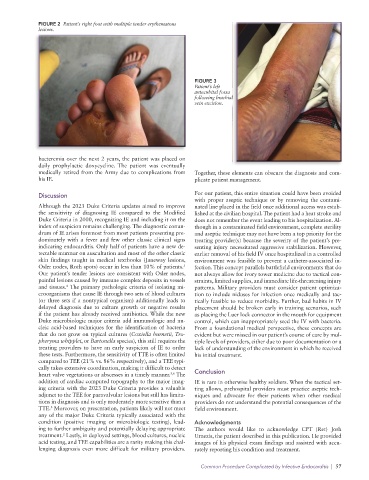
FIGURE 2  Patient’s right foot with multiple tender erythematous
              lesions.


                                                                 FIGURE 3
                                                                 Patient’s left
                                                                 antecubital fossa
                                                                 following brachial
                                                                 vein excision.


              bacteremia over the next 2 years, the patient was placed on
              daily prophylactic doxycycline.  The patient was eventually
              medically retired from the Army due to complications from   Together, these elements can obscure the diagnosis and com-
              his IE.                                            plicate patient management.

              Discussion                                         For our patient, this entire situation could have been avoided
                                                                 with  proper  aseptic  technique  or  by  removing  the  contami-
              Although the 2023 Duke Criteria updates aimed to improve   nated line placed in the field once additional access was estab-
              the sensitivity of diagnosing IE compared to the Modified   lished at the civilian hospital. The patient had a heat stroke and
              Duke Criteria in 2000, recognizing IE and including it on the   does not remember the event leading to his hospitalization. Al-
              index of suspicion remains challenging. The diagnostic conun-  though in a contaminated field environment, complete sterility
              drum of IE arises foremost from most patients presenting pre-  and aseptic technique may not have been a top priority for the
              dominately with a fever and few other classic clinical signs   treating provider(s) because the severity of the patient’s pre-
              indicating endocarditis. Only half of patients have a new de-  senting injury necessitated aggressive stabilization. However,
              tectable murmur on auscultation and most of the other classic   earlier removal of his field IV once hospitalized in a controlled
              skin findings taught in medical textbooks (Janeway lesions,   environment was feasible to prevent a catheter-associated in-
              Osler nodes, Roth spots) occur in less than 10% of patients.    fection. This concept parallels battlefield environments that do
                                                             3
              Our patient’s tender lesions are consistent with Osler nodes,   not always allow for ivory tower medicine due to tactical con-
              painful lesions caused by immune complex deposits in vessels   straints, limited supplies, and immediate life-threatening injury
              and tissues.  The primary pathologic criteria of isolating mi-  patterns. Military providers must consider patient optimiza-
                       4
              croorganisms that cause IE through two sets of blood cultures   tion to include niduses for infection once medically and tac-
              (or three sets if a nontypical organism) additionally leads to   tically feasible to reduce morbidity. Further, bad habits in IV
              delayed diagnosis due to culture growth or negative results   placement should be broken early in training scenarios, such
              if the patient has already received antibiotics. While the new   as placing the Luer lock connector in the mouth for equipment
              Duke microbiologic major criteria add immunologic and nu-  control, which can inappropriately seed the IV with bacteria.
              cleic  acid-based  techniques for  the  identification  of bacteria   From a foundational medical perspective, these concepts are
              that do not grow on typical cultures (Coxiella burnetii, Tro-  evident but were missed in our patient’s course of care by mul-
              pheryma whipplei, or Bartonella species), this still requires the   tiple levels of providers, either due to poor documentation or a
              treating providers to have an early suspicion of IE to order   lack of understanding of the environment in which he received
              these tests. Furthermore, the sensitivity of TTE is often limited   his initial treatment.
              compared to TEE (21% vs. 86% respectively), and a TEE typi-
              cally takes extensive coordination, making it difficult to detect
              heart valve vegetations or abscesses in a timely manner.  The   Conclusion
                                                         5,6
              addition of cardiac computed topography to the major imag-  IE is rare in otherwise healthy soldiers. When the tactical set-
              ing criteria with the 2023 Duke Criteria provides a valuable   ting allows, prehospital providers must practice aseptic tech-
              adjunct to the TEE for paravalvular lesions but still has limita-  niques and advocate for their patients when other medical
              tions in diagnosis and is only moderately more sensitive than a   providers do not understand the potential consequences of the
              TTE.  Moreover, on presentation, patients likely will not meet   field environment.
                  3
              any of the major Duke Criteria typically associated with the
              condition (positive imaging or microbiologic testing), lead-  Acknowledgments
              ing to further ambiguity and potentially delaying appropriate   The authors would like to acknowledge CPT (Ret) Josh
              treatment.  Lastly, in deployed settings, blood cultures, nucleic   Urnezis, the patient described in this publication. He provided
                      2
              acid testing, and TEE capabilities are a rarity making this chal-  images of his physical exam findings and assisted with accu-
              lenging  diagnosis even  more  difficult  for  military  providers.   rately reporting his condition and treatment.

                                                                   Common Procedure Complicated by Infective Endocarditis  |  57

