


Page 63 - JSOM Winter 2025
P. 63
list any skills for ASM during “Circulation/Bleeding Control”   This is another reason tourniquet reassessment should be at
              as seen in Figure 2 below.                         the forefront of every soldier’s mind during all phases of ca-
                                                                 sualty care.
              FIGURE 2  Circulation/Bleeding Control, TCCC Skill Sets by
              Responder Level Master List 2024. 16
                                                                 Recommendations
              Circulation / Bleeding Control  ASM  CLS  CM/HM  CP
              Assessment and Treatment of                        1.  Tourniquet reassessment should be clearly reclassified as an
              Bleeding in TCCC              X      X      X        ASM (Tier 1) skill.
              Pelvic Compression Device                          2.  All service members should be trained to identify and re-
              Application                          X      X        solve ineffective or not medically indicated tourniquets via
              Tourniquet Reassessment /                            tourniquet conversion and tourniquet optimization within
              Replacement                   X      X      X        2 hours of initial application.
              Tourniquet Conversion to      X      X      X      3.  To emphasize these skills, TCCC training lanes should have
              Other Hemostatic Adjuncts                            tourniquet reassessment and  TC/TO as critical passing
                                                                   criteria.
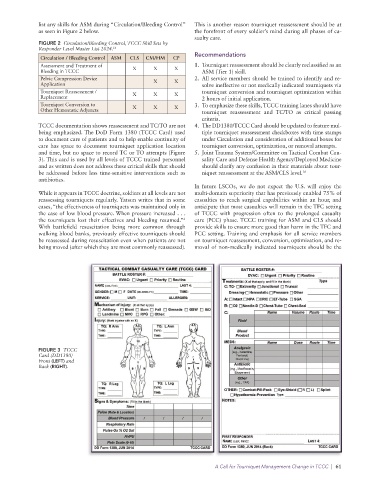
              TCCC documentation shows reassessment and TC/TO are not   4.  The DD1380/TCCC Card should be updated to feature mul-
              being emphasized. The DoD Form 1380 (TCCC Card) used   tiple tourniquet reassessment checkboxes with time stamps
              to document care of patients and to help enable continuity of   under Circulation and consideration of additional boxes for
              care has space to document tourniquet application location   tourniquet conversion, optimization, or removal attempts.
              and time, but no space to record TC or TO attempts (Figure   5.  Joint Trauma System/Committee on Tactical Combat Cau-
              3). This card is used by all levels of TCCC trained personnel   sality Care and Defense Health Agency/Deployed Medicine
              and as written does not address these critical skills that should   should clarify any confusion in their materials about tour-
              be addressed before less time-sensitive interventions such as   niquet reassessment at the ASM/CLS level. 16
              antibiotics.
                                                                 In future LSCOs, we do not expect the U.S. will enjoy the
              While it appears in TCCC doctrine, soldiers at all levels are not   multi-domain superiority that has previously enabled 75% of
              reassessing tourniquets regularly. Yatsun writes that in some   casualties  to  reach  surgical  capabilities  within  an  hour,  and
              cases, “the effectiveness of tourniquets was maintained only in   anticipate that most casualties will remain in the TFC setting
              the case of low blood pressure. When pressure increased . . .     of TCCC with progression  often to the prolonged casualty
              the tourniquets lost their effectives and bleeding resumed.”    care (PCC) phase. TCCC training for ASM and CLS should
                                                             6
              With battlefield resuscitation being more common through   provide skills to ensure more good than harm in the TFC and
              walking blood banks, previously effective tourniquets should   PCC setting. Training and emphasis for all service members
              be reassessed during resuscitation even when patients are not   on tourniquet reassessment, conversion, optimization, and re-
              being moved (after which they are most commonly reassessed).   moval of non-medically indicated tourniquets should be the


              FIGURE 3  TCCC
              Card (DD1380)
              Front (LEFT) and
              Back (RIGHT).


                                                                       A Call for Tourniquet Management Change in TCCC  |  61

